
When you live with Borderline Personality Disorder (BPD), everyday emotions can feel like storms without warning. One moment you're fine, the next you're overwhelmed, desperate, or convinced you're unlovable. These intense feelings don't just fade-they crash into relationships, jobs, and even your sense of safety. Many people with BPD have spent years trying to calm themselves with self-harm, substance use, or impulsive decisions, only to feel worse afterward. The good news? There's a proven way out. DBT skills aren't just theory-they're practical tools used daily by thousands to survive crises, rebuild relationships, and finally feel in control.
What DBT Actually Does for BPD
Dialectical Behavior Therapy, or DBT, wasn't created in a lab. It was built by Dr. Marsha Linehan after years of watching people with BPD get stuck in cycles of pain and self-destruction. Standard talk therapy often failed them. So she combined proven behavioral techniques with mindfulness practices from ancient traditions. The result? A system that doesn't just talk about emotions-it teaches you how to handle them when they're at their worst. DBT works because it doesn't ask you to stop feeling. It asks you to stop letting those feelings control your actions. Research shows that after six months of consistent DBT, people reduce self-harm by nearly half. Suicide attempts drop by 50% within the first year. These aren't small wins. They're life-changing. Unlike other therapies that focus on understanding your past, DBT focuses on building your present. It gives you concrete skills you can use while you're crying, screaming, or staring at a razor blade. It’s not about healing your childhood. It’s about surviving today.The Four Core DBT Skill Modules
DBT is built on four skill sets, each designed to tackle a different part of BPD’s chaos. You don’t need to master them all at once. Start with one. Build from there.- Mindfulness: This isn’t meditation for relaxation. It’s about learning to notice what’s happening inside you without reacting. The goal? To pause before you act. Skills like “observe,” “describe,” and “participate” help you step back from emotional flooding. One study found that after just eight weeks of mindfulness training, BPD patients improved their emotional regulation by 32%.
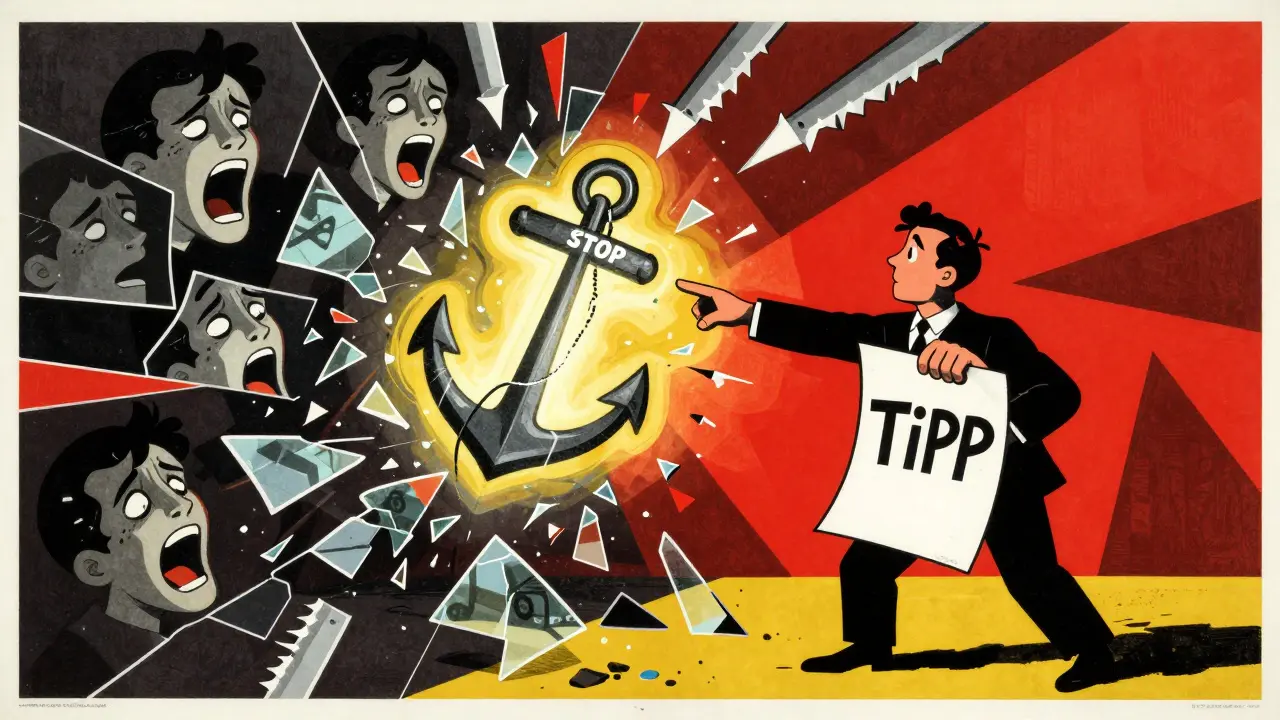
- Distress Tolerance: This is your emergency toolkit. When you’re in crisis-when you feel like you can’t take it anymore-this module gives you ways to get through without hurting yourself. Techniques like TIPP (Temperature, Intense exercise, Paced breathing, Paired muscle relaxation) work fast. Splash cold water on your face. Run in place for two minutes. Breathe slowly. These aren’t tricks-they’re biological hacks that calm your nervous system in minutes.
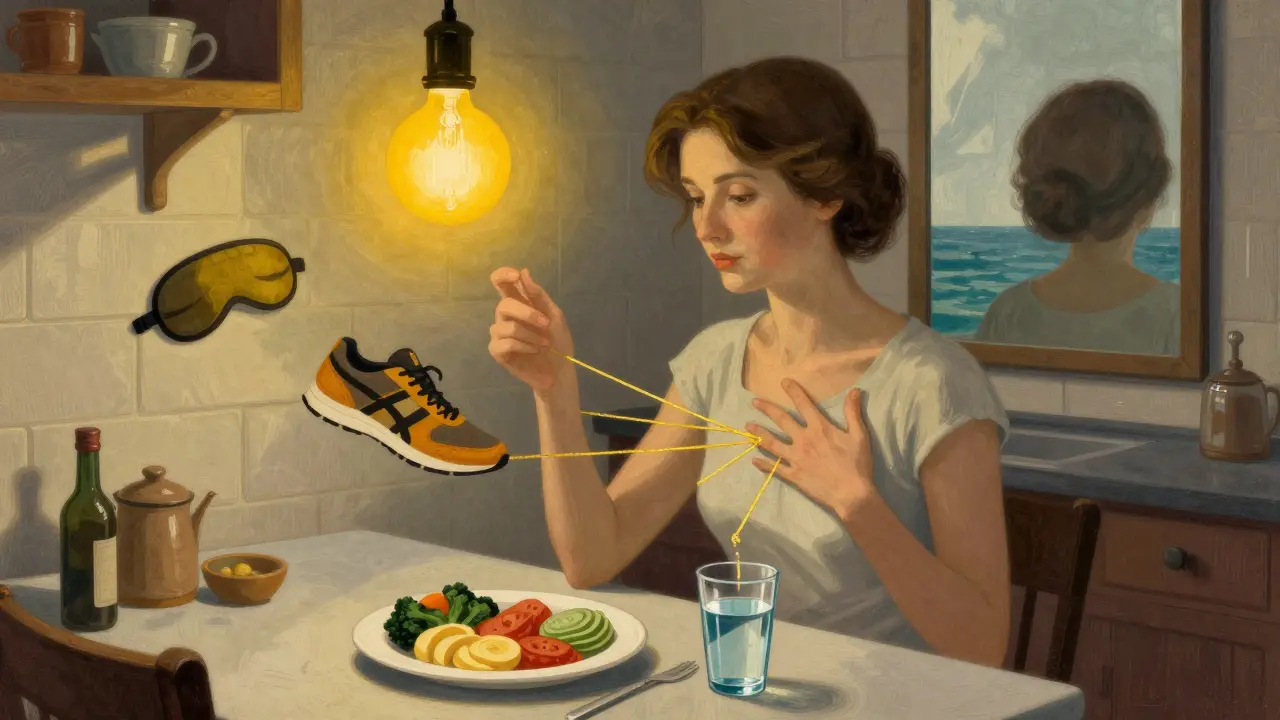
- Emotion Regulation: Most people with BPD feel emotions intensely and for too long. This module teaches you how to reduce emotional vulnerability. The PLEASE skill (Treat Physical Illness, Balanced Eating, Avoid mood-altering drugs, Balanced Sleep, Exercise) isn’t optional. Skipping sleep or drinking alcohol makes emotional crashes worse. Studies show that following PLEASE consistently cuts emotional reactivity by 40% over six months.
- Interpersonal Effectiveness: BPD often comes with relationship chaos-pushing people away, then begging them back. DEAR MAN (Describe, Express, Assert, Reinforce, stay Mindful, Appear confident, Negotiate) gives you a script for asking for what you need without losing your temper or your dignity. GIVE (be Gentle, show Interest, Validate, use Easy manner) helps you keep relationships from burning out. One Reddit user said DEAR MAN saved her marriage when she was about to walk out during an argument. Instead, she used the skill and stayed.
Crisis Planning: Your Personal Survival Blueprint
A crisis plan isn’t a list of things to do when you’re calm. It’s a written guide you create when you’re stable-so you can use it when you’re falling apart. Start by answering these questions:- What are your top three warning signs that a crisis is coming? (e.g., racing thoughts, feeling numb, texting an ex at 3 a.m.)
- What’s your go-to distress tolerance skill? (TIPP? IMPROVE? STOP?)
- Who can you call? List three people-even if they’re not family. A friend, a therapist, a crisis line.
- What’s your safety plan if you feel suicidal? (Remove means of harm, go to a public place, call 988)
- What’s one thing that always helps you feel a little better? (A song? A pet? A shower? A specific memory?)
DBT vs. Other Treatments: What Works Best
There are other therapies for BPD. But DBT has the strongest evidence.- Mentalization-Based Therapy (MBT): Focuses on understanding your own and others’ mental states. Reduces self-harm by 22%.
- Schema Therapy: Looks at deep-rooted patterns from childhood. Reduces self-harm by 28%.
- STEPPS: A group-based program that’s easier to access. Helps with symptoms but doesn’t reduce crises as well as DBT.
What to Expect When You Start DBT
Starting DBT feels overwhelming. You’ll be asked to do homework. Fill out worksheets. Track your emotions. Attend two-hour group sessions every week. It’s a lot. Most people struggle at first. Sixty-five percent report emotional flooding in the first month. Forty percent don’t complete their homework. But by month six, those numbers flip. Skills become habits. The worksheets stop feeling like chores and start feeling like lifelines. You don’t need to be perfect. You just need to show up. Even using one skill once a day changes your brain over time. Find a certified DBT therapist. As of 2023, there are only about 1,842 certified DBT providers worldwide. Check the Linehan Board of Certification website. Avoid therapists who say they “do DBT” without training. Real DBT follows a strict model. If it’s not structured, it’s not DBT.Real Stories: What People Say
On Reddit’s r/DBT, users share daily wins: > “I used IMPROVE to get through a night I thought I’d never survive. Imagined myself on a beach. Felt the sand. Heard the waves. Didn’t touch a knife. First time in 10 years.” - u/DBTSurvivor > “I used DEAR MAN to ask my boss for a schedule change. I didn’t cry. I didn’t yell. I got it. I felt proud.” - u/RecoveryWarrior2020 > “I keep the PLEASE worksheet on my fridge. I check it every morning. Sleep. Food. No alcohol. Movement. It’s simple. But it works.” - u/EmotionRegulationNow These aren’t outliers. They’re the norm for people who stick with it.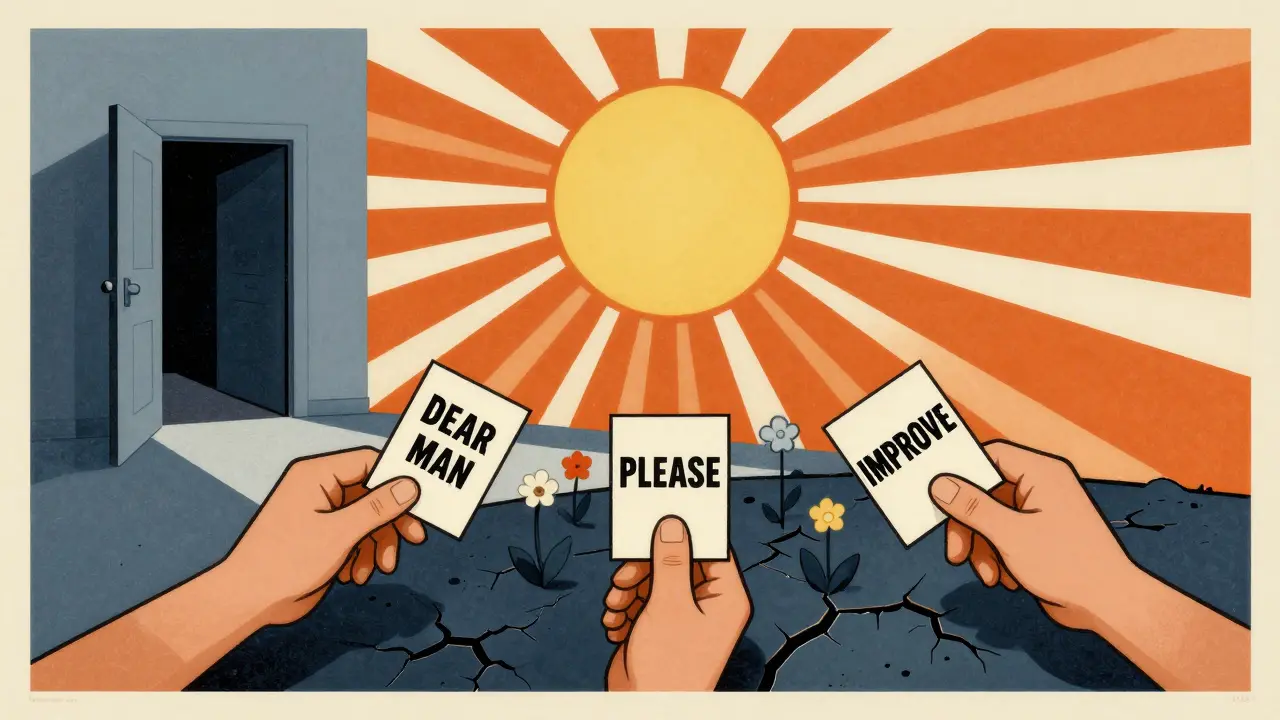
Challenges and Barriers
DBT isn’t easy. It’s not a quick fix. The time commitment is real: 2-3 hours per week, for 6-12 months. Insurance often covers only 12-20 sessions a year. Many people drop out because they’re too overwhelmed. Rural areas have almost no access. Only 12% of rural U.S. communities have certified DBT providers. But telehealth has helped. Since 2020, access has increased by 28%. Some find the worksheets too rigid. The workbook has 320 pages. It’s heavy. But you don’t need to read it all. Pick one skill. Practice it. Then move to the next.What’s Next for DBT
DBT is evolving. New apps like DBT Coach and Virtual Reality DBT are making skills easier to practice. AI tools now suggest which skill to use based on your mood patterns. In 2023, a University of Washington study found that people using digital tools stuck with DBT 68% of the time-compared to 45% with paper worksheets. The Linehan Institute launched a new “DBT-Crisis Survival” certification in June 2023, focusing only on emergency skills. That means more people will get trained to help in moments of crisis. DBT won’t cure BPD. But it gives you control. It gives you choices. And for many, that’s enough to start living again.How to Begin Today
You don’t need to wait for therapy to start using DBT skills.- Download the free “TIPP” guide from the Linehan Institute website.
- Print the PLEASE worksheet and put it where you’ll see it daily.
- Practice STOP for five minutes every morning-before you check your phone.
- Write your crisis plan now. Even if you feel fine. Do it while you’re calm.
- Search for a DBT therapist near you. If none are available, look for therapists trained in DBT-informed care.
Sue Stone
January 23, 2026 AT 07:02DBT saved my life. I used to self-harm every week. Now I use TIPP when I feel like I’m drowning. Cold water on my face? Game changer. I didn’t believe it would work until I tried it. No magic, just biology.
Stacy Thomes
January 25, 2026 AT 04:14I JUST USED STOP RIGHT NOW. I was about to text my ex. I stopped. Breathed. Observed: I’m lonely, not abandoned. I called my sister instead. I cried. Then I ate cereal. I’m alive. Thank you for this post. I needed to see this today.
Laura Rice
January 25, 2026 AT 17:56Y’all need to know this isn’t about being ‘fixed.’ It’s about being able to stay in your own skin long enough to breathe. I used to think I was broken. Turns out I just never had the tools. The PLEASE worksheet? I have it taped to my fridge next to my cat’s food bowl. Every morning I check it. Sleep. Food. No booze. Walk around the block. That’s it. I’m not perfect. But I’m here. And that’s enough.
Kerry Evans
January 26, 2026 AT 14:29This is just behavior modification dressed up as therapy. You’re teaching people to suppress emotions instead of confronting their trauma. DBT avoids depth. It’s a band-aid on a broken leg. Real healing requires facing childhood wounds, not breathing exercises and worksheets.
Kerry Moore
January 28, 2026 AT 13:24While I acknowledge the empirical efficacy of DBT, I must respectfully note that its structured, skills-based approach may inadvertently pathologize normative emotional responses in individuals who have experienced chronic interpersonal invalidation. The emphasis on behavioral regulation, while clinically advantageous, risks minimizing the existential dimensions of identity disturbance inherent in BPD. A more integrative model may better serve those for whom emotional dysregulation is a survival adaptation rather than a disorder.
Oladeji Omobolaji
January 28, 2026 AT 21:54Man, I read this on my phone while waiting for my bus. I’m from Nigeria, no DBT here. But I tried TIPP-splashed cold water on my face. Felt weird. Felt better. I didn’t know emotions could be managed like this. I’m gonna print this out and show my cousin. She needs this.
Janet King
January 29, 2026 AT 00:34DBT is not a cure. It is a management protocol. The research is robust. The adherence rates improve with structured support. The 50% reduction in suicide attempts is statistically significant and clinically meaningful. Access remains the primary barrier. Telehealth expansion is critical. Do not confuse accessibility with efficacy.
dana torgersen
January 29, 2026 AT 07:30Okay so… I’ve been doing DBT for 14 months… and I still cry during group… and I still forget to do my homework… and I still think I’m a burden… BUT… I didn’t cut myself last week… and I told my mom I needed space… and I didn’t say ‘I hate you’… and I drank water instead of wine… and I listened to ‘Hallelujah’ while staring at the ceiling… and I didn’t die… and that… that is… a win… right?… right???
Dawson Taylor
January 30, 2026 AT 16:07Behavioral tools are not avoidance. They are scaffolding. When the structure is collapsing, you build the ladder before you rebuild the house. Crisis comes first. Identity follows. This is not shallow. It is wise.
Sallie Jane Barnes
January 31, 2026 AT 01:35To Kerry Evans: I hear you. Trauma matters. But when you’re holding a razor blade at 2 a.m., your past doesn’t help you put it down. DBT gave me the hand to reach for. Later, I could sit with my pain. Not before. This isn’t denial. It’s survival. And survival is the first step to healing.