
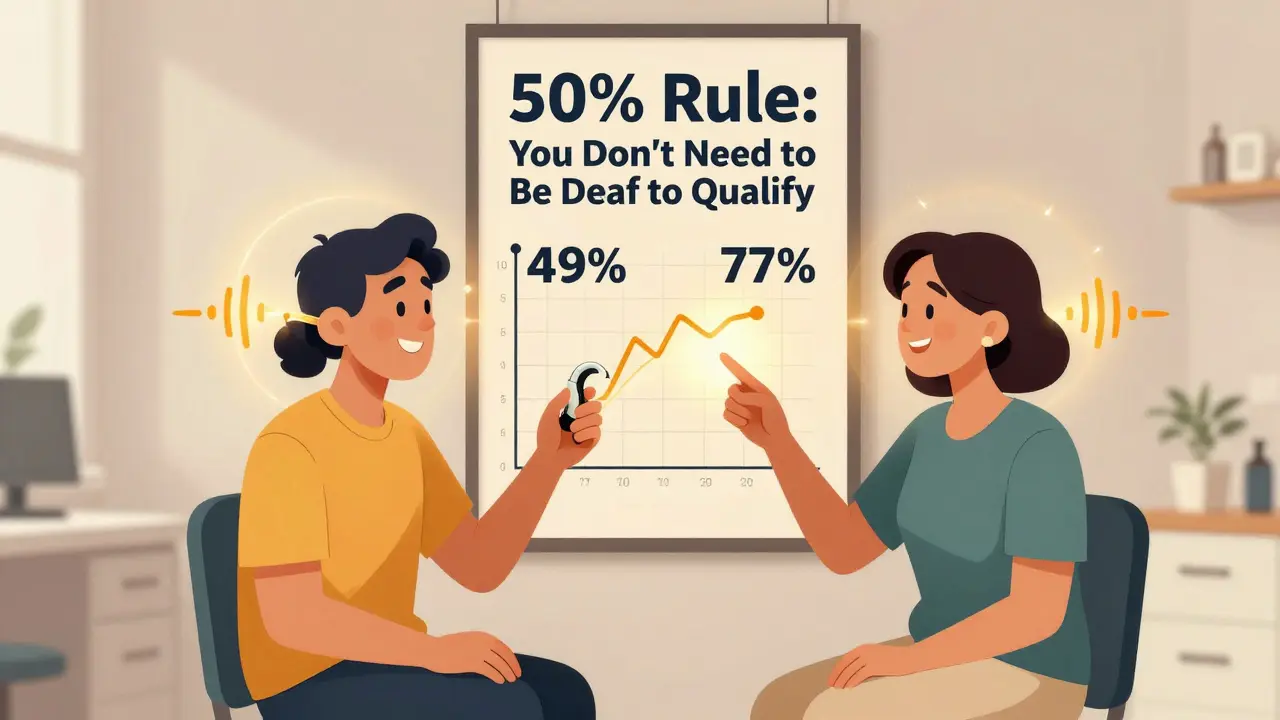
Many people assume cochlear implants are only for those who are completely deaf. That’s not true anymore. In fact, if you’re struggling to understand speech even with hearing aids, you might be a candidate - and waiting too long could hurt your long-term hearing health. The rules changed in 2023, and now more people than ever can benefit from this technology. This isn’t about fixing deafness. It’s about stopping the slow decline in your ability to connect with the world around you.
What Changed in the 2023 Guidelines?
Before 2023, you needed to be nearly completely deaf to qualify. The old standard? You had to understand less than 40% of sentences with your best hearing aids. That left out a lot of people who were barely hanging on. They could hear sounds, but conversations were exhausting. They missed jokes at dinner. They avoided phone calls. They felt isolated. And doctors didn’t always know what to do.
The new guidelines from the American Cochlear Implant Alliance (ACIA) flipped the script. Now, if you understand fewer than 50% of words with properly fitted hearing aids, you should be referred for evaluation. That’s it. No need to wait until you’re completely dependent on lip reading. No need to prove you’ve tried everything. The focus is on how well you communicate in real life - not just in a quiet testing room.
One big shift? They now look at each ear separately. If one ear is working okay and the other is failing, you might still be a candidate. This matters because 8.3% of people with hearing loss have what’s called single-sided deafness. Before, they were told they didn’t qualify. Now, they’re being offered a real solution.
How Do You Know If You’re a Candidate?
The evaluation isn’t a single test. It’s a full picture. Here’s what it usually includes:
- Audiometry: You’ll sit in a sound booth and repeat words and sentences. Both unaided and with your hearing aids on. The gold standard now is the AzBio sentence test - it uses real-life phrases like “The boy kicked the ball” instead of nonsense words.
- Hearing aid verification: Are your hearing aids actually working right? Many people are given aids but never properly fitted. Real-ear measurements check if the sound is reaching your eardrum at the right level. A 2021 study found 43% of rejected referrals failed this step - not because they didn’t qualify, but because their aids were misadjusted.
- Imaging: A CT scan and MRI look at your inner ear. Are the cochleas intact? Is there bone growth or fluid buildup? This helps surgeons plan the procedure.
- Functional assessment: Tools like the SSQ (Speech, Spatial and Qualities of Hearing Scale) ask how you really feel in daily life. Can you hear someone calling your name in a supermarket? Do you avoid group dinners? This often reveals problems that booth tests miss.
- Medical and psychological review: Do you have other health conditions? Are you motivated to do the follow-up work? Recovery isn’t just surgery. It’s months of listening therapy.
You don’t need to be perfect. You don’t need to be totally deaf. You just need to be struggling. And if you’re struggling, you’re likely a candidate.
What Happens After You Get the Implant?
The surgery itself takes 2-4 hours. You’ll go home the same day. But the real work starts weeks later, when the device is turned on. It doesn’t sound like normal hearing right away. It’s robotic. Metallic. Like a cartoon character talking. That’s normal.
Within 3-6 months, most people see big improvements. A 2022 study of 1,247 recipients found an average improvement of 47.3 percentage points in sentence understanding. That means if you were understanding 30% of sentences before, you’re now understanding closer to 77%. That’s life-changing.
People report:
- Being able to talk on the phone again (92% of users)
- Feeling less tired after social events (87%)
- Reconnecting with family - especially grandchildren
- Returning to work or staying employed longer
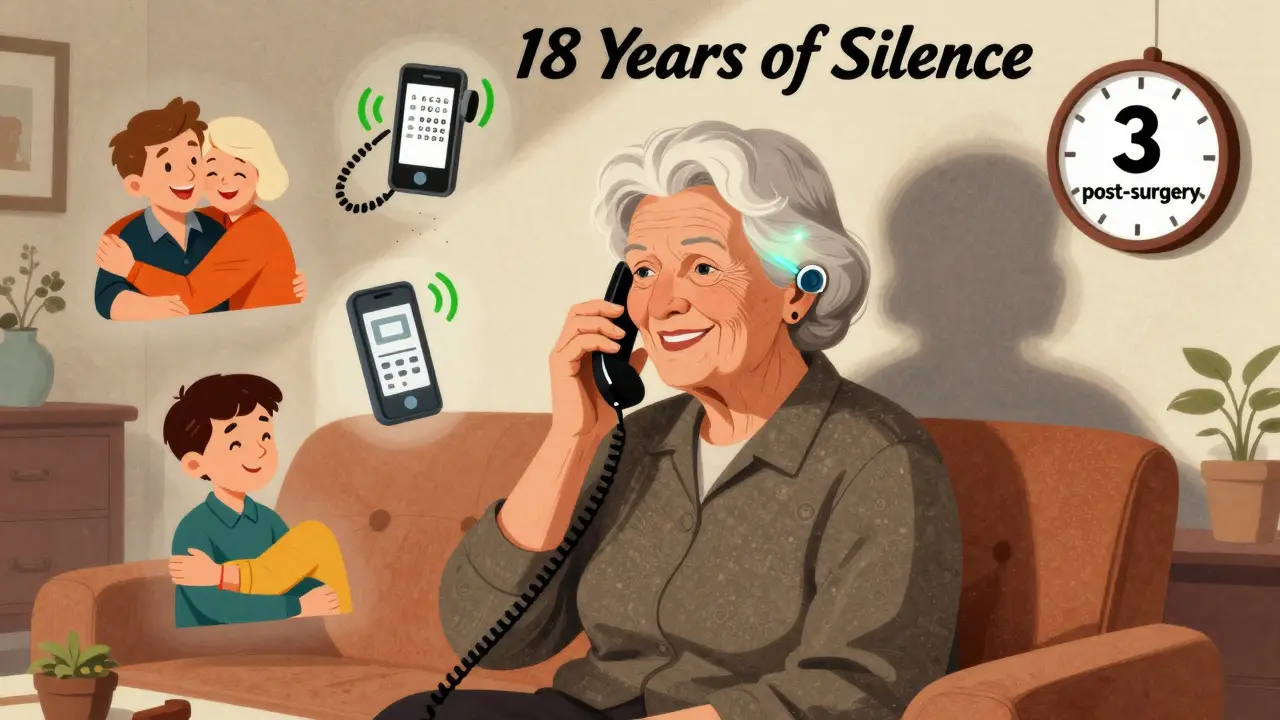
One woman in Ohio, 72, got her implant after 18 years of hearing aids. She told her audiologist, “I didn’t realize how much I’d stopped laughing at my husband’s jokes. Now I hear them again.”
What About the Downsides?
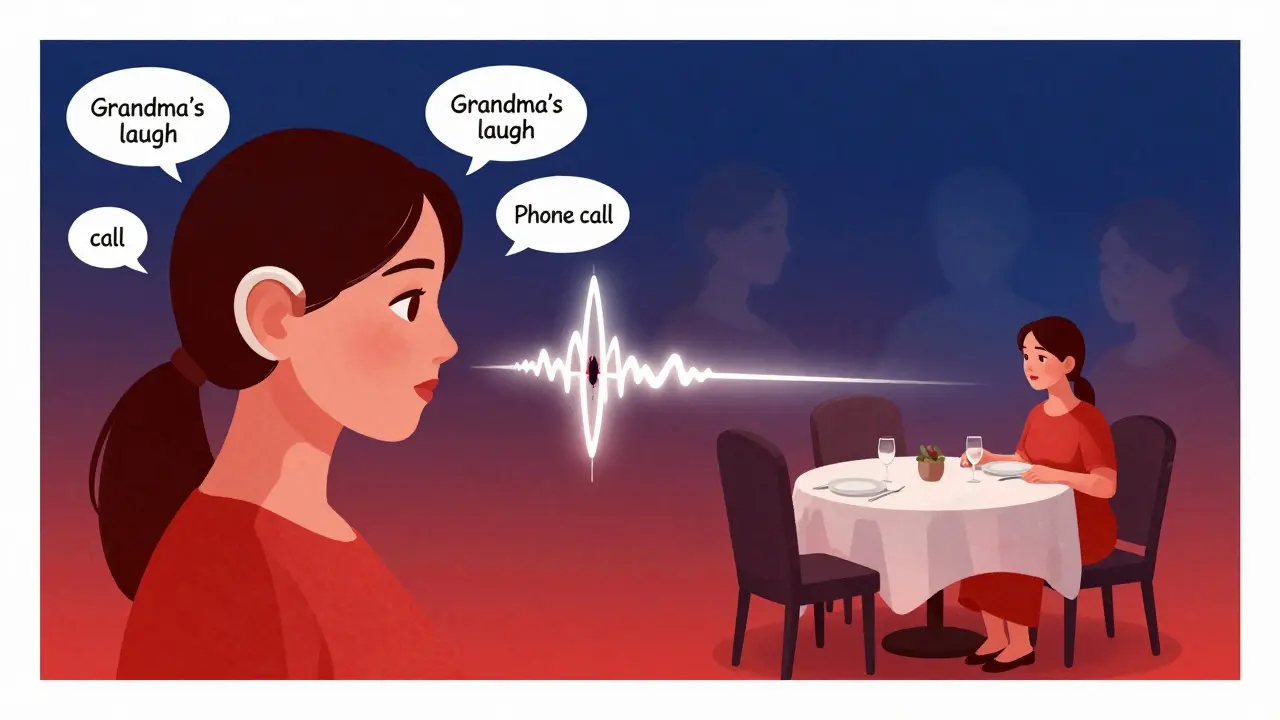
It’s not magic. Some people struggle with music. A 2022 survey found 63% of users say music still sounds “weird” or “distorted.” That’s because cochlear implants don’t replicate pitch the way natural hearing does. You might enjoy rhythm, but melody? Not so much.
Noise is still hard. Crowded rooms, restaurants, parties - those are still challenges. But they’re better than before. Most users say they can now follow conversations in noise, even if it takes more effort.
There’s also the risk of surgery. Infection, dizziness, facial nerve injury - these are rare (under 2%) but real. And the device can fail. Batteries wear out. Wires break. You’ll need to replace the external part every 5-10 years.
But here’s the thing: for most people, the benefits far outweigh the risks. And the longer you wait, the more your brain forgets how to process sound. That’s why experts say: don’t wait until you’re completely lost.
Why So Few People Get Them?
Here’s the shocking part: 38 million American adults have disabling hearing loss. Only 128,000 cochlear implants were done in 2022. That’s less than 1%.
Why? Three big reasons:
- Doctors don’t know: A 2021 survey found only 32% of primary care doctors knew the current referral criteria. They still think you need to be totally deaf.
- No clear referral path: You don’t just walk in and ask for one. You need to be referred to a specialized center. Most clinics don’t have one on-site.
- Cost and stigma: Even with Medicare and private insurance, out-of-pocket costs can be $15,000-$30,000. And some people still see implants as “extreme” - not as a tool, like glasses.
But here’s the economic truth: untreated hearing loss costs the U.S. economy $56 billion a year in lost productivity and increased dementia risk. Cochlear implants pay for themselves in under three years through better employment, fewer hospital visits, and reduced need for social services.
Who Is Still Left Out?
Even with better guidelines, disparities remain. In 2022, only 18% of cochlear implant recipients were from minority groups - even though they make up 40% of the hearing-impaired population. Why? Access. Language barriers. Lack of culturally competent care. Insurance gaps. These aren’t medical problems - they’re system problems.
And older adults? They’re still under-referred. Many assume hearing loss is just part of aging. But research shows people over 65 with moderate-severe loss and poor word recognition benefit just as much as younger people - if they get the implant. Age isn’t a barrier. Attitude is.
What’s Next?
The FDA is reviewing new labeling that would officially adopt the 50% word recognition threshold. That means insurance companies will have to cover more people. By 2030, experts predict cochlear implants will be standard care for anyone with bilateral hearing loss over 55 dB HL and speech understanding below 60% - even if they still have some hearing left.
Research is moving fast. Scientists at Johns Hopkins are testing brainwave tests (cortical auditory evoked potentials) to predict who will benefit. These tests could replace some of the guesswork in current evaluations.
One thing is clear: if you’re tired of saying “What?” three times a minute, if you’re skipping family events because it’s too hard, if you’re avoiding the phone - you’re not too late. You’re exactly who this technology was designed for.
Don’t wait until you’re completely lost. Get evaluated. Even if you’re told no, you’ll walk away with a baseline. And if you’re told yes? You might get back more than you ever thought possible.
Do I need to be completely deaf to get a cochlear implant?
No. You don’t need to be completely deaf. The 2023 guidelines say if you understand fewer than 50% of words with properly fitted hearing aids, you should be evaluated. Many people with residual hearing - even those who can hear some sounds - benefit greatly from implants. In fact, keeping some natural hearing can make the implant work better.
Is it too late if I’ve had hearing loss for 10+ years?
No. Studies show people implanted after 10, 15, or even 20 years of hearing loss can still achieve excellent outcomes - as long as they’re motivated, have good cognitive health, and commit to rehabilitation. Your brain can relearn how to process sound, even after a long time. Waiting doesn’t protect you - it just makes recovery harder.
Can I still use hearing aids after getting a cochlear implant?
Yes. Many people use a hearing aid in one ear and a cochlear implant in the other. This is called hybrid stimulation. It works especially well for people with low-frequency hearing left in one ear. The implant handles high pitches, and the hearing aid preserves natural low sounds. This combination often gives the best speech understanding in noise.
Will the implant restore normal hearing?
No. A cochlear implant doesn’t restore natural hearing. It bypasses damaged parts of the ear and sends electrical signals directly to the auditory nerve. Sounds will feel different at first - robotic or electronic. But with time and therapy, most people learn to interpret those signals as speech. It’s not magic, but it’s close.
Are cochlear implants covered by insurance?
Yes. Medicare, Medicaid, and most private insurers cover cochlear implants for people who meet current guidelines. Coverage includes surgery, the device, and follow-up care. The biggest barrier isn’t cost - it’s awareness. Many doctors don’t know the updated criteria, so they don’t refer patients. If you think you qualify, ask for a referral to a cochlear implant center.
Rob Turner
February 11, 2026 AT 17:10Man, this post hit different. I’ve been living with hearing loss for 12 years, and yeah, I’ve been avoiding family dinners like they’re tax season. The part about laughing at my husband’s jokes? That’s me. I didn’t even realize how much I’d shut down until I saw someone else put it into words. Thanks for writing this. 🙏
christian jon
February 12, 2026 AT 20:33OH MY GOD. FINALLY. Someone who GETS it. I’ve been screaming into the void for YEARS that hearing aids are a SCAM if they’re not properly fitted. I had mine for 5 years, and they were set to 'background noise' mode-like I’m in a library, not a damn grocery store! 43% of people fail verification? That’s not a stat-that’s a national scandal. Who’s responsible? WHO IS PAYING FOR THIS?!
Autumn Frankart
February 14, 2026 AT 08:48They’re not telling you the whole truth. The real reason they pushed this change in 2023? Big Med is pushing implants because they’re profitable. You think they care about your 'connection to the world'? Nah. They care about your insurance premiums. The device costs $30K? That’s a $20K profit margin. And don’t get me started on the brainwave tests-next thing you know, they’ll be scanning your thoughts before they’ll even let you near a surgeon.
Pat Mun
February 14, 2026 AT 15:50I work with older adults in rehab, and I can’t tell you how many people I’ve seen come in after 15+ years of silence. They’re quiet. Withdrawn. Like they’ve given up. Then they get the implant. And it’s like someone flipped a switch. One man, 81, started singing along to the radio. Just… out of nowhere. He cried for 20 minutes. It wasn’t about the sound. It was about feeling alive again. This isn’t a medical procedure-it’s a reawakening. Don’t wait. Please.
Skilken Awe
February 14, 2026 AT 23:37Let me guess-you’re one of those people who thinks 'hearing loss' is just 'old people being lazy.' You know what? I’ve been in audiology for 18 years. I’ve seen people with 70 dB loss who still think they’re 'fine' because they hear the microwave beep. The real problem isn’t the implant-it’s the delusion. If you can’t hear 'The boy kicked the ball,' you’re not 'partially deaf.' You’re functionally isolated. Stop making excuses.
andres az
February 15, 2026 AT 10:2950% word recognition? That’s arbitrary. Why not 48%? Or 52%? Who decided this? Was there a committee? Did they all have coffee together and say 'meh, half’s good enough'? And what about people who lip-read really well? Are they just supposed to give up their coping mechanism? This feels like another bureaucratic checkbox. Not medicine. Not care. Just policy.
Alyssa Williams
February 17, 2026 AT 00:25I got my implant last year. I was 63. Thought I was too old. Thought I’d 'get used to it.' But then I heard my granddaughter say 'I love you' for the first time without her having to repeat it 5 times. I didn’t cry. I laughed. Like, full-body, snort-laugh. That’s what this is. Not a fix. Not a miracle. Just… being able to be present again. You don’t need to be perfect. You just need to be ready. And you’re way closer than you think.
Jack Havard
February 17, 2026 AT 11:17They say 'don’t wait until you’re completely lost.' But what if you’re already lost? What if your brain forgot how to listen? Is it too late? Or is that just what they tell you so you’ll sign the consent form? I’ve been on the fence for 8 years. I don’t trust this anymore. Too many 'experts.' Too many studies. Too many sales pitches disguised as hope.
Gloria Ricky
February 18, 2026 AT 01:46My mom got one last year. She’s 76. Used to say 'huh?' every 30 seconds. Now she watches courtroom dramas and laughs at the jokes. She says the music still sounds like a robot doing karaoke-but she doesn’t care. She says she finally feels like she’s part of the conversation again. I cried when she told me. You don’t need to be perfect. You just need to want to hear your grandkids say 'I love you' without having to ask them to repeat it. Go get evaluated. Even if you say no. Just go.