
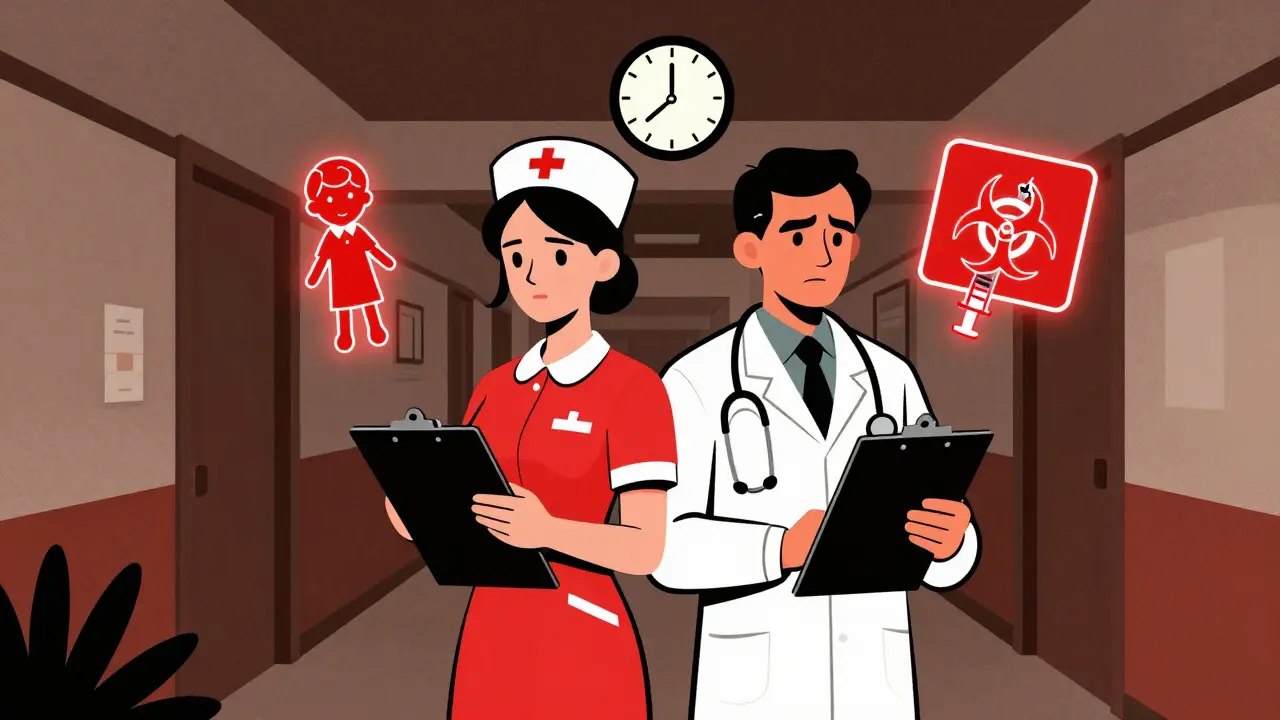
Every day, doctors and nurses see things they can’t ignore - a child with unexplained bruises, an elderly patient with bedsores no one mentions, a colleague who’s clearly impaired at work. These aren’t just clinical observations. They’re legal obligations. In the U.S., healthcare providers are required by law to report certain situations, and failing to do so can mean losing your license, facing fines, or even criminal charges. This isn’t about bureaucracy. It’s about stopping harm before it gets worse.
What You Must Report: The Big Four
There are four main categories of mandatory reporting that apply to nearly all healthcare workers. These aren’t optional. They’re written into state law, and they override patient confidentiality under HIPAA when triggered.
- Child abuse and neglect: Required in all 50 states. You don’t need proof - just reasonable suspicion. A pattern of missed appointments, inconsistent explanations for injuries, or a child who flinches at touch can be enough.
- Elder and vulnerable adult abuse: 47 states plus D.C. require reporting. This includes physical harm, financial exploitation, neglect, and emotional abuse. A diabetic elder left without insulin for days? That’s reportable.
- Public health threats: 57 diseases are nationally notifiable. Some, like anthrax or botulism, must be reported within an hour. Others, like Lyme disease, have a 7-day window. Hospitals use automated systems now, but if you’re in private practice, you still need to know your state’s list.
- Professional misconduct: If you see a nurse giving meds incorrectly, a doctor prescribing opioids without documentation, or a colleague practicing while impaired, you’re legally required to report it in 42 states. Some states require the institution’s leadership to report; others require you to report directly.
These aren’t hypotheticals. A 2019 JAMA study found that states with mandatory reporting identified 37% more child abuse cases than states without them. In Michigan, a nurse reported a father who kept bringing his 3-year-old in with new fractures each visit. The child was removed from the home the next day. That report saved a life.
When You Must Report: The Clock Is Ticking
Timing matters. Reporting late can be as bad as not reporting at all.
In states like California, Texas, and Florida, child abuse reports must be made immediately - usually interpreted as within 24 hours. In Minnesota and Michigan, you have 36 to 48 hours. But if you wait until Monday to report abuse that happened Friday, you’re already out of compliance.
Public health reporting has tighter deadlines. Anthrax? One hour. Measles? 24 hours. Tuberculosis? 72 hours. These aren’t suggestions - they’re legal deadlines tied to outbreak control. Hospitals use electronic systems that auto-submit reports to state health departments. Private providers? You’re on your own. Miss the window, and you risk contributing to an outbreak.
For elder abuse, timing varies wildly. In New York, you must report within 24 hours. In Texas, there’s no state law requiring individual providers to report elder abuse at all - only institutions. That means if you’re seeing an elderly patient in a private clinic in Texas, you’re not legally required to report neglect unless it’s part of a larger pattern that also involves child abuse or public health.
How to Report: The Real Process
Most people think reporting means filling out a form and mailing it. It’s not that simple.
For child and elder abuse, you call your state’s child protective services (CPS) or adult protective services (APS) hotline. You don’t need to be right - you just need to be suspicious. The hotline will ask for:
- Name and age of the victim
- Location and living situation
- Names and contact info of caregivers
- Description of the abuse or neglect
- Your name and license number (required in most states)
Some states, like California, require a written follow-up within 36 hours. Others accept the phone call as sufficient. Always ask: “Do I need to submit a written report?” and write it down.
For public health threats, most hospitals use electronic case reporting (eCR), which auto-fills data from your EMR and sends it to the state. If you’re in private practice, you’ll need to use your state’s online portal or fax a form. The CDC’s NEDSS system is the backbone of this - but you still need to know your state’s specific requirements.
For professional misconduct, the process depends on your employer. In Minnesota, the Chief Nursing Executive must report nurse misconduct within 30 days. In Utah, you can report directly to the state nursing board. Some hospitals have internal reporting systems; others require you to go straight to the state. Always document your report - date, time, who you spoke to, what was said.

What You Don’t Have to Report - And Why That Matters
Not every concerning situation triggers a legal duty. You don’t have to report:
- Patient noncompliance (e.g., someone refusing insulin)
- General poor judgment without clear harm (e.g., a patient who forgets appointments)
- Disagreements over treatment plans
- Financial disputes between family members
But here’s the trap: if you assume something isn’t reportable, you might be wrong. A patient who’s “noncompliant” with diabetes care might be hiding abuse. A patient who forgets appointments might be being controlled by an abusive partner. That’s why “reasonable suspicion” is the key - not proof.
One nurse in Washington reported a patient who kept missing dialysis. The patient said she was “too tired.” The nurse called APS. It turned out the patient’s daughter was stealing her Social Security checks and locking her in the house. That report led to criminal charges and a protective order.
The Hidden Cost: Fear, Burnout, and Broken Trust
Reporting saves lives - but it also breaks relationships.
A 2020 AMA survey found that 68% of physicians said mandatory reporting made patients less likely to be honest. One pediatrician on Reddit shared: “I had a teen come in for opioid withdrawal. She was terrified I’d report her to CPS because her mom was using. I didn’t report - but I lost her trust. She never came back.”
Nurses report similar fears. A 2022 survey by the American Nurses Foundation found 63% felt “significant anxiety” about reporting - not just because of legal risk, but because they worried about being seen as a snitch. One nurse in Utah reported unsafe staffing ratios. Despite state law protecting whistleblowers, she was demoted two weeks later.
And the paperwork? It’s heavy. The AMA found healthcare workers spend an average of 2.7 hours per report. For a busy ER doctor seeing 10 patients a day, that’s 27 hours a month - just on reporting.
How to Stay Compliant - And Keep Your Sanity
You don’t need to memorize 50 state laws. But you do need a system.
- Know your state’s rules. Go to your state’s health department website. Look for “mandatory reporter training.” Most offer free online modules.
- Keep a cheat sheet. Print or save a one-page list of what’s reportable and the deadline. Tape it to your desk.
- Use institutional resources. Most hospitals have a compliance officer or legal team. Ask them before you report if you’re unsure.
- Document everything. Write down what you saw, when, and why you thought it was reportable. If you’re ever questioned later, that note is your shield.
- Don’t wait for a second opinion. If you’re unsure, call the hotline. They’re trained to help you decide. In Washington State, the hotline is open 24/7: 1-800-252-0230.
And remember: you’re not the judge. You’re the trigger. Once you report, trained investigators take over. Your job is to spot the signs - not fix the problem.
The Future: Automation, AI, and Standardization
Change is coming. In 2023, Massachusetts General Hospital piloted an AI tool that scans patient charts for signs of abuse - like repeated fractures, inconsistent histories, or missed follow-ups. It flagged cases doctors missed, reducing reporting errors by 38%.
States are also pushing for standardization. The Uniform Law Commission proposed a national reporting act in 2021. The Department of Health and Human Services is rolling out a nationwide eCR system by 2025. That means fewer forms, fewer mistakes, and less time spent on paperwork.
But until then, you’re still stuck with 50 different sets of rules. The best defense? Stay informed, stay documented, and never assume someone else will report it.
What Happens If You Don’t Report?
It’s not just professional risk - it’s personal.
In 2021, a physician in Ohio failed to report a child with multiple fractures. The child died two months later. The doctor lost her license and was charged with misdemeanor child endangerment.
A 2022 study in the New England Journal of Medicine found that 12% of malpractice claims against doctors involved failure to report. That’s not rare. That’s common enough to be a leading cause of disciplinary action.
And the consequences aren’t just legal. They’re moral. When you don’t report, you become part of the silence. And silence lets abuse continue.
Do I have to report abuse if the patient asks me not to?
Yes. Patient confidentiality does not override mandatory reporting laws. You are legally required to report suspected child, elder, or vulnerable adult abuse - even if the patient begs you not to. You can explain that the law requires you to report, but you’re not obligated to tell them you’ve done so. Most states protect your identity in the report.
What if I’m not sure whether something counts as abuse?
If you have reasonable suspicion, report it. You don’t need proof. The purpose of mandatory reporting is to get trained investigators involved. They’ll determine if abuse occurred. Your job is to flag the concern. Waiting for certainty often means waiting too long.
Can I be sued for reporting someone falsely?
In most states, you’re protected from civil or criminal liability if you report in good faith - even if the report turns out to be wrong. This is called “immunity.” As long as you acted without malice and based your report on what you reasonably observed, you won’t be held liable. The risk comes from not reporting, not from reporting.
Do telehealth providers have different reporting rules?
Yes. If you’re providing care across state lines, you must follow the laws of the state where the patient is physically located - not where you are. A doctor in Pennsylvania treating a child in Texas must follow Texas reporting rules. Many telehealth platforms now include state-specific reporting prompts, but it’s still your responsibility to know the rules.
What if I report a colleague and they retaliate?
Retaliation is illegal in 42 states. If you’re demoted, fired, or harassed after reporting misconduct, document everything and contact your state’s medical or nursing board immediately. Some states, like Utah and Minnesota, have strong whistleblower protections. But enforcement varies. Don’t wait - act fast.
Arjun Seth
January 15, 2026 AT 12:12People just don't get it-this isn't about being a snitch, it's about being a human. If you see a kid with bruises and do nothing, you're just as guilty as the abuser. I've seen nurses hesitate because they 'didn't want to cause trouble.' Well, guess what? The kid didn't ask for trouble either.
Nat Young
January 16, 2026 AT 02:06Let’s be real-mandatory reporting is a bureaucratic nightmare dressed up as morality. You’re forced to report based on ‘reasonable suspicion’? That’s just legal theater. Most cases get dismissed anyway. Why waste 2.7 hours per report when the system’s rigged to ignore 90% of them? It’s performative compliance with zero impact.
Annie Choi
January 16, 2026 AT 07:05As a nurse who’s filed 14 reports in 5 years, I can tell you-this system saves lives. That one kid in ER with the spiral fracture? Turned out he was being thrown against walls. The system worked. Yes, it’s heavy. Yes, it’s emotional. But if you’re tired of watching people suffer in silence, then do the damn report. You’re not the judge-you’re the first line of defense.
Ayush Pareek
January 16, 2026 AT 11:32Hey, if you're unsure-call the hotline. Seriously. They don't judge. They help. I used to worry I’d mess up a report, but after talking to APS in Delhi, I learned they’re trained to walk you through it. You don’t need to be perfect. You just need to care enough to speak up. That’s all.
Amy Ehinger
January 17, 2026 AT 07:03I work in a rural ER and honestly? Most of us just roll our eyes at the paperwork. But then last month, a mom brought in her 4-year-old with a broken arm and said ‘he fell down the stairs’-but the pattern was wrong. Three visits in six months, same injury, different stories. I called CPS. Turned out the dad was beating him. The kid’s in foster care now. So yeah, the system’s clunky-but sometimes it works. And that’s enough for me.
Tom Doan
January 18, 2026 AT 08:27Interesting. So we’re now treating healthcare workers as state-enforced informants? The erosion of physician-patient trust is not a side effect-it’s the intended outcome of a system that prioritizes liability over healing. If patients fear you’ll report them for opioid use, they’ll stop coming. And then what? They overdose alone in a basement. Is that the world we want?
Sohan Jindal
January 18, 2026 AT 21:21This is why America is falling apart. We’ve turned every doctor into a government snitch. Next they’ll make you report your neighbor for not wearing a mask. Mandatory reporting? More like mandatory paranoia. Who gave the state the right to turn healthcare into a surveillance network? This isn’t protection-it’s tyranny.
Nilesh Khedekar
January 20, 2026 AT 11:45Let me tell you something from India-when we see elder neglect, we don’t report. We take them home. We fix it ourselves. Why? Because the system doesn’t care. Here, you get a form, a waitlist, and then silence. So we do what’s right-family takes care of family. Maybe America needs less bureaucracy and more community.
RUTH DE OLIVEIRA ALVES
January 20, 2026 AT 20:06It is imperative to underscore that the legal obligations delineated herein are codified within the statutory frameworks of each jurisdiction, and noncompliance constitutes a breach of professional fiduciary duty. Furthermore, the ethical imperatives articulated in the Hippocratic Oath necessitate the prioritization of patient welfare above institutional convenience or personal apprehension. Consequently, adherence to mandated reporting protocols is not merely a procedural requirement-it is a moral imperative.
Crystel Ann
January 21, 2026 AT 13:30I’ve been doing this for 18 years and I still get nervous before I call the hotline. But I do it anyway. Not because I want to. Because I have to. And sometimes, like that time with the diabetic grandma whose daughter was stealing her checks… it actually changes everything. You don’t need to be brave. You just need to be consistent.
Niki Van den Bossche
January 22, 2026 AT 16:40There’s a profound existential dissonance here, isn’t there? We are simultaneously entrusted with the sacred intimacy of the human body-witnessing vulnerability in its rawest form-and then weaponized as instruments of state surveillance. We are not caseworkers. We are not cops. We are healers. And yet, the system demands we become both-and in doing so, fractures the very trust that makes healing possible. The real tragedy isn’t the abuse we fail to report-it’s the silence we cultivate to survive the system that forced us into this role.