
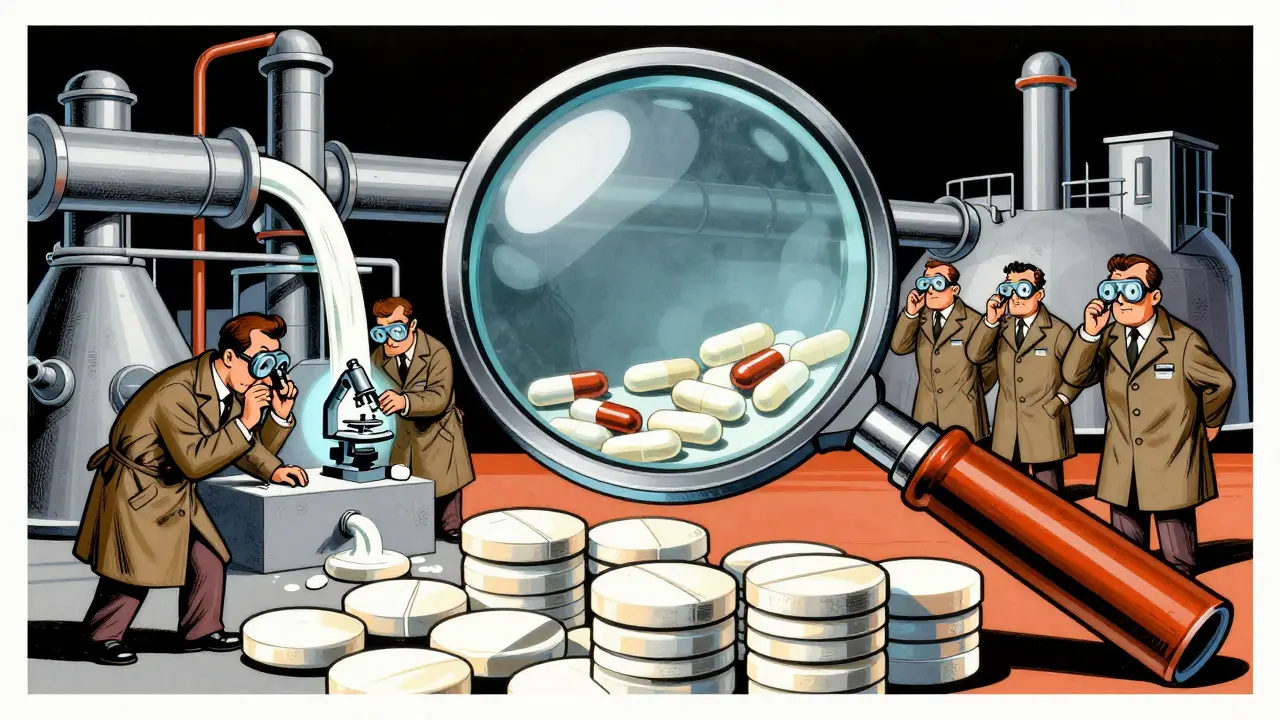
When you pick up a generic pill at the pharmacy, you expect it to work just like the brand-name version. You don’t want to wonder if it’s weaker, less safe, or made in a dirty facility. The truth is, the FDA doesn’t just approve generic drugs - it watches over every step of how they’re made. And that oversight is far more detailed than most people realize.
How Generic Drugs Get Approved Without Full Clinical Trials
Generic drugs don’t need to repeat the expensive, years-long clinical trials that brand-name drugs go through. That’s thanks to the Hatch-Waxman Act of 1984, which created the Abbreviated New Drug Application (ANDA) process. Instead of proving safety and effectiveness all over again, generic manufacturers must show their product is bioequivalent to the original. That means the generic drug delivers the same amount of active ingredient into the bloodstream at the same rate as the brand-name version - within a 90% to 110% range.
This isn’t a shortcut. It’s a scientifically rigorous standard. The FDA’s Office of Generic Drugs (OGD) reviews every ANDA submission with the same level of scrutiny as a new drug application. They check the chemistry, the formulation, the stability data, and the manufacturing process. If any part doesn’t meet the standard, the application gets a Complete Response Letter - meaning it’s rejected until the issues are fixed. Many applications go through multiple rounds of review before approval.
The Three Pillars of Manufacturing Quality
Once a generic drug is approved, the real work begins: making sure every batch is safe and consistent. The FDA requires all manufacturers - whether in the U.S. or overseas - to follow Current Good Manufacturing Practices (cGMP). These aren’t suggestions. They’re legally binding rules.
There are three non-negotiable systems every generic drug maker must have in place:
- Raw Material Control - Every ingredient, from the active pharmaceutical ingredient (API) to fillers and coatings, must be tested and traced. Suppliers are audited. Materials are stored under strict conditions to prevent contamination or degradation.
- Process Controls - Every step in manufacturing has a written procedure. Temperature, pressure, mixing time, and humidity are monitored in real time. If a parameter goes outside the approved range, the batch is rejected.
- Quality Control Testing - Finished products are tested in labs using validated methods. Each batch is checked for potency, purity, dissolution rate, and microbial contamination. The FDA can request and review these test results at any time.
These aren’t theoretical standards. In 2019, FDA inspections found quality issues in 15% of foreign generic drug facilities - compared to 8% in the U.S. That’s why inspections are so critical.
Inspections: The FDA’s Eyes on the Ground
The FDA doesn’t just read paperwork. They send inspectors to factories. Before a drug is approved, the FDA inspects the manufacturing site. After approval, they come back - regularly.
In 2021, the FDA conducted 1,082 inspections worldwide of generic drug facilities. That number is climbing. Under GDUFA III, which started in 2022, the FDA aims to hit 1,500 foreign inspections annually by 2025. That’s a 40% increase in just a few years.
Inspections aren’t random. The FDA uses a risk-based system. Facilities with past violations, complex products, or a history of supply chain issues get priority. Some sites are inspected every two years. Others, especially those flagged for problems, get visited more often.
Inspection teams include chemists, engineers, and pharmacists. They walk through the facility, check equipment logs, review training records, and examine data from quality control labs. They don’t just look for paperwork - they look for patterns. A single inconsistent temperature reading might lead to a full audit.
What Happens When Something Goes Wrong?
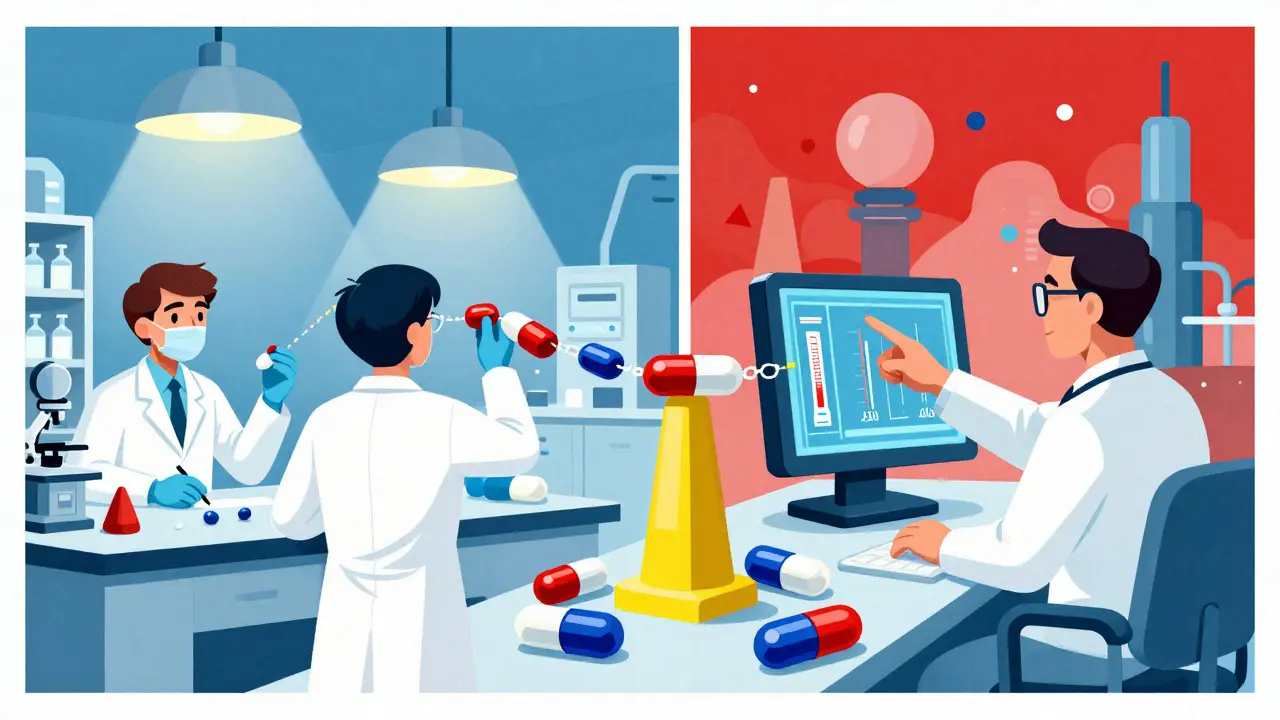
Even with strict oversight, problems happen. In 2018, the FDA found that a major Indian manufacturer had falsified test results and reused samples to pass inspections. The company’s products were pulled from the market. That’s not rare. In fact, the FDA issues dozens of warning letters each year to generic drug makers for violations ranging from poor sanitation to data manipulation.
When safety concerns arise, the FDA doesn’t wait. They can:
- Issue a public warning letter
- Require a voluntary recall
- Update the drug’s labeling to warn of risks
- Issue a “Dear Healthcare Provider” letter
- Block imports from a facility
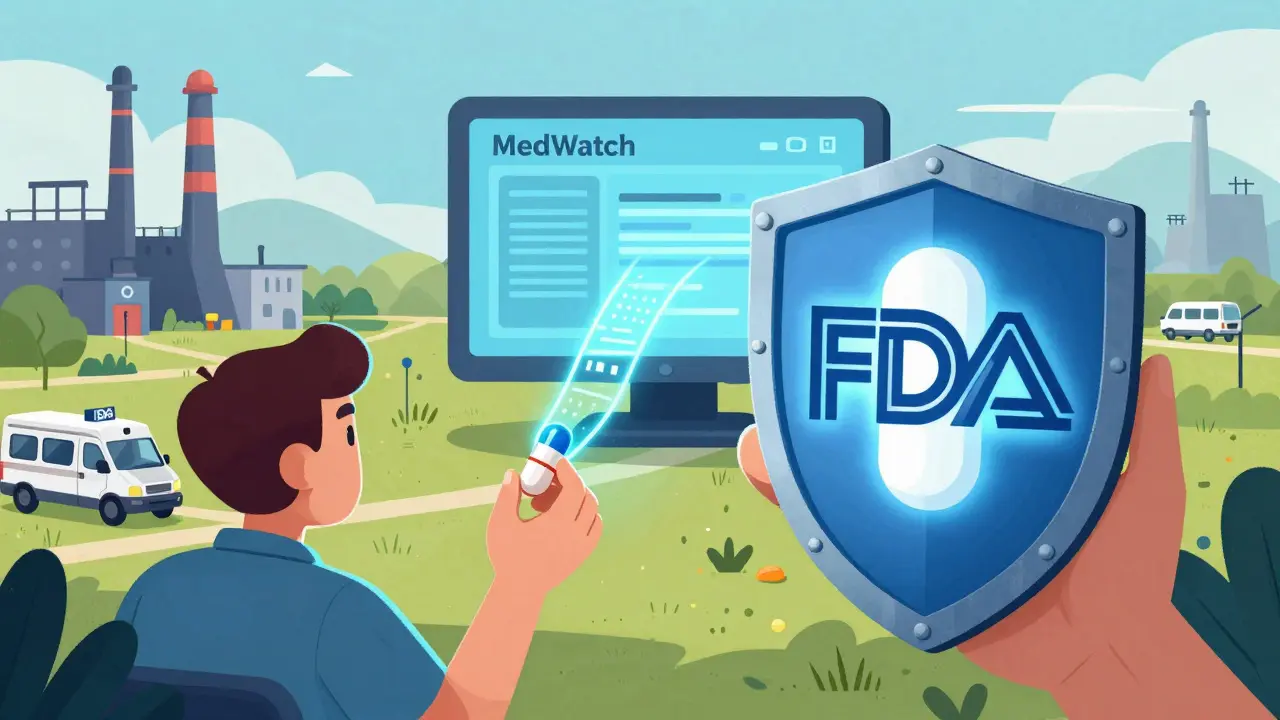
The FDA also tracks adverse events through MedWatch, their system for collecting reports from patients and doctors. In 2023, over 1.3 million reports came in. While most are unrelated to the drug itself - like side effects from underlying conditions - the FDA’s Division of Clinical Safety and Surveillance uses data analysis to spot unusual patterns. If a specific generic drug shows a spike in reports of liver injury or dizziness, investigators dig in.
Why Generic Drugs Are So Much Cheaper - And Still Safe
Generic drugs make up about 90% of all prescriptions filled in the U.S. But they cost only 23% of what brand-name drugs do. That’s saved Americans $313 billion in a single year.
Why the big difference? Brand-name drugs cost $2.6 billion and take 10 to 15 years to develop. Generics skip the clinical trials, so development costs are between $1 million and $5 million. But that doesn’t mean they’re cheaper because they’re lower quality. It means the FDA’s system lets manufacturers avoid repeating the same science - not cutting corners on safety.
The FDA’s job isn’t to make drugs cheap. It’s to make sure cheap drugs are just as safe as expensive ones. That’s the whole point of the ANDA process and the cGMP rules. A generic drug must be identical in dose, strength, quality, performance, and intended use.
The Future: More Data, Faster Reviews, Global Reach
The FDA isn’t standing still. GDUFA III, which runs through 2027, is investing $1.1 billion to modernize oversight. That money is funding:
- Real-time data monitoring from manufacturing facilities
- Advanced lab tools to detect impurities faster
- Training for inspectors on complex drugs like inhalers and injectables
- More staff to review applications - now 95% of standard ANDAs are approved within 10 months, down from 30 months in 2012
The FDA is also working on new guidance for hard-to-copy drugs - like complex inhalers, topical creams, and long-acting injectables. These aren’t simple pills. They require special testing methods, and the FDA is building the science to match.
One thing hasn’t changed: the goal. As former FDA Director Dr. Janet Woodcock said in 2012, “Generic drugs must be identical to their brand-name counterparts.” That hasn’t changed. And the FDA’s oversight system - inspections, data checks, lab reviews, and enforcement - is designed to make sure it stays true.
What You Can Do
You don’t need to be a scientist to help keep generic drugs safe. If you notice something unusual - a pill that looks different, a side effect you’ve never had before, or a medication that just doesn’t seem to work - report it. Use MedWatch. Your report could help the FDA spot a problem before it affects thousands.
Generic drugs are a lifeline for millions. They’re not second-rate. They’re rigorously tested, tightly monitored, and constantly watched. The FDA doesn’t just approve them - it guards them, every day, from the factory floor to your medicine cabinet.
Are generic drugs as safe as brand-name drugs?
Yes. The FDA requires generic drugs to be identical to their brand-name counterparts in dose, strength, safety, quality, performance, and intended use. They must demonstrate bioequivalence - meaning they deliver the same amount of active ingredient into your bloodstream at the same rate. The FDA reviews every generic drug for these standards before approval and continues to monitor them after they’re on the market.
How does the FDA know if a generic drug is made safely?
The FDA inspects manufacturing facilities - both in the U.S. and overseas - to ensure they follow Current Good Manufacturing Practices (cGMP). Inspectors check everything: how raw materials are handled, how production steps are controlled, and how finished products are tested. Facilities with past violations or complex products are inspected more often. The FDA also reviews detailed documentation from manufacturers and can request test results at any time.
Do generic drugs come from the same factories as brand-name drugs?
Sometimes. Many brand-name drugmakers also produce generic versions of their own drugs. Other times, independent manufacturers make generics under contract. The FDA doesn’t care who makes the drug - only that it meets the same quality standards. Whether made in the U.S., India, or China, every facility is subject to the same inspection rules and compliance requirements.
What happens if a generic drug causes side effects?
The FDA tracks side effects through MedWatch, where patients and doctors can report problems. If a pattern emerges - like a spike in liver issues linked to a specific generic - the FDA investigates. They may request more data from the manufacturer, update the drug’s warning label, issue a public alert, or require a recall. The FDA’s Clinical Safety and Surveillance Committee reviews all serious safety signals for approved generics.
Why do some generic drugs look different from the brand name?
Generic drugs can look different because U.S. law doesn’t allow them to copy the exact appearance of brand-name drugs - that’s to avoid confusion. The color, shape, or flavor might be different, but the active ingredient, strength, and how it works in your body must be the same. The FDA ensures that these differences don’t affect safety or effectiveness.
Can I trust generics made overseas?
Yes - if they’re approved by the FDA. Over 80% of generic drugs sold in the U.S. contain ingredients made overseas, mostly in India and China. The FDA inspects these foreign facilities just like U.S. ones. In 2021, the FDA completed 74% of its foreign inspections within its performance goals. While quality issues have been found at some foreign plants, the FDA takes action when problems are detected - including blocking imports and revoking approvals.
Manufacturing oversight isn’t a one-time check. It’s a continuous system - from the moment a drug is designed to the day it’s taken off the shelf. The FDA’s job isn’t to stop innovation. It’s to make sure that when you choose a generic, you’re not choosing less safety. You’re choosing the same quality - at a fraction of the cost.
Lydia H.
January 18, 2026 AT 22:27Been taking generics for years-never had an issue. My grandma’s blood pressure med? Generic. My anxiety script? Generic. My kid’s antibiotics? Also generic. The FDA’s got this. If you’re worried, check the label-active ingredient’s the same. End of story.
Tracy Howard
January 19, 2026 AT 16:10Oh wow, the FDA? The same agency that let Purdue Pharma sell OxyContin like candy? Please. You think they’re watching factories in India? They’re too busy sipping lattes in D.C. while Chinese labs pump out pills with 12% active ingredient and 88% talcum powder. Wake up, sheeple.
Aman Kumar
January 20, 2026 AT 08:59Let me elucidate the epistemological fallacy inherent in your argument: bioequivalence is a statistical mirage. The 90–110% range is not a guarantee-it’s a probabilistic loophole exploited by contract manufacturers with zero accountability. cGMP? A façade. The FDA’s inspection regime is a theater of compliance, not a system of integrity. The Indian pharma sector is a cesspool of data integrity violations masked as ‘process deviations.’
Phil Hillson
January 21, 2026 AT 07:23So you’re telling me the government is watching every pill? Bro. I bought a generic Adderall once and it made me feel like a ghost. Like, I could’ve sworn it was just sugar. And now I’m supposed to trust this? No thanks. I’ll pay extra for the blue one with the little white stripe. At least I know what I’m getting.
Jacob Hill
January 23, 2026 AT 06:56I really appreciate how thorough this breakdown is. The FDA’s system isn’t perfect, but it’s the best we’ve got-and it’s constantly improving. The fact that they’re investing in real-time monitoring and training inspectors on complex delivery systems? That’s huge. I’ve worked in pharma QA, and I can tell you: the rigor is real. It’s not sexy, but it saves lives.
Valerie DeLoach
January 23, 2026 AT 17:19Generics are a civil rights issue. For millions of Americans, brand-name drugs are a luxury they can’t afford. The FDA’s oversight ensures that poverty doesn’t mean sacrificing safety. This isn’t about cost-cutting-it’s about justice. And yes, foreign facilities are inspected. The FDA doesn’t play favorites. If you’re selling in the U.S., you play by U.S. rules. Period.
Astha Jain
January 23, 2026 AT 23:56lol generic drugs are just made in india with dirt and hope lmao my cousin works in a lab there and they reuse the same samples for testing. the fda is just a joke. i took a generic for my thyroid and my heart was racing for 3 days. so much for 'bioequivalent'.
sujit paul
January 25, 2026 AT 01:34Consider this: if the FDA truly enforced cGMP, why are 74% of foreign facilities flagged for critical deficiencies? Why do recalls happen in clusters? Why do inspectors receive advance notice? The system is not broken-it is designed to appear functional while permitting systemic corruption. The Indian and Chinese supply chains are not merely compromised-they are weaponized. The FDA’s 1,500 inspections per year? A drop in the ocean of global pharmaceutical production. We are all lab rats in a controlled experiment.
Christi Steinbeck
January 26, 2026 AT 14:17THIS. THIS RIGHT HERE. I’ve been screaming this from the rooftops for years. Generics aren’t ‘cheap alternatives’-they’re the backbone of American healthcare. I work in a clinic in rural Ohio. Half our patients are on generics. They’re not ‘second-rate.’ They’re second-to-none. The FDA’s job is invisible, but it’s the reason your grandma doesn’t die because her BP med was made in a garage. Thank you for writing this.
Lewis Yeaple
January 28, 2026 AT 12:51It is important to note that the Hatch-Waxman Act of 1984 established the ANDA pathway under Title 21 of the Code of Federal Regulations, Section 314.100 et seq. The bioequivalence standard is defined by the FDA’s Guidance for Industry: Bioavailability and Bioequivalence Studies for Orally Administered Drug Products-General Considerations, dated 2003. The 90% to 110% confidence interval is derived from statistical power analysis with alpha set at 0.05. The cGMP requirements are codified under 21 CFR Part 211. These are not subjective standards-they are regulatory mandates with enforceable penalties.
Jackson Doughart
January 30, 2026 AT 00:26I’ve seen firsthand how a single inspection can change a company’s entire culture. I once worked with a plant in Puerto Rico that had three critical violations. After the FDA visit, they hired a full-time compliance officer, rewrote every SOP, and installed real-time temperature sensors on every mixer. They’re now one of the most trusted suppliers in the region. The system works-not perfectly, but it works. And when it doesn’t, it corrects itself.
Malikah Rajap
January 31, 2026 AT 03:45Okay but… what if your generic looks different and tastes weird? Like, I swear my generic Lexapro has a metallic aftertaste now. Is that normal? I don’t know if it’s the filler or if they changed the coating or… I just feel like my brain is melting. I’m not mad, just confused. Can someone explain? I’m just trying to get through my day.
Jake Rudin
January 31, 2026 AT 22:55There’s a quiet irony here: we demand transparency in our food, our water, our electronics-and yet, when it comes to the pills we swallow daily, we outsource trust to a bureaucratic system we don’t understand. The FDA’s oversight is not a guarantee of perfection-it’s a guarantee of process. And process, when rigorously applied, is the closest thing we have to safety in a world of chaos. We don’t need miracles. We need consistency. And that’s what they’re trying to deliver.