
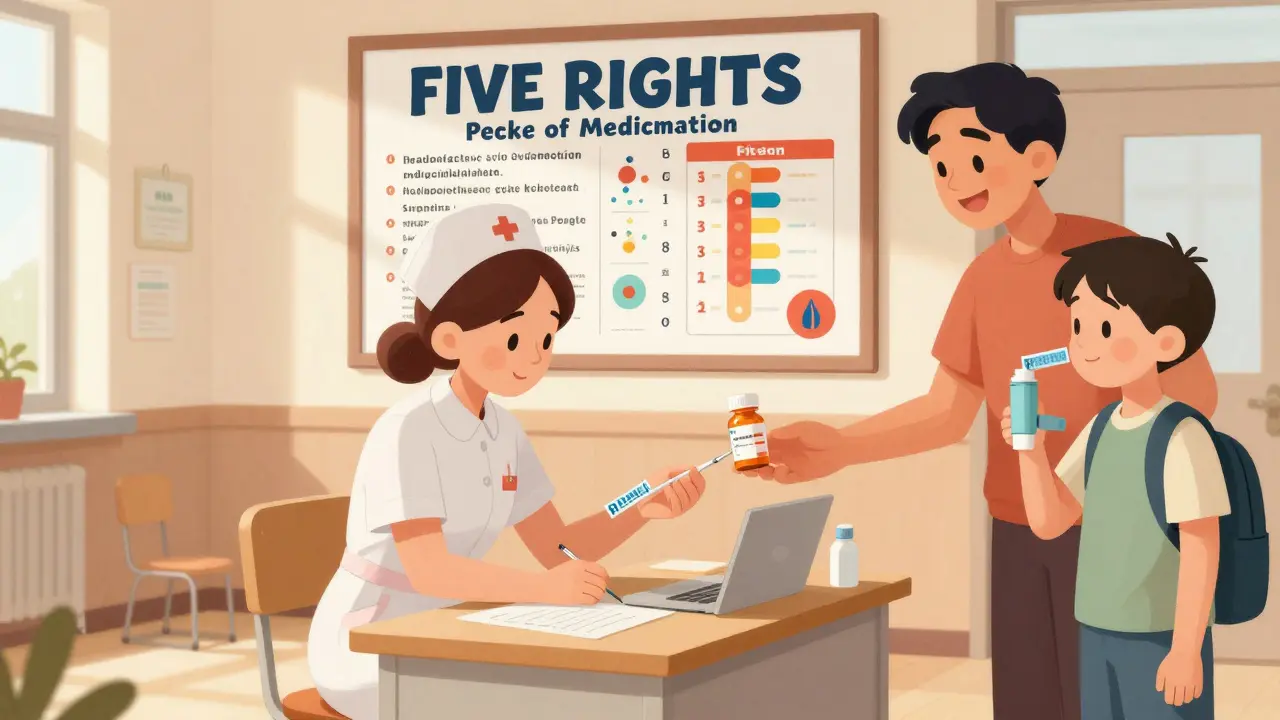
Every morning, hundreds of thousands of children across the U.S. swallow pills, use inhalers, or get insulin shots-not at home, not at the doctor’s office, but in the school hallway or nurse’s station. For many, this isn’t optional. It’s life-saving. And it all depends on one person: the school nurse. But coordinating daily pediatric medications in schools isn’t just about handing out pills. It’s a tightly woven system of legal rules, training protocols, documentation, and human trust. Get one step wrong, and the consequences can be severe.
Why School Nurses Are the Backbone of Pediatric Medication Safety
School nurses don’t just treat scrapes and fevers. They’re the only licensed medical professionals on-site for most students with chronic conditions like asthma, diabetes, or epilepsy. According to the National Association of School Nurses (NASN), 14.7% of all U.S. schoolchildren need daily medication during school hours. That’s nearly 1 in 7 kids. Without a coordinated system, medication errors happen. And they’re not rare-about 1.2% of all school-based administrations involve mistakes, according to 2023 NASN data. That might sound small, but in a school of 1,000 students, that’s 12 errors a year. Some are minor. Others can be deadly.
The fix isn’t more nurses-it’s better coordination. Even with a national average of 1 nurse for every 1,102 students (far above the recommended 1:750), schools manage by relying on trained staff, clear policies, and strict protocols. The key? Following the Five Rights of medication administration: right student, right medication, right dose, right route, right time. This isn’t just a slogan. It’s the legal and clinical standard enforced by the AAP and NASN since 2022.
Step 1: Build a District-Wide Policy (And Stick to It)
Every school district needs a written policy. Not a vague memo. A full policy document, approved by the school board, that answers: Who can give meds? What forms are required? What happens if a parent forgets the bottle? The NASN’s 2022 Clinical Practice Guideline is the gold standard. Districts using it see 37% fewer errors, according to a 2022 Journal of School Nursing study.
Start with templates from NASN’s Implementation Toolkit. Customize them to fit your state’s Nurse Practice Act. In Texas, medication administration is treated as an administrative task-this creates legal risk. In Virginia, nurses must personally review every first dose. Know your state’s rules. If your district doesn’t have a policy, push for one. Non-compliance can cost districts millions-like Houston ISD, which was fined $2.3 million in 2022 for medication failures.
Step 2: Screen Students and Create Individualized Healthcare Plans (IHPs)
Not all kids need the same level of care. Use a three-tier system like New York’s: Nurse Dependent (needs direct help-e.g., insulin), Supervised (needs watching-e.g., asthma inhaler), and Self-Administered (can do it alone, with approval-e.g., ADHD pills).
For every student in the first two categories, create an Individualized Healthcare Plan (IHP). This isn’t a form you fill out once. It’s a living document. It includes:
- Exact medication name, dose, timing
- Prescriber’s signature and contact info
- Side effects to watch for
- Emergency instructions (e.g., when to use an EpiPen)
- Parent/guardian contact details
Each IHP takes 2-4 hours to build. But schools that use them see 28% better adherence. That’s not just data-it’s fewer hospital visits, fewer missed school days, fewer panicked parents.
Step 3: Train Your Staff-Properly
School nurses can’t be everywhere. That’s why delegation is critical. But delegation isn’t handing a pill to a teacher and saying, “Do this.”
Unlicensed assistive personnel (UAP)-like aides, coaches, or office staff-can be trained to give meds, but only under strict rules. In 37 states, they can, but training varies from 4 to 16 hours. Virginia requires 16 hours for complex meds like insulin. Texas allows as little as 4 hours for simple pills. That’s dangerous.
Here’s what real training includes:
- Verifying the Five Rights every single time
- Reading pharmacy labels correctly (no exceptions)
- Knowing when to stop-e.g., if the child looks sick or the dose looks wrong
- How to document immediately after giving the med
Training must be hands-on. Watch a nurse give a dose. Practice with dummy pills. Role-play a panic situation. Don’t skip this. Sixty-three percent of medication errors happen when this assessment is skipped, says the AAP.
Step 4: Use Original, Properly Labeled Containers
This one trips up even experienced schools. Medications must come in the original pharmacy bottle-with the child’s name, drug name, dose, prescriber, and expiration date printed on the label. No Ziploc bags. No pill organizers. No handwritten notes.
Why? Because federal law (21 CFR § 1306.22) requires it. And because mistakes happen. A 2023 survey found 38% of districts had parents bring meds in unlabeled containers. That’s a legal and safety disaster. One wrong pill, one misread dose, and a child could end up in the ER.
Solution: Require parents to bring meds to the nurse’s office on the first day of school. Offer a parent education session. In Montgomery County, MD, this cut unlabeled med incidents by 52%. Make it mandatory. No exceptions.
Step 5: Document Everything-Immediately
Documentation isn’t busywork. It’s your legal shield. If a child has a reaction, you need to prove you did everything right. That means recording every dose, every time, right after it’s given.
98% of districts use electronic systems now. But 42 states still allow paper logs. Electronic systems like the one used in Fairfax County Public Schools cut documentation time by 45% and improved accuracy by 31%. They auto-flag missed doses, send alerts to nurses, and sync with IHPs.
If you’re still using paper:
- Use pre-printed, tamper-proof logs
- Require two signatures for controlled substances (like Adderall)
- Store logs in locked cabinets
- Review them daily
And here’s the truth: 76% of school nurses say they don’t have enough time to document properly. That’s why tech matters. If your district can’t afford an EHR, start with free templates from NASN. But don’t skip it.

Step 6: Handle Emergency Meds Like a Pro
Anaphylaxis doesn’t wait for the nurse to finish her paperwork. Epinephrine must be given within 5 minutes of symptom onset, per CDC guidelines. That’s why 87% of U.S. schools now keep stock epinephrine on hand-even for kids who don’t have a personal EpiPen.
Every school needs:
- At least two EpiPens in a locked but accessible cabinet
- Staff trained to recognize anaphylaxis (swelling, trouble breathing, hives)
- A clear protocol: Call 911 → Give EpiPen → Call parent → Document
And don’t forget asthma inhalers. Most schools keep rescue inhalers on hand too. Train staff to recognize wheezing, coughing, and labored breathing. These are silent emergencies.
Step 7: Review, Improve, and Protect Your Team
Medication safety isn’t a one-time project. It’s a cycle. Every month, hold a short meeting with the nurse, principal, and trained staff. Review:
- Any near-misses or errors
- Parent complaints
- Missing doses
- Staff questions or confusion
Use a “Just Culture” approach-no blame, just learning. A 2022 study found this reduced staff anxiety by 70%. One school nurse on Reddit said, “We used to hide mistakes. Now we fix them.”
Also, protect your nurses. They’re overworked. The average nurse handles 1,102 students. That’s impossible. Push for more staff. Advocate for state funding. Use NASN’s 24/7 consultation line if you’re stuck. And remember: if a principal overrules a nurse’s medication decision, document it. That’s your paper trail.
What Happens When It All Goes Right?
When coordination works, kids thrive. A child with asthma can run track. A child with diabetes can go on a field trip. A child with ADHD can focus in class. Parents sleep better. Teachers aren’t panicked. Nurses aren’t drowning.
And it’s not just about health. It’s about equity. Kids with chronic conditions are more likely to miss school, fall behind, or be labeled “difficult.” Proper medication coordination levels the playing field. It says: You belong here. Your health matters.
It’s not easy. But it’s doable. Start with one step. Build the policy. Train one aide. Fix the labeling issue. Document one dose. Then do it again tomorrow. And the next day. Because for these kids, every dose counts.
Can a teacher give a child medication at school?
Yes, but only if they’ve been properly trained by a licensed school nurse and the school’s policy allows delegation. In 37 states, unlicensed staff can give medications under supervision. However, they must follow the Five Rights, use original labeled containers, and document every dose. Nurses must assess both the child’s needs and the staff’s competence before delegation. Never allow someone to give meds without formal training.
What if a parent brings medication in a Ziploc bag?
Refuse it. Federal law requires all medications to be in original, pharmacy-labeled containers with the child’s name, drug name, dosage, prescriber, and expiration date. Ziploc bags, pill organizers, or handwritten notes are not legal or safe. Provide parents with a clear policy and offer a brief orientation session. In districts that enforced this rule, compliance jumped by 52% within a year.
Do schools need to keep emergency epinephrine on hand?
Yes. The CDC recommends all schools maintain stock epinephrine for unknown or unexpected allergic reactions. At least two EpiPens should be stored in an easily accessible, locked cabinet, and staff must be trained to recognize anaphylaxis and use them. Eighty-seven percent of U.S. schools already do this. It’s not optional-it’s a safety standard.
How often should medication logs be reviewed?
Daily. Medication logs-whether paper or electronic-must be reviewed every day by the school nurse to catch missed doses, errors, or inconsistencies. Monthly reviews with staff are also required for quality improvement. In districts that skipped daily reviews, error rates increased by 22% over six months.
Is electronic documentation required in schools?
No, but it’s strongly recommended. While 42 states still allow paper logs, 98% of districts now use electronic systems because they reduce errors, save time, and improve compliance. Electronic systems auto-flag missed doses, sync with health plans, and create auditable records. If your district uses paper, upgrade as soon as possible-especially if serving students with complex needs like insulin or seizure meds.
What’s the biggest mistake schools make with medication administration?
Skipping the nurse’s assessment before delegation. Too often, schools assign medication tasks to staff without evaluating the child’s complexity or the staff’s training level. This is the leading cause of errors, according to the American Academy of Pediatrics. Always have the school nurse personally review the student’s condition, the medication’s risk level, and the staff’s competence before allowing delegation.
Brandon Boyd
January 1, 2026 AT 06:25This is the kind of guide every school district needs pinned to their bulletin board. I’ve seen nurses juggling 1,500 kids with zero support - and somehow still keeping everyone alive. Seriously, props to every school nurse out there. You’re the real MVPs.
Start small: get one teacher trained. Fix the Ziploc bag problem. Document one dose. Then do it again tomorrow. It’s not about perfection - it’s about showing up.
And if your district still uses paper logs? Please. Just upgrade. Your nurse will cry tears of joy.
Harriet Hollingsworth
January 2, 2026 AT 11:41Why are we letting unlicensed people give medicine at all? This is a criminal negligence waiting to happen. A teacher isn’t a nurse. A coach isn’t a pharmacist. Letting them touch insulin? That’s not delegation - that’s gambling with children’s lives.
I don’t care what state laws say. If you’re not licensed, you shouldn’t be touching a pill. Period. End of story. No exceptions. No ‘but we’re short-staffed.’ That’s not an excuse - it’s a confession of failure.
Deepika D
January 3, 2026 AT 10:41As someone who works in a rural Indian school with no nurse at all, I’m both inspired and heartbroken reading this. We give meds using handwritten notes because that’s all we have. No original bottles. No training. No backups.
But this guide? It’s a lifeline. I’m translating it into Hindi and sharing it with every school I know. The Five Rights? We’re learning them now. The IHP? We’re drafting our first one this week.
It’s not perfect. But it’s better than yesterday. And that’s what matters. To the nurses reading this - you’re not alone. We’re building this with you.
Also - if anyone has free templates for IHPs in multiple languages, DM me. We need them.
Stewart Smith
January 4, 2026 AT 20:09Wow. A school nurse guide that doesn’t sound like it was written by a bureaucrat who’s never met a child.
And for once, someone actually says the truth: ‘Don’t let untrained staff give meds.’
Still waiting for the day a principal says ‘no’ to a parent who brings meds in a Ziploc bag. Until then… we’ll keep pretending this system works.
Retha Dungga
January 6, 2026 AT 06:22life is just a series of tiny risks right? 😅
one kid gets the wrong pill and boom 🤯
but hey at least the nurse tried 🤷♀️
we all do our best with what we got 🙏
send help or send snacks 🍫
Aaron Bales
January 7, 2026 AT 14:37Step 1: Policy. Step 2: IHPs. Step 3: Training. Step 4: Original containers. Step 5: Documentation. Step 6: Emergency meds. Step 7: Review.
Do these seven things. Everything else is noise.
Start with Step 1. Do it now.
Lawver Stanton
January 8, 2026 AT 21:20Let me guess - this whole guide was written by someone who’s never had to manage 20 kids with diabetes, 15 with asthma, 8 with seizures, and 3 with behavioral meds while also being the only adult who knows where the fire extinguisher is.
I’ve been there. You don’t ‘review logs daily’ when you’re also filling out IEPs, calming down a kid having a panic attack, and fielding calls from parents who think ‘Adderall is just caffeine for kids.’
And don’t get me started on the ‘stock EpiPens’ policy. We keep two. But no one knows where they are. The cabinet’s locked. The key’s with the principal who’s on leave. The substitute doesn’t know how to open it.
This guide? It’s beautiful. It’s also a fantasy. We need funding. We need nurses. We need less paperwork and more people.
But hey - at least we’ve got a 14-page PDF to feel good about.
Sara Stinnett
January 9, 2026 AT 06:48How quaint. A step-by-step guide to managing children’s medication like it’s a corporate compliance checklist. Where’s the humanity? Where’s the compassion? You’ve turned a child’s insulin shot into a bullet point.
And yet - you’ve missed the real crisis: we’ve outsourced care to overworked, underpaid women who are expected to be nurse, counselor, therapist, and janitor all before lunch.
This isn’t about policy. It’s about moral failure. We let teachers give pills because we refuse to pay nurses a living wage. That’s the real error. Not the Ziploc bag.
Fix the system. Not the form.
linda permata sari
January 10, 2026 AT 12:47As an Indonesian mom whose child has epilepsy - I cried reading this.
In my country, schools say ‘we don’t have the resources’ and send my child home. Here in the U.S., they at least try. This guide? It’s not just helpful - it’s sacred.
I’m sharing this with every parent group I know. And I’m donating to the NASN. No one should have to beg for their child to be safe at school.
Branden Temew
January 12, 2026 AT 01:15If every dose counts… then why do we treat medication administration like a chore? Why isn’t it treated like a sacred ritual? A child swallowing a pill isn’t just taking medicine - they’re trusting the system to not kill them.
And yet we let untrained staff do it because we’re too cheap to hire nurses.
That’s not logistics. That’s a moral paradox.
Maybe the real question isn’t ‘how to coordinate’ - but ‘why do we keep failing them?’
Emma Hooper
January 12, 2026 AT 18:14Let’s be real - the only reason this works anywhere is because school nurses are superheroes who work for peanuts.
They’re not just giving meds. They’re holding the emotional space for kids who are scared. They’re translating medical jargon for parents who don’t speak English. They’re the only ones who notice when a kid hasn’t eaten in three days.
So yeah - follow the Five Rights.
But also? Pay them. Give them time. Let them breathe.
Otherwise, this whole system is just a beautifully written obituary.
Martin Viau
January 13, 2026 AT 14:07Canada does this better. We have national guidelines, federally funded nurse positions, and mandatory training hours. No Ziploc bags. No paper logs. No ‘it depends on the district.’
Why are we still doing this like it’s 1998? We have the tech. We have the data. We have the models.
But no - we’d rather argue about state Nurse Practice Acts while kids get the wrong dose.
Pathetic.
Marilyn Ferrera
January 14, 2026 AT 11:39Step 1: Policy. Step 2: IHP. Step 3: Training. Step 4: Original containers. Step 5: Documentation. Step 6: Emergency meds. Step 7: Review.
Do these. In order. Every time.
And if you skip one - you’re not just cutting corners.
You’re risking a life.