
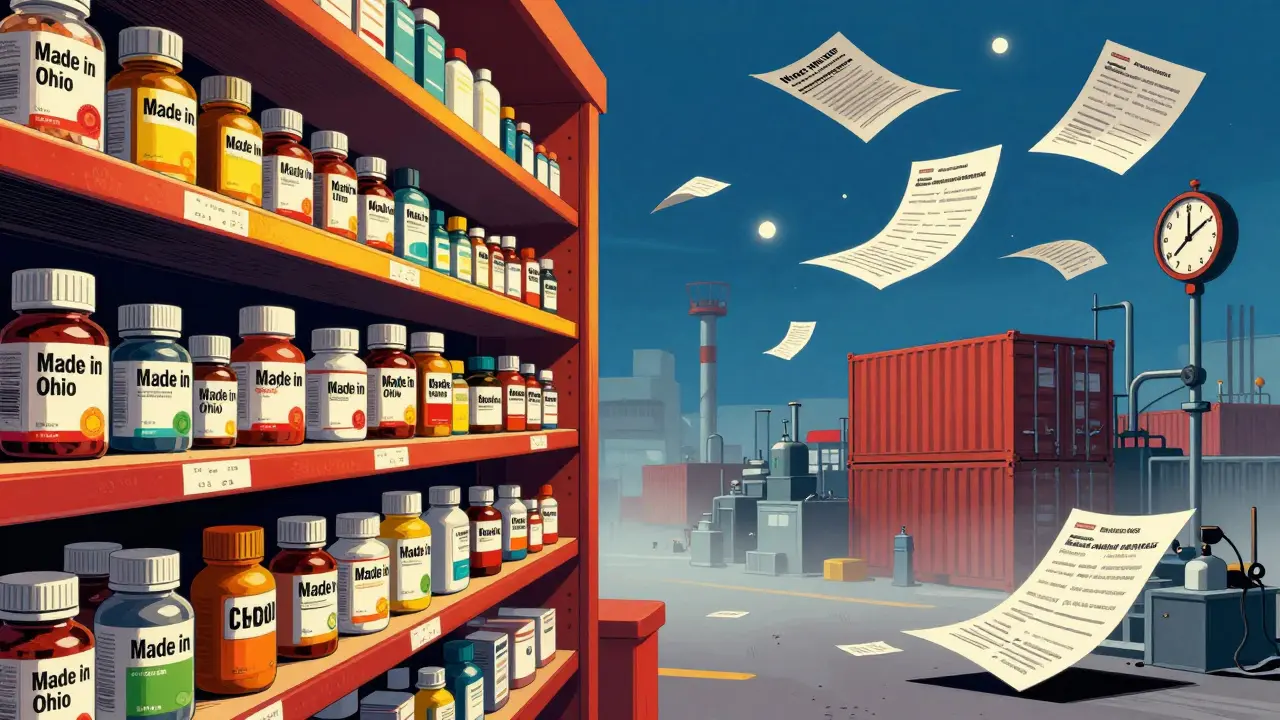
When you’re producing generic medications, every decision matters. Not just the formula. Not just the packaging. But where it’s made. The choice between overseas and domestic manufacturing isn’t just about price. It’s about control, timing, risk, and trust. And in 2026, the old assumption - that overseas is always cheaper and domestic is always slower - is outdated.
Cost Isn’t What It Used to Be
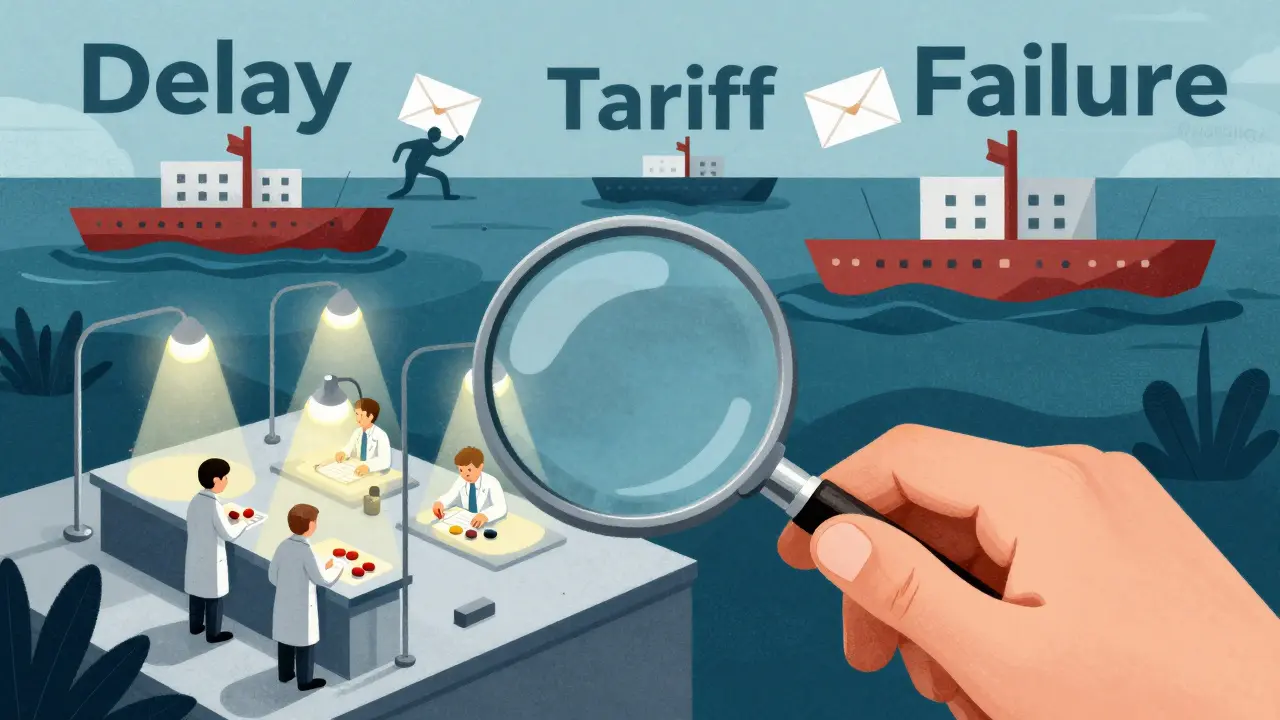
You’ve heard the number: overseas manufacturing is 20-60% cheaper. That used to be true. But today, that gap has narrowed. For many generic drugs, the real cost difference is now closer to 12-15%. Why? Because hidden costs add up fast.Shipping delays? That’s inventory sitting in a warehouse, costing you money every day. Third-party quality inspections? That’s $300-$500 per batch, and you’re not always getting reliable results. Customs paperwork? One missing form can hold up a shipment for weeks. And don’t forget tariffs. Section 301 tariffs on Chinese-made goods can add 7.5% to 25% to your costs, depending on the product.
Domestic production might cost $300 to $3,000 more per unit. But when you factor in reduced inventory holding, fewer delays, and less risk of recalls, the true cost difference shrinks. One company that switched from a Vietnamese manufacturer back to Ohio saw their total landed cost drop by 18% in 18 months - not because materials got cheaper, but because they stopped paying for chaos.
Time Is Your Most Valuable Asset
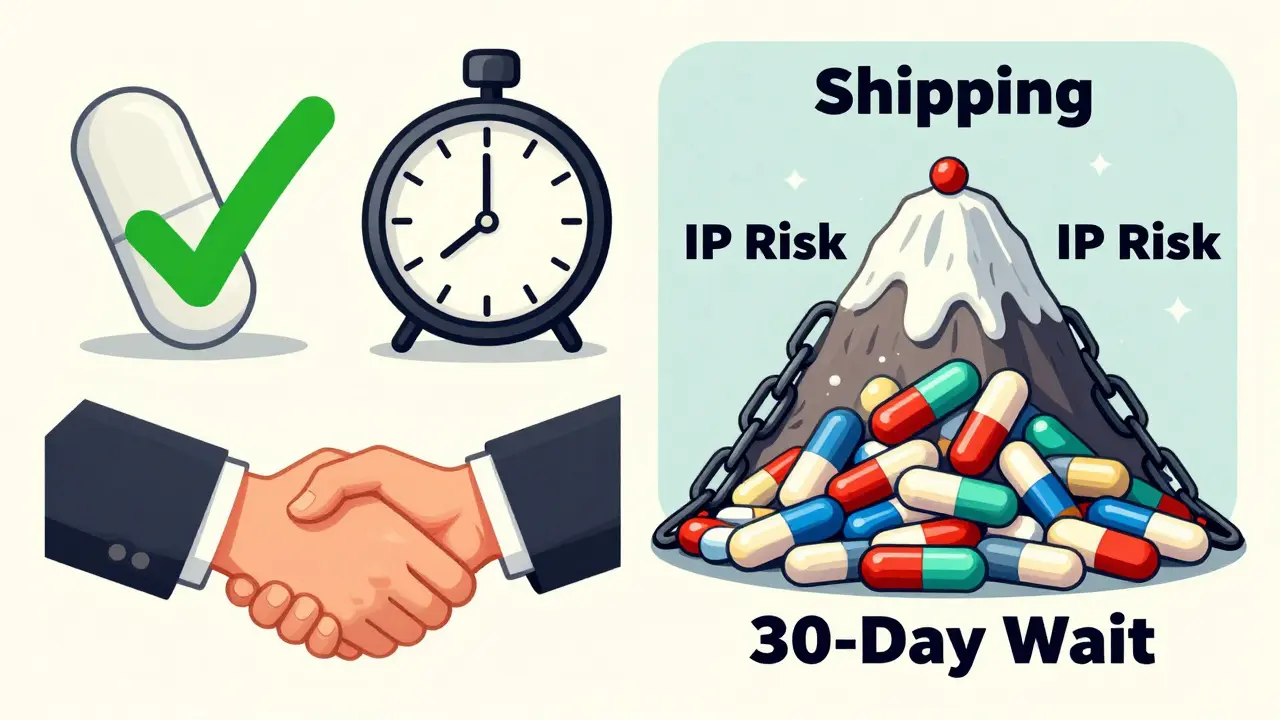
If you need a new batch of generic pills in 30 days, overseas manufacturing won’t save you. It’ll cost you.Domestic production averages 45-60 days from order to delivery. Overseas? That’s 90-135 days. Why? 45-60 days to make it. Then 30-45 days to ship it, clear customs, and get it to your warehouse. And that’s if nothing goes wrong.
Real-world example: A small U.S. pharmacy chain ordered 10,000 units of generic metformin from a factory in Shenzhen. The order was placed in October. By December, they were still waiting. Holiday season hit. The shipment got stuck in a port. They lost $187,000 in sales they could’ve made. They switched to a domestic supplier the next month. Now, they reorder every 45 days - on time, every time.
For generic drugs with tight demand cycles - like seasonal allergy meds or flu treatments - domestic manufacturing isn’t a luxury. It’s a necessity.
Quality Control Isn’t Optional
You can’t inspect a batch of pills through a Zoom call. And third-party inspectors? They’re not always on your side.One Reddit user, ‘FactoryOwner87’, lost $48,000 on a single overseas order because 37% of the pills failed basic potency tests - even though the inspection report said everything was fine. That’s not rare. Trustpilot data shows 68% of negative reviews for overseas manufacturers cite communication issues or quality surprises.
Domestic manufacturers let you walk the floor. You see the machinery. You check the humidity controls. You watch the QC team test samples. You don’t have to guess. And when a problem happens, you’re not waiting 72 hours for a reply. You’re in the room, talking to the shift supervisor, fixing it by lunch.
That’s why 78% of industry experts say direct oversight leads to better quality. Even if some overseas factories are technically compliant, the lack of real-time control increases risk. And in pharma, risk isn’t just financial - it’s patient safety.
Minimum Orders and Flexibility
Generic drug manufacturers often need to run small batches. Maybe it’s a new formulation. Maybe it’s a limited-release version. Maybe you’re testing a new market.Domestic suppliers typically accept orders as small as 100-500 units. Overseas? You’re looking at 1,000-5,000 minimums. That’s a huge barrier for startups or niche products.
One startup used a Yiwu manufacturer to produce 300 units of a new generic antihistamine at $2.10 per unit - way below the $8.75 domestic quote. It worked. They got their prototype out. But they couldn’t scale without tying up $15,000 in inventory. They switched to a domestic partner for volume runs and kept the overseas route only for initial testing.
Flexibility matters. If you need to tweak the dosage, change the coating, or switch packaging, domestic manufacturers can make that happen in 3-5 days. Overseas? You’re looking at 14-21 days. And that’s if they even agree to do it.
Intellectual Property and Compliance
Generic drugs aren’t just copies. They’re engineered to match brand-name drugs exactly. That means precise formulations, exact excipients, and strict bioequivalence testing.Where you make it matters for IP protection. In the U.S., patent infringement is enforceable. In some overseas hubs, product cloning is common. One industry report found product replication risks are 37% higher in certain Asian manufacturing regions.
And compliance? FDA inspections are strict. But if your drug is made overseas, you’re still subject to U.S. standards - and you’re still responsible. If the FDA finds a violation, you’re the one fined. You’re the one recalling product. You’re the one explaining to patients why their meds were unsafe.
Domestic production means you’re operating under the same regulatory system as your customers. No translation gaps. No legal gray zones. No surprise inspections from foreign agencies you don’t understand.
The Hybrid Model Is Winning
The smartest companies aren’t choosing one or the other. They’re using both.Forty-four percent of mid-sized manufacturers now use a hybrid model: make core components or high-risk batches domestically, outsource low-risk, high-volume items overseas. Think of it like this - your flagship generic drug? Made in the U.S. Your bulk packaging? Made in Mexico. Your non-critical accessories? Made in Vietnam.
Mexico is becoming a popular middle ground. Labor costs are 12-15% of U.S. rates, but shipping takes only 7-10 days. It’s close enough for oversight, fast enough for demand spikes, and legally aligned with U.S. standards.
And with the CHIPS Act and Inflation Reduction Act pouring $250 million into domestic manufacturing support, the infrastructure is getting better. More labs. More certified facilities. More skilled workers.
Sustainability and Consumer Expectations
It’s not just about cost and control anymore. It’s about perception.68% of consumers say they’re willing to pay 5-12% more for products made locally. That’s not a niche group. That’s mainstream. And for generic drugs, where trust is everything, that matters.
Domestic production cuts shipping emissions by 62%. Even if a factory in Vietnam is ISO 14001-certified, the carbon footprint of shipping across the Pacific can’t be ignored. And when your brand stands for health, that contradiction sticks out.
Companies that highlight domestic production in their marketing are seeing higher customer retention. It’s not just a cost decision. It’s a brand decision.
What Should You Do?
Here’s how to decide:- Make it domestic if: You need speed, quality control, small batches, regulatory certainty, or brand trust.
- Make it overseas if: You’re producing high-volume, low-risk items, have a strong logistics partner, and can absorb delays.
- Use hybrid if: You want the best of both - control for critical items, savings for volume.
Don’t pick based on what your competitor does. Pick based on what your patients need. And what your business can actually manage.
The global supply chain is more complex than ever. But the answer isn’t to go all-in on one side. It’s to build a smart, balanced strategy - one that protects quality, respects time, and honors your responsibility to the people who rely on your medicine.
Sarah Little
January 2, 2026 AT 06:07Let’s be real-overseas manufacturing isn’t just about cost, it’s about liability arbitrage. You’re outsourcing compliance risk, not just labor. FDA audits don’t care if your supplier in Bangladesh has ‘certified’ staff if their humidity controls are calibrated with a smartphone app. And don’t get me started on the ‘quality reports’ that look like they were generated by a bot trained on 2010 WHO guidelines.
Domestic isn’t perfect, but at least when your QC lead walks over and says ‘this batch smells off,’ you can actually shut it down before it hits the warehouse. Overseas? You get a PDF. And a prayer.
innocent massawe
January 2, 2026 AT 15:09I work in pharma logistics in Lagos. We’ve seen both sides. Overseas = cheaper, but chaotic. Domestic = slower to scale, but predictable. The hybrid model? That’s the future. Not because it’s patriotic. Because it’s practical. 🤝
veronica guillen giles
January 4, 2026 AT 10:50Oh wow. A 12-15% cost difference? How quaint. I guess we’re all just supposed to be thrilled that our generic meds aren’t being manufactured in a basement with a 3D printer and a stack of expired ibuprofen labels anymore. 🙄
Meanwhile, back in the real world, people are choosing between insulin and rent. But hey-let’s all sip our artisanal cold brew while we ‘optimize our supply chain.’
Ian Ring
January 5, 2026 AT 12:50Interesting analysis. I appreciate the data-driven approach-especially the landed cost recalculations. However, I must note that the 68% consumer willingness-to-pay-more stat needs context: is that across all demographics? Or just urban, middle-class Americans? Also, carbon footprint claims require lifecycle analysis-shipping isn’t the only variable. Still, solid points. 👍
erica yabut
January 7, 2026 AT 05:15Domestic manufacturing? Please. You think the FDA is some holy guardian of truth? They’re a bureaucratic circus run by ex-pharma lobbyists who still have their corporate parking passes. Meanwhile, overseas factories are churning out bioequivalent generics with better QC than half the ‘Made in USA’ crap that gets labeled ‘pharmaceutical grade’ just because it passed a 30-minute audit in a climate-controlled room with a $200,000 camera.
And don’t even get me started on ‘brand trust.’ You think patients care if their metformin was made in Ohio or Odisha? They care if it works. And if it’s cheaper, they’ll take the pill-even if it came from a factory where the workers sleep in the packaging bay.
Tru Vista
January 8, 2026 AT 02:14Overseas is always cheaper. Period. You're just now noticing? Also, 'domestic' doesn't mean 'safe'-remember the compounding pharmacy scandals? And who cares about carbon footprint? We're talking pills, not Teslas. 🤷♀️
Vincent Sunio
January 8, 2026 AT 18:32The assertion that ‘the old assumption is outdated’ is not only empirically dubious but ideologically motivated. The data presented selectively omits critical variables: currency volatility, intellectual property enforcement disparity, and the systemic inefficiencies of U.S. labor markets. Moreover, the ‘hybrid model’ is not innovation-it is capitulation. A rational actor would optimize for marginal cost efficiency, not performative nationalism. The emotional framing of ‘patient safety’ is a rhetorical sleight-of-hand to mask protectionist agendas.
JUNE OHM
January 10, 2026 AT 09:10They don’t want you to know this-but the FDA is in bed with Big Pharma and the Chinese government. They let counterfeit pills in through ‘approved’ overseas factories so they can push you toward expensive brand-name drugs. And now they’re pushing this ‘domestic = safe’ nonsense to scare you into paying more. 🇺🇸🔥
Meanwhile, the real drug crisis? The ones they’re hiding. You think your ‘Made in Ohio’ pills are clean? Check the fillers. They’re all the same. Just repackaged. 🤫💊
Philip Leth
January 10, 2026 AT 09:35Man, I worked at a generic lab in Chennai for three years. The truth? Some of the best QC I’ve ever seen was overseas. Not all factories are sketchy. Some have ISO 13485, automated blister lines, and engineers who studied at IIT. But yeah-communication? Yeah, that’s a nightmare. Time zones, language gaps, ‘yes’ meaning ‘maybe.’
Still, I wouldn’t trash the whole system. Just pick your partners like you’d pick a surgeon. Ask for audits. Visit. Don’t just trust a PDF.
Angela Goree
January 11, 2026 AT 20:06Domestic manufacturing is the only way to protect American jobs-and American lives! We can’t let foreign nations control our medicine supply chain! If a pill fails, who do we sue? A company in Vietnam? We need to fund more U.S. plants! The government must mandate 80% domestic production! 🇺🇸✊
And stop with this ‘hybrid’ nonsense-either you’re with us or you’re with the cartels!
Shanahan Crowell
January 12, 2026 AT 19:06Love this breakdown. Real talk: the ‘cost savings’ myth has been killing small manufacturers for years. I’ve seen companies go under because they bet on ‘cheaper overseas’ and then got stuck with a 6-month delay and a batch that failed potency tests. The real win? Predictability.
Hybrid is the future. Domestic for the critical stuff-like insulin, epinephrine, antivirals. Overseas for the stuff that’s just… there. Like vitamin B12 or generic aspirin.
And if you’re still using ‘lowest bid’ as your main metric? You’re not a manufacturer-you’re a gambler.
Shruti Badhwar
January 13, 2026 AT 03:34As a supply chain analyst in Mumbai, I must clarify: the cost differential is not as narrow as claimed. Labor and utilities in India remain 70-80% lower than U.S. levels. However, the hidden costs you mention-logistics, customs, compliance-are indeed substantial. The hybrid model is not merely strategic; it is economically optimal. Yet, the emotional framing of ‘trust’ and ‘national pride’ obscures the core issue: access. In developing nations, generic drugs are life-saving. Restricting production to high-cost regions risks pricing out millions. The solution lies not in isolation, but in global standards and transparency.