
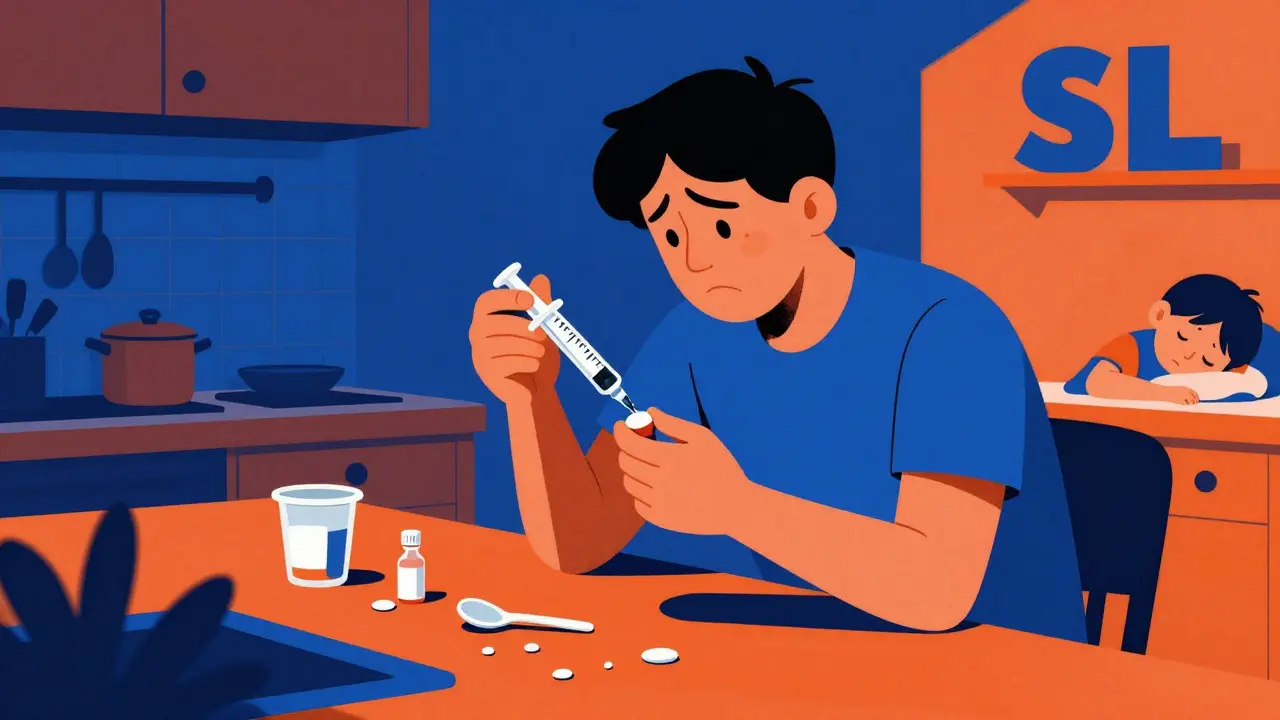
Every year, thousands of people - especially children - get the wrong amount of liquid medicine because someone used a kitchen spoon, misread a label, or didn’t have the right tool. These aren’t small mistakes. A 2023 study in the Journal of Pediatrics found that 80% of pediatric home medication errors involve liquid doses that are too high or too low. In emergency rooms, nearly half of caregivers give doses that are more than 20% off from what was prescribed. Some go over 40%. That’s not just risky - it can be deadly.
Why Liquid Medications Are So Easy to Get Wrong
Liquid meds are tricky because they’re measured in tiny amounts. A child’s dose might be 2.5 mL. An adult’s might be 15 mL. But the tools we use to measure them? Often outdated, confusing, or just plain wrong.Here’s what goes wrong:
- People use teaspoons or tablespoons from the kitchen - even though a teaspoon can hold anywhere from 3 to 7 mL depending on the spoon.
- Dosing cups have unclear markings, and people read them at an angle, making the level look higher or lower than it is.
- Prescriptions still say "1 tsp" instead of "5 mL" - even though the American Academy of Pediatrics banned that practice in 2015.
- Look-alike bottles and labels make it easy to grab the wrong medicine, especially in a rush.
- Pharmacists don’t always hand out a proper measuring device with the prescription.
And it’s not just parents. Nurses, doctors, and even pharmacy techs make these mistakes. The Institute for Safe Medication Practices (ISMP) calls wrong-dose liquid errors one of the top 10 persistent dangers in healthcare. The numbers don’t lie: 38% of errors happen when the doctor writes the order, 32% when the pharmacy fills it, and 30% when it’s given to the patient.
The #1 Fix: Ditch the Cup, Use the Syringe
The single most effective way to prevent wrong doses? Use an oral syringe - every time.A 2016 Yale study published in Pediatrics found that oral syringes are 37% more accurate than dosing cups. For doses under 1 mL, syringes with 0.1 mL graduations cut error rates in half. For doses between 1 and 5 mL, 0.5 mL markings make it easy to measure precisely. NIH testing in 2022 showed syringes are 94% accurate for a 2.5 mL dose. Dosing cups? Only 76%. Household spoons? Just 62%.
And it’s not just about accuracy - it’s about clarity. Oral syringes have one scale: milliliters. No confusing "tsp," "tbsp," or "cc." Just mL. That’s why the American Academy of Family Physicians and the American Society of Health-System Pharmacists now say: never give liquid medicine with a cup. Always use a syringe.
If you’re a parent or caregiver, ask for an oral syringe every time you pick up a liquid prescription. If the pharmacy doesn’t give you one, ask why. Most pharmacies stock them for under $1 each. If they say no, ask to speak to the pharmacist. You’re not being difficult - you’re protecting your child.
What the Pharmacy Should Do - And What They Often Don’t
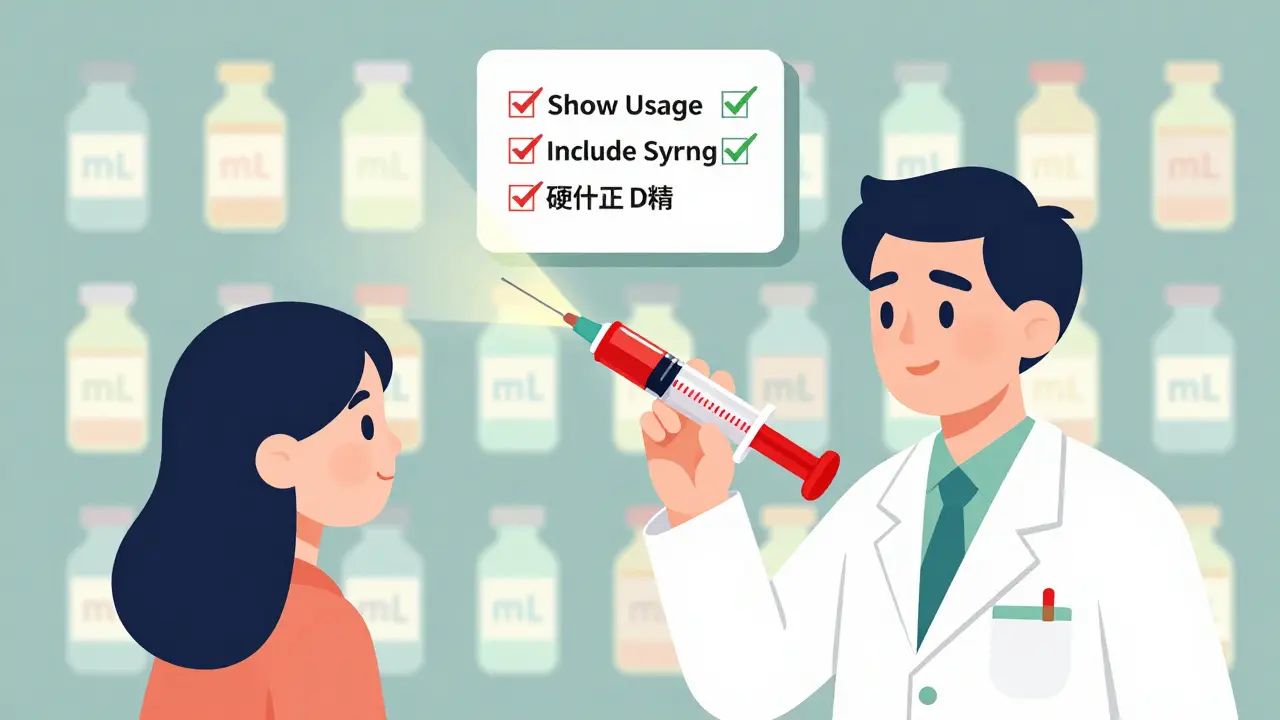
Pharmacies are on the front lines. They’re the last checkpoint before the medicine reaches the patient. But too often, they skip the basics.Here’s what a pharmacy should do every time:
- Dispense the liquid in an amber-colored bottle with bold, clear labeling: "FOR ORAL USE ONLY." (ANSI Z535.4-2011 standard)
- Include a measuring device - always an oral syringe - with the prescription.
- Print the dose in milliliters only. No teaspoons. No tablespoons. No "cc."
- Label the syringe with the exact dose: "Give 3.5 mL by mouth every 6 hours."
- Explain how to use it. Show the caregiver. Don’t just hand it over.
According to HealthyChildren.org, 82% of caregivers prefer syringes - but only 54% actually get them. That gap is dangerous. And it’s not because pharmacies don’t have them. It’s because they don’t prioritize it.
There’s a reason some hospitals are changing. Kaiser Permanente started requiring oral syringes with every pediatric liquid prescription. Result? A 92% drop in dosing errors. That’s not magic. That’s policy.
Technology Can Help - But Only If It’s Used Right
In hospitals and clinics, technology is making a difference - if it’s fully adopted.Computerized physician order entry (CPOE) systems with built-in dose-checking flags can catch 58% of wrong doses before they’re written. If a doctor tries to order 10 mL of a medicine that should be 2.5 mL for a 10-pound child, the system should scream, "Are you sure?" Many don’t - or they’re turned off because they "cause too many alerts."
Barcode medication administration (BCMA) systems scan the patient’s wristband and the medicine before giving it. That cuts errors by 48%. But only if every single dose is scanned. If a nurse skips the scan because they’re rushed, the system fails.
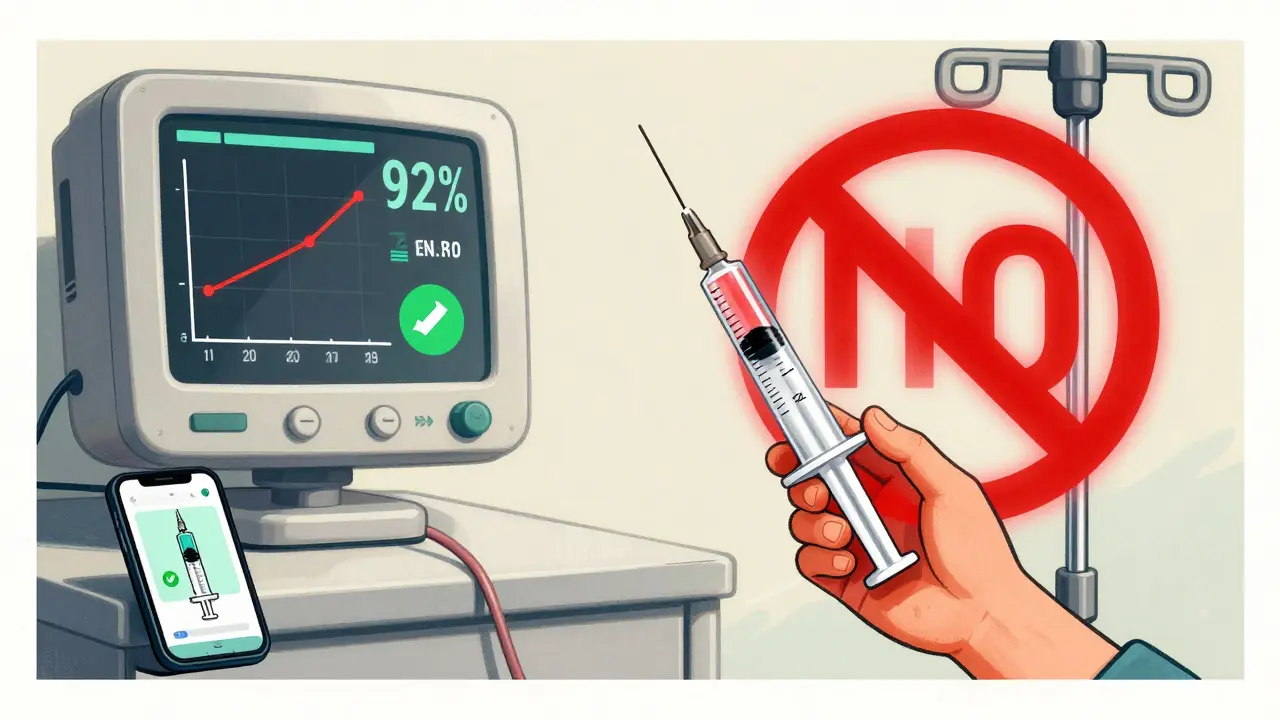
And then there’s ENFit. This is a big one. Since 2016, the international standard for enteral (tube) feeding connectors has been ENFit - a design that physically won’t connect to IV lines. Before ENFit, a feeding tube could accidentally plug into an IV, and a child could get a full bottle of medicine directly into their bloodstream. That’s fatal. Hospitals that switched to ENFit saw wrong-route errors drop by 98%. But only 42% of U.S. hospitals have fully adopted it. Why? Cost. Training. Resistance.
It’s not just about buying new equipment. It’s about changing culture. Every nurse, pharmacist, and doctor needs to understand: if it doesn’t snap into ENFit, it doesn’t belong in that patient.
What You Can Do at Home - Right Now
You don’t need a hospital budget to prevent a wrong dose. Here’s what you can do today:- Always ask for an oral syringe. Don’t accept a cup. Don’t accept a dropper unless it has clear mL markings.
- Never use a kitchen spoon. Even if the label says "1 tsp," measure it as 5 mL with your syringe.
- Double-check the dose. If the prescription says "5 mL" and the syringe says "5 mL," count the lines. Is it exactly on the line? Don’t guess.
- Write it down. Keep a log: time, dose, medicine name. If you’re giving it every 4 hours, write it on your phone or a sticky note.
- Ask the pharmacist to show you how to use it. If they don’t offer, ask. Say: "Can you please show me how to measure this correctly?"
And if you’ve ever used a spoon? You’re not alone. A Reddit thread with over 1,200 parents revealed 68% admitted to using kitchen spoons at least once. 41% said they’d made a dosing error because of it. The good news? Once they switched to syringes, 94% said they felt much safer.
What’s Changing in 2026 - And Why It Matters
The rules are tightening. In 2024, the FDA proposed new rules requiring all over-the-counter liquid medicines to come with a dosing device that meets ASTM F3100-23 standards - meaning metric-only markings, clear labeling, and a design that prevents misuse.By 2026, all certified electronic health records in the U.S. must include automatic pediatric dose-checking. That means if a doctor tries to order a dose that’s too high for a child’s weight, the system won’t let them proceed without a second review.
And new tech is on the horizon: smartphone apps that use your phone’s camera to verify the dose in the syringe, and RFID-tagged syringes that talk to hospital systems to confirm the right drug, right dose, right patient. These aren’t sci-fi - they’re in pilot programs at Boston Children’s and Johns Hopkins, with error reductions over 85%.
But none of this matters if we keep using spoons.
Final Thought: This Isn’t Just About Tools - It’s About Trust
Preventing wrong-dose errors isn’t just about buying syringes or upgrading hospital systems. It’s about building trust - between doctors and patients, pharmacists and families, nurses and caregivers.When a pharmacist takes 90 seconds to show you how to use the syringe, you feel seen. When a nurse scans the barcode even when she’s tired, you feel safe. When the label says "3.5 mL" and nothing else, you don’t have to guess.
Every time you choose a syringe over a spoon, you’re not just measuring medicine - you’re protecting a life. And that’s worth every extra second, every phone call, every question you ask.
Alexandra Enns
January 24, 2026 AT 16:12Okay but let’s be real - if your pharmacist doesn’t hand you a syringe, they’re literally endangering children. I’ve seen pharmacists in Canada act like asking for a syringe is a personal insult. Like, no, I’m not being difficult - I’m not letting my kid become a statistic. The fact that this is still even a debate in 2024 is criminal.
Marie-Pier D.
January 25, 2026 AT 06:25Thank you for this. 🙏 I used a spoon once with my twins - I thought it was fine because it was "a teaspoon." Then I read this study and nearly cried. Got syringes, marked them with tape, and now I feel like I’m actually doing my job as a parent. You’re not overreacting - you’re being responsible. 💙
asa MNG
January 25, 2026 AT 15:39bro why are we even talking about this?? i just use the cap on the bottle its got lines right?? why do i need a $1 syringe?? also my kid’s fine lol 🤷♂️
Sushrita Chakraborty
January 25, 2026 AT 21:06It is imperative to underscore that the persistence of non-standardized dosing devices constitutes a systemic failure in public health communication. The conflation of household measurements with clinical precision is not merely an oversight - it is an institutional negligence that disproportionately affects low-literacy populations. The adoption of metric-only labeling, coupled with mandatory provision of calibrated syringes, is not optional; it is a moral imperative.
Sawyer Vitela
January 27, 2026 AT 09:5280% error rate. 37% more accurate with syringes. 92% drop at Kaiser. You’re welcome.
Vatsal Patel
January 29, 2026 AT 07:49So we’ve reduced children’s dosing errors to a technical problem, like fixing a leaky faucet. But what about the parents who are exhausted, poor, or illiterate? You hand them a syringe and say "use this" - but if they can’t read mL, or don’t have light to see the markings, or their hands shake from stress - what then? The real fix isn’t the tool. It’s dignity. It’s time. It’s care. But no one wants to pay for that.
Himanshu Singh
January 30, 2026 AT 12:51Hey, I used to think syringes were too much hassle too - until my nephew almost got a double dose because the cup was misread. Now I keep 5 syringes in my medicine cabinet. I even give them to friends. It’s not about being paranoid - it’s about being prepared. You got this. One drop at a time. 💪❤️
Jamie Hooper
February 1, 2026 AT 02:17obviously the answer is syringes but also… like… why is the american healthcare system so obsessed with making everything a chore? i just want to give my kid medicine without feeling like i’m doing a chemistry lab. can’t we just have magic pills that taste like gummy bears? 🤔
Husain Atther
February 2, 2026 AT 19:47This is one of the most thoughtful and practical guides I’ve read in a long time. It’s rare to see such a clear call to action without blame or fear-mongering. The data is compelling, the solutions are simple, and the tone is compassionate. Thank you for writing this. It will save lives.
Izzy Hadala
February 3, 2026 AT 18:30While the empirical evidence supporting the use of oral syringes is robust, one must consider the ecological validity of the studies cited. The Yale and NIH trials were conducted in controlled environments with trained observers. In real-world home settings, cognitive load, lighting conditions, and caregiver fatigue may significantly attenuate the observed accuracy gains. Further longitudinal, ethnographic research is warranted.
Don Foster
February 4, 2026 AT 20:37Everyone’s acting like this is a revelation but let’s be honest - if you can’t measure 5 mL you probably shouldn’t be parenting. Also stop blaming pharmacists they’re just following the system that’s broken. Fix the system not the spoon