
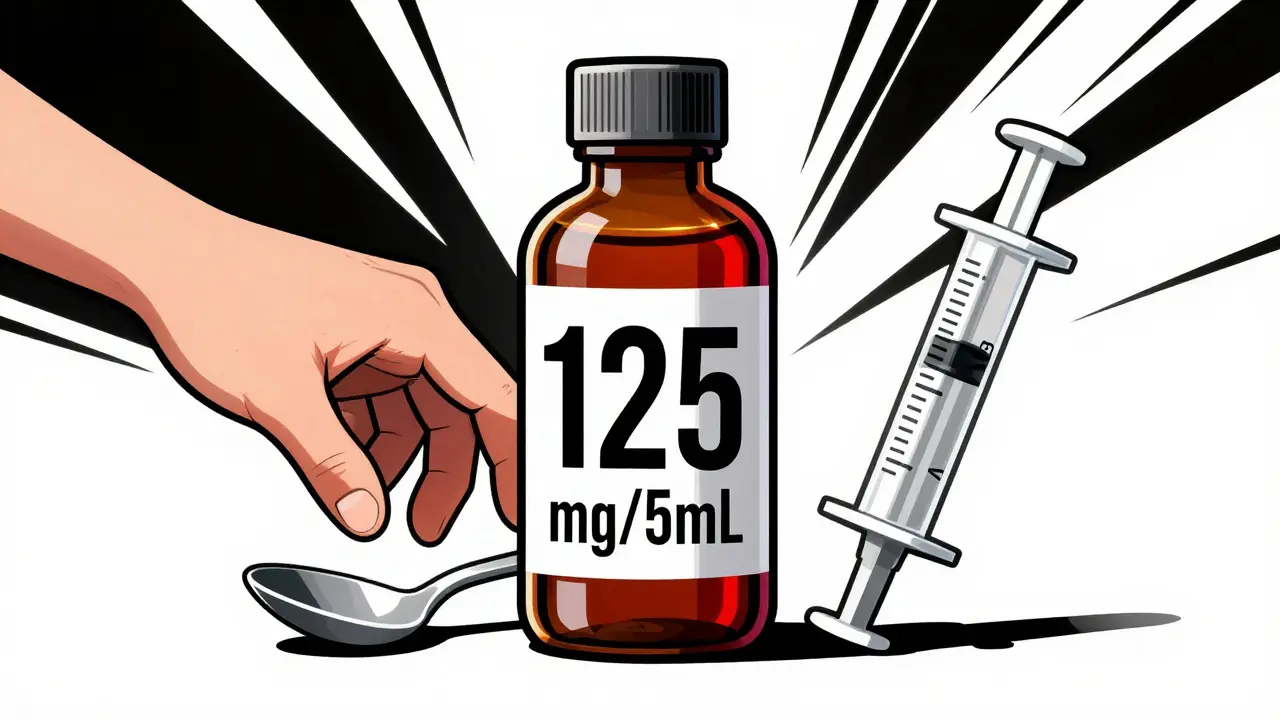
Getting the right dose of liquid medicine isn’t just about following instructions-it’s about understanding what’s written on the label. A simple mistake, like confusing 5 mL with 50 mL, can lead to serious harm. Every year, over a million people in the U.S. are injured because of errors in liquid medication dosing, according to the FDA. The good news? The system is getting better. But you still need to know how to read the label correctly.
What’s on the label? Three things you must see
Every liquid prescription label has three critical pieces of information. If any of these are missing or unclear, ask your pharmacist before taking the medicine.
- Total container volume: This tells you how much liquid is in the bottle-usually 118 mL, 237 mL, or sometimes 30 mL for infants. This is not the dose. It’s just the total amount in the bottle.
- Concentration: This is the most important part. It looks like 125 mg/5 mL. That means every 5 milliliters of liquid contains 125 milligrams of medicine. If your dose is 250 mg, you need to take 10 mL-not 5 mL.
- Dosage instructions: This says how much to take and how often. Example: Take 10 mL twice daily. Always match this number to the concentration.
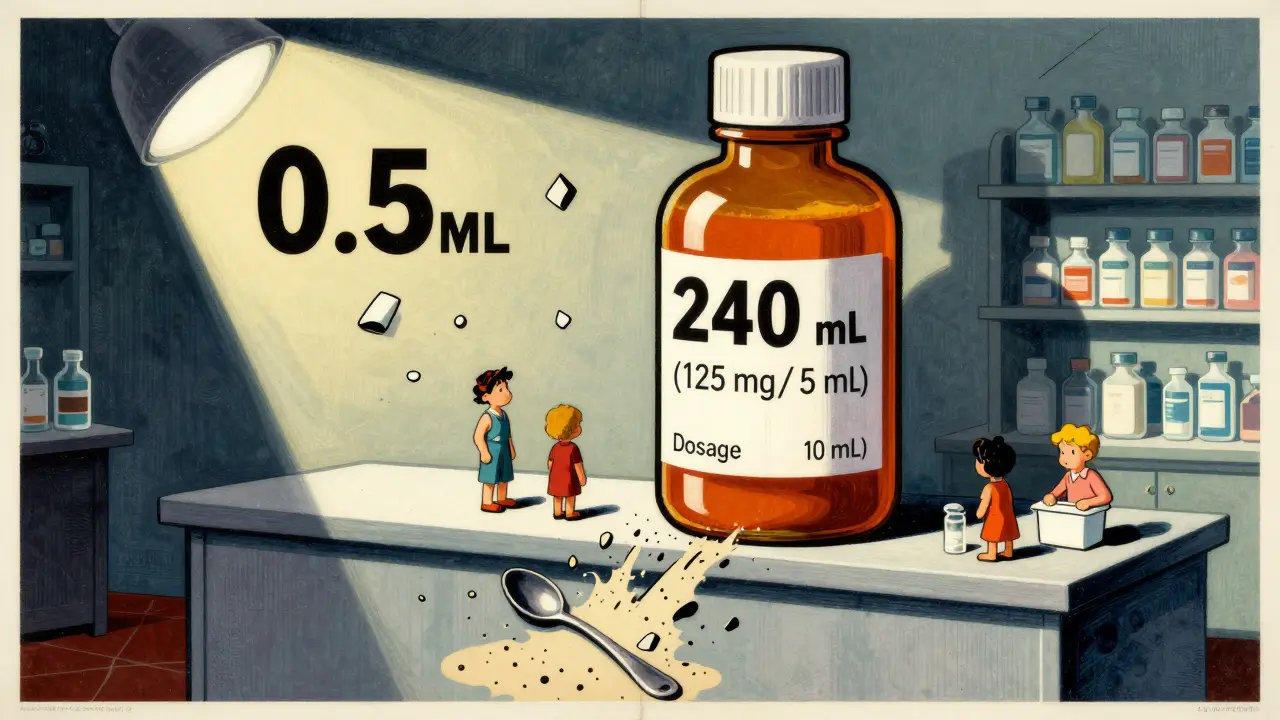
People often mix up the total volume with the dose. Seeing “240 mL” on the bottle and thinking that’s the dose? That’s a common mistake. The 240 mL is just how much medicine the bottle holds. The dose is always tied to the concentration.
Why milliliters (mL) matter-no more teaspoons
Old labels used teaspoons (tsp) and tablespoons (tbsp). That’s gone. Today, all legal prescriptions must use milliliters (mL) only. Why? Because household spoons are wildly inaccurate.
A 2019 Consumer Reports study found that a kitchen teaspoon held anywhere from 2.5 mL to 7.5 mL. A tablespoon? It ranged from 5 mL to 20 mL. That’s a 200% difference. If you think you’re giving “1 teaspoon,” you might be giving 3 mL-or 7 mL. That’s a dangerous swing.
By contrast, a 5 mL measuring device is exact. The NCPDP standard, adopted by 68% of U.S. pharmacies as of 2021, bans all non-metric units. CVS, Walgreens, and Rite Aid now follow this rule. Even if your doctor wrote “1 tsp,” the pharmacy must convert it to 5 mL on the label.
And here’s the catch: even with mL on the label, people still grab spoons. A 2021 Nationwide Children’s Hospital study found that 23% of low-income families still use kitchen utensils. Don’t be one of them. Always use the device that came with the medicine.
Decimal points and zeros: tiny marks, huge consequences
Two tiny rules prevent deadly mistakes:
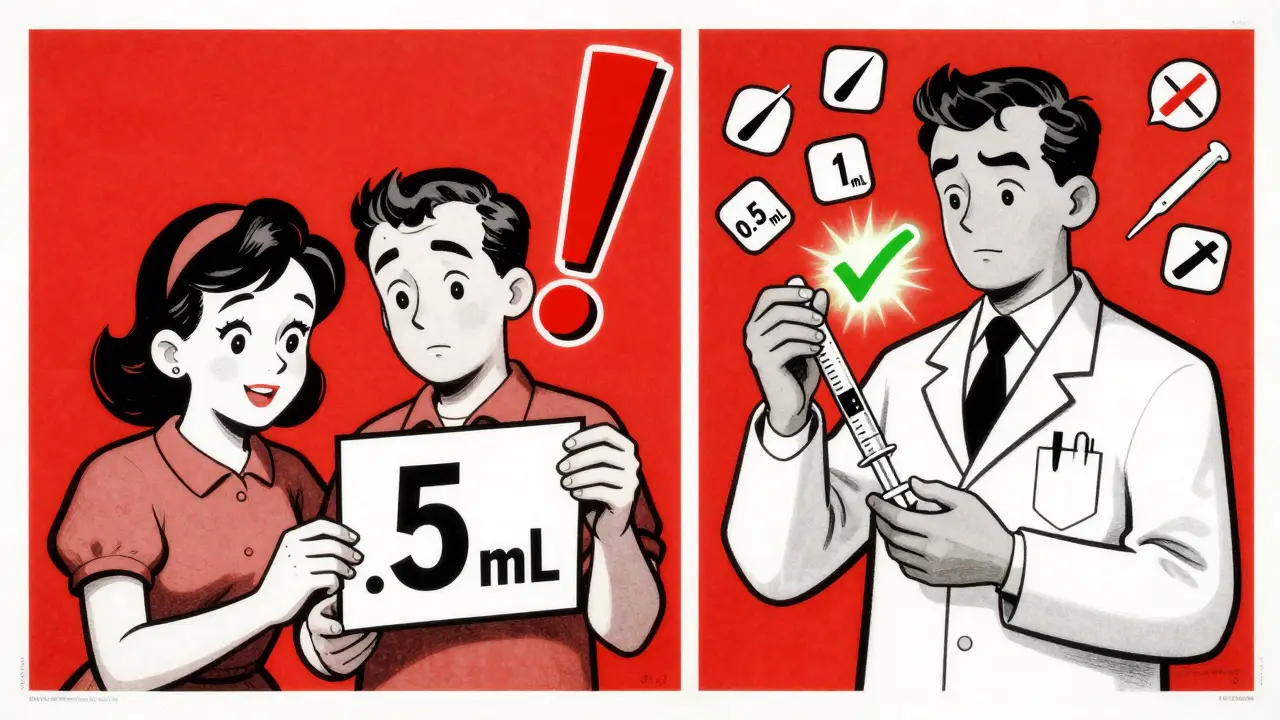
- Always use a leading zero: Write 0.5 mL, never .5 mL.
- Never use a trailing zero: Write 5 mL, never 5.0 mL.
Why? Because a dot can be missed. If a label says “.5 mL,” someone might read it as “5 mL.” That’s a tenfold overdose. A 2018 Johns Hopkins study showed that using leading zeros cut these errors by 47%.
And trailing zeros? They look like decimals. If a label says “5.0 mL,” someone might think it’s precise to the tenth-and accidentally give 50 mL. That’s why it’s always just “5 mL.”
Also, check spacing. It should be “5 mL,” not “5mL.” That tiny space helps your brain separate the number from the unit.
How to use the dosing device
The bottle should come with a syringe, cup, or dropper. Never use a kitchen spoon. Here’s how to use each correctly:
- Syringe: Pull the plunger to the exact line matching your dose. Don’t push air out first-just draw up the liquid. Hold it straight, eye level, and check the line. If it’s 2.5 mL, the top of the plunger should be at the 2.5 mark.
- Cup: Pour slowly until the liquid reaches the correct line. Put it on a flat surface. Bend down to eye level. Never hold it in the air.
- Dropper: Squeeze gently to draw up the liquid. Look at the dropper’s markings. Some go as low as 0.1 mL. If your dose is 0.8 mL, don’t guess-count the lines.
Pro tip: If the device has both mL and tsp markings, trust the mL. The tsp markings are there for reference, not precision. Many devices show both because older users are used to teaspoons-but the mL line is what matters.
What if the label is confusing?
Even with standards, labels can still be unclear. Here’s what to look out for:
- Too small print: The concentration and dose must be printed in at least 10-point font. If it’s hard to read, ask for a larger-print label.
- Missing concentration: If the label says “Take 10 mL” but doesn’t say “125 mg/5 mL,” call the pharmacy. That’s a violation of FDA guidelines.
- Multiple strengths: Some medicines come in different strengths-like 100 mg/5 mL and 200 mg/5 mL. Make sure the label matches the bottle color and your doctor’s instructions.
One of the most common errors? Confusing the concentration. Say the label says “240 mg/5 mL” and your dose is “120 mg.” You might think: “120 is half of 240, so I’ll take half the volume.” That’s wrong. Half the dose means half of 5 mL-that’s 2.5 mL. Not 2.5 mL of liquid, but 2.5 mL of the 240 mg/5 mL solution.
If you’re unsure, ask: “Can you show me how to measure this?” A 2021 study found that parents who got a live demonstration from a pharmacist made zero dosing errors. Those who didn’t? Nearly 40% got it wrong.
What to do if you make a mistake
If you accidentally gave the wrong dose:
- Don’t panic. Don’t give another dose.
- Call your pharmacist or poison control immediately. In the U.S., call 1-800-222-1222.
- Keep the bottle and device. They’ll need to see what was written and what you used.
Most errors don’t cause harm if caught early. But waiting to act can make things worse. If your child is sleepy, vomiting, or acting strangely after a dose, seek help right away.
How pharmacies are improving
Pharmacies aren’t just printing labels-they’re redesigning them. In January 2023, NCPDP released Version 2.0 of its standard. Now, labels must:
- Use high-contrast black text on white background
- Limit font size to no smaller than 10-point
- Include the concentration in bold
Some pharmacies are testing QR codes. Scan it, and a short video shows you how to measure the dose. Amazon Pharmacy and McKesson’s Medly system already use this. Early results show 28% fewer calls about dosing confusion.
The FDA is also pushing for pictograms-simple images showing how to use the syringe. A 2022 JAMA Internal Medicine study found that adding pictures reduced errors by 37%.
But progress isn’t equal. Hospital pharmacies are 92% compliant. Independent pharmacies? Only 58%. If you go to a small pharmacy and the label looks outdated, speak up. Ask if they follow NCPDP standards.
Bottom line: Measure smart, not guess
You don’t need to be a doctor to read a liquid prescription label. You just need to know three things:
- Find the concentration (e.g., 125 mg/5 mL).
- Match the dose (e.g., 250 mg) to the volume (10 mL).
- Use the device that came with the medicine-no spoons.
And if you’re ever unsure? Ask. Pharmacists are trained to explain this. Don’t be shy. A quick question now can prevent a hospital visit later.
Medication errors are preventable. You have the power to stop one-just by reading the label the right way.
Why do liquid medicine labels now only use mL instead of teaspoons?
Household teaspoons and tablespoons vary too much in size-anywhere from 2.5 mL to 7.5 mL for a teaspoon. That inconsistency leads to dangerous overdoses or underdoses. The NCPDP and FDA mandated mL because it’s precise, universal, and reduces errors by over 50%. Using mL removes guesswork and makes dosing safer, especially for children.
What should I do if the dosing device doesn’t have the exact line for my dose?
If your dose is 2.8 mL but the syringe only has marks at 2.5 and 3.0 mL, round to the nearest mark. In most cases, 2.8 mL is close enough to 3 mL-but always check with your pharmacist. For infants or high-risk medications, they may give you a different device or prescribe a different strength to match the measuring tool. Never estimate between lines without professional advice.
Can I use a kitchen measuring spoon if I don’t have the right device?
No. Even if you think your spoon is “about right,” it’s not reliable. A 2018 Consumer Product Safety Commission study found that household spoons varied by up to 200%. A teaspoon could hold 2 mL or 7 mL. That’s a 3.5x difference. If you lost the device, call your pharmacy. They’ll give you a new one for free. Never risk it with a spoon.
Why is it important to write 0.5 mL and not .5 mL?
A decimal point can be missed or smudged. If a label says “.5 mL,” someone might read it as “5 mL,” leading to a tenfold overdose. Using “0.5 mL” forces clarity-the leading zero acts as a visual cue that this is less than one. Studies show this simple change cuts dosing errors by nearly half.
How do I know if my pharmacy is following the right standards?
Check the label. It must use mL only, include a leading zero (0.5 mL), avoid trailing zeros (5 mL not 5.0 mL), and clearly state the concentration (e.g., 125 mg/5 mL). If it says “tsp” or “tbsp,” or if the concentration is missing, ask if they follow NCPDP guidelines. Major chains like CVS and Walgreens comply. Smaller pharmacies may not. If in doubt, request a printed handout or ask for a demonstration.
Brandie Bradshaw
February 27, 2026 AT 17:58The precision of milliliters isn't just about numbers-it's about epistemological clarity. When we replace ambiguous, culturally variable units like teaspoons with metric precision, we're not merely standardizing measurement-we're rejecting subjective interpretation as a basis for life-or-death decisions. The decimal point isn't a punctuation mark; it's a boundary between life and catastrophe. A trailing zero isn't a typo-it's a silent killer. We must treat medication labels as sacred texts, where every character carries ontological weight. No room for whimsy. No tolerance for negligence. This isn't healthcare-it's a moral imperative.
Vikas Meshram
March 1, 2026 AT 17:14Umm... you forgot to mention that in India we use mL too but also rely on local terms like 'chammach' or 'botali' because most people don't have syringes. Also, '5mL' without space is common in handwritten scripts here. And why are you assuming everyone has access to a measuring cup? Many families use clean, washed spoons because pharmacies don't provide devices. You're preaching to a privileged audience. Also, '0.5' vs '.5'-in handwritten prescriptions, the zero is often omitted. It's not a mistake-it's context.
Ben Estella
March 3, 2026 AT 15:41Look, I get it. You want people to be careful. But let’s be real-this whole system is overengineered. You’re telling me a mom with three kids and a job can’t just eyeball a teaspoon? That’s not safety, that’s elitism. And don’t even get me started on the QR code nonsense. My grandma can’t scan a code. She needs someone to show her. The real problem? Pharmacies won’t take five seconds to explain it. They just hand you the bottle and say ‘read the label.’ Meanwhile, the same pharmacy sells candy next to the insulin. This isn’t about mL vs tsp-it’s about America treating people like dumb robots instead of humans.
Jimmy Quilty
March 3, 2026 AT 23:35Did you know the NCPDP standard was pushed by Big Pharma to eliminate competition from generic manufacturers? The 'mL-only' rule? It forces patients to buy expensive dosing devices that only work with specific bottles. Meanwhile, the same companies patent syringes with proprietary tips. And the 'leading zero' rule? That's not about safety-it's about tracking. Every label with '0.5 mL' has a microcode embedded in the print pattern. Your pharmacy scans it. They know when you refill. They know when you skip doses. They sell that data. The FDA? They're in bed with them. You think you're being safe? You're being tracked. And they're billing you for it.
Sneha Mahapatra
March 5, 2026 AT 00:06I really appreciate how detailed this is. As someone who’s given medicine to a sick child at 3 a.m. with no sleep, I can say-this clarity saves lives. But I also think we need to meet people where they are. Not everyone has access to a syringe. Not everyone speaks English. Not everyone can read 10-point font. Maybe the real innovation isn’t just the label-it’s the community health worker who sits with the family, shows them with their own hands, and says, 'This line right here-that’s your child’s dose.' Sometimes, the most precise tool isn’t the syringe. It’s compassion.
bill cook
March 5, 2026 AT 21:44I gave my kid 10 mL once because I thought the '5 mL' was the total bottle size. I didn’t even know concentration was a thing. I just read 'take 10 mL' and did it. I almost lost her. Now I keep a highlighter on the label. I underline the concentration. I write the dose next to it in big letters. I don’t trust anything. Not the pharmacist, not the label, not even my own eyes. I’m not paranoid. I’m just done being a statistic.
Angel Wolfe
March 7, 2026 AT 02:09They want you to use mL? That’s because they’re preparing for the next phase-microchip implants in every medicine bottle. The QR code? It’s not for education. It’s for surveillance. The FDA doesn’t care if you live or die-they care if you’re compliant. And that 'leading zero'? That’s a data tag. They’re tracking every dose you take. You think your child’s asthma inhaler is safe? It’s sending a ping to a server every time you use it. The government doesn’t need your permission. They just need your trust. And you’re giving it away with every '0.5 mL' you read.
Sophia Rafiq
March 7, 2026 AT 23:02Use the device. No spoons. 0.5 not .5. 5 not 5.0. That’s it. Seriously. That’s all you need to remember. Everything else is noise. If you’re stressed, just do those three things. The rest? The system’s trying. It’s not perfect. But if you follow the basics? You’re already ahead of 90% of people. Chill. You got this.