
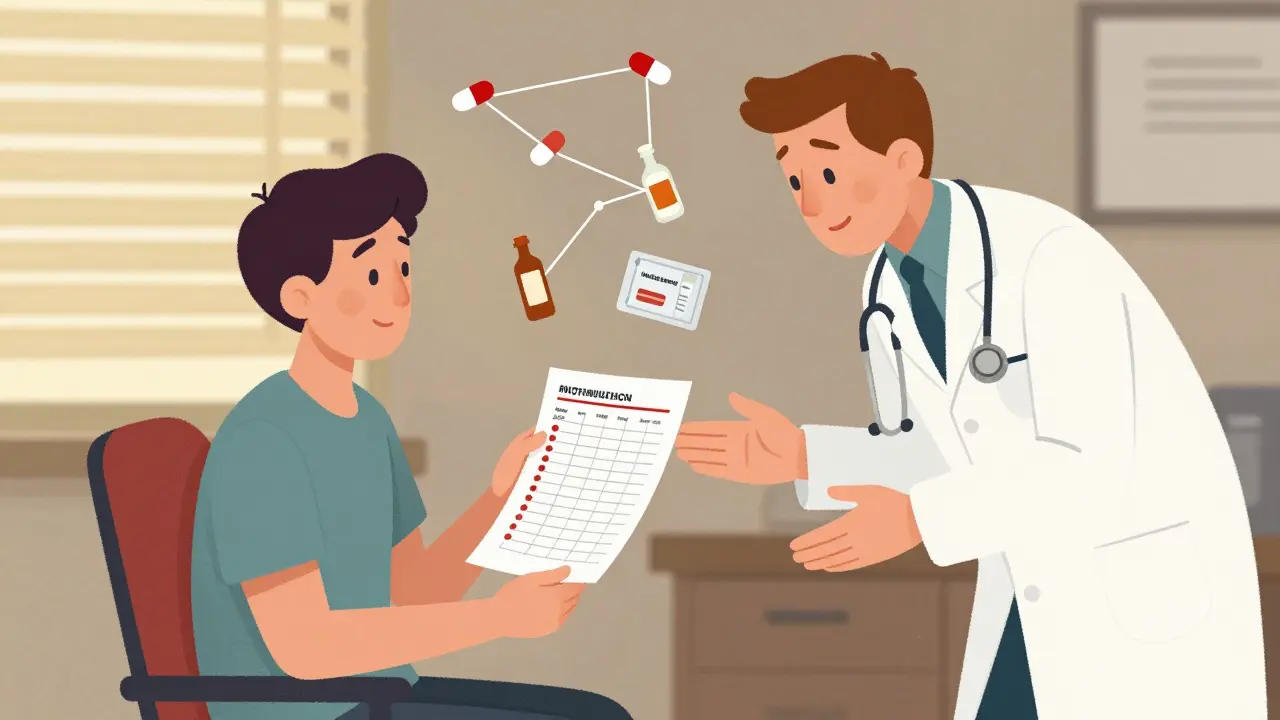
It’s hard to bring up overdose risk with your doctor-not because you don’t care about your safety, but because you’re afraid of being judged. You might be taking opioids for chronic pain, using benzodiazepines for anxiety, or mixing prescriptions with alcohol. You know the risks, but saying it out loud feels like admitting you’ve failed. What if they think you’re just looking for drugs? What if they shut you down? You’re not alone. Nearly 7 out of 10 people with substance use disorder say they’ve been treated with disrespect or shame by healthcare providers. But here’s the truth: you have the right to ask for help without being labeled. And there’s a way to do it that actually works.
Start with the right words
The language you use changes everything. Saying “I’m an addict” or “I can’t stop using” puts the focus on your identity, not your health. That triggers stigma. Instead, use person-first language: “I have a substance use disorder.” That simple shift isn’t just politically correct-it’s backed by science. A 2022 Johns Hopkins study found that when patients used this language, doctors were 37% more likely to respond with empathy and offer real support. Don’t say, “I’m scared I might overdose.” That sounds vague, emotional, and easy to dismiss. Say this instead: “I’d like to discuss overdose prevention strategies as part of my health plan.” That’s not a cry for help-it’s a medical request, like asking for a flu shot or a blood pressure check. And it works. A 2021 JAMA study showed patients who used this exact phrase were 62% more likely to get naloxone prescribed.Prepare a simple medication timeline
Walk into your appointment with a one-page list. Not a confession. Just facts. Write down:- Every prescription you take, including doses and how often
- Any over-the-counter meds or supplements (especially sleep aids or pain relievers)
- Alcohol use-how many drinks a week
- Any non-prescribed substances, even once a month
Ask for naloxone like you’d ask for an EpiPen
Naloxone isn’t a sign you’re using too much. It’s a safety tool-like a fire extinguisher in your home. Dr. Bobby Mukkamala from the American Medical Association says it best: “There’s no stigma for using an EpiPen or a defibrillator. Why should naloxone be any different?” Say this: “I’d like to receive naloxone as a safety measure. Can you prescribe it today?” That’s direct. It’s clinical. And it’s effective. Since the FDA approved a generic nasal naloxone in July 2023, the price has dropped from $130 to $25 per kit. Most insurance plans cover it now. If your doctor hesitates, ask: “Is this something you’d recommend for a patient with diabetes or heart disease?” The answer should be yes.
Anticipate the pushback-and how to handle it
Not every doctor is trained to handle this conversation well. A 2019 study found 43% of providers still hold negative attitudes toward people with opioid use disorder. You might hear things like:- “Why would you need that? Are you using heroin?”
- “You’re just looking for drugs.”
- “You’re not a real patient.”
Use the same framework as for other chronic conditions
Substance use disorder isn’t a moral failure. It’s a medical condition-like diabetes or hypertension. The CDC’s 2023 update to its opioid prescribing guidelines says this clearly: “Assessment of overdose risk should be routine for all patients prescribed opioids, regardless of perceived risk.” That means your doctor should be asking you these questions-not the other way around. But they often don’t. So you lead. Frame it like this: “As part of my comprehensive health plan, I’d like to talk about overdose prevention, just like we do for heart disease or asthma. What do you recommend?” This approach aligns with the AMA’s 2023 policy, which requires all member physicians to complete annual stigma training. 78% have done it. That means most doctors now know how to respond. You’re not asking for something new. You’re asking for what they’re supposed to offer.
Know your support resources
You don’t have to do this alone. The Substance Abuse and Mental Health Services Administration (SAMHSA) runs a free, confidential helpline: 1-800-662-4357. In 2022, they answered nearly 300,000 calls-up 22% from the year before. They can help you prepare what to say, find local providers, and even connect you with peer coaches who’ve been through this. Organizations like SMART Recovery host weekly online meetings focused on preparing for medical appointments. Over 1,200 people join each month. You can practice your script. Get feedback. Build confidence. And if you’re worried about privacy: your medical records are protected by law. What you say stays confidential unless you’re in immediate danger.What to do if your doctor still doesn’t get it
Sometimes, despite your best efforts, the conversation doesn’t go well. You feel dismissed. Shameful. Like you’ve been punished for trying to stay alive. That’s not your fault. It’s a system failure. You have options:- Ask for a second opinion at a federally qualified health center (FQHC). 65% of these clinics now use standardized protocols for overdose prevention.
- Go to an urgent care center or ER. They’re required to offer naloxone to anyone at risk-and they don’t need a prior relationship with you.
- Buy naloxone over the counter at any pharmacy. In 48 states, you can walk in and ask for it without a prescription.
It’s not about being perfect-it’s about being alive
You don’t have to be “clean” to deserve safety. You don’t have to be “sick enough” to get help. You don’t have to earn the right to live. This isn’t about guilt. It’s about preparedness. Just like you check your smoke detector every month, you can check in with your doctor about overdose risk. It’s not a failure. It’s responsibility. The people who survive overdoses aren’t the ones who avoided talking about it. They’re the ones who found a way to say it-clearly, calmly, and without shame. You can be one of them.Can I get naloxone without a prescription?
Yes. In 48 U.S. states, you can walk into any pharmacy and ask for naloxone without a prescription. It’s available behind the counter-just ask the pharmacist. Since the FDA approved a generic version in 2023, the price has dropped to around $25 per kit. Many insurance plans cover it, and some community health centers give it out for free.
What if my doctor says I’m just looking for drugs?
That’s a stigmatizing response-and it’s not acceptable. You can say: “I’m not asking for more medication. I’m asking for a safety tool, like an EpiPen for allergies. I’ve researched this. Naloxone saves lives. If you’re not comfortable prescribing it, can you refer me to someone who is?” If they still refuse, go to a different provider. Your life matters more than one doctor’s bias.
Is it safe to take naloxone if I haven’t overdosed?
Yes. Naloxone only works if opioids are in your system. If you haven’t taken any, it has no effect. It won’t make you sick or cause withdrawal. It’s safe for anyone to carry-even if you’re not using opioids yourself, but someone you live with is. Many people keep it in their car, purse, or medicine cabinet as a precaution.
How do I know if I’m at risk for overdose?
You’re at higher risk if you: take opioids for chronic pain, use benzodiazepines (like Xanax or Valium), mix medications with alcohol, recently stopped using after a break (your tolerance drops), or use substances alone. The CDC says anyone prescribed opioids should be screened for overdose risk-even if they’ve been taking them for years. Risk isn’t about how much you use-it’s about how you use it.
Will talking about this hurt my chances of getting pain treatment?
No. In fact, the opposite is true. Doctors are more likely to continue prescribing pain medication when they know you’re taking safety seriously. A 2022 study showed that patients who asked for naloxone and discussed overdose prevention were 40% less likely to have their pain meds cut abruptly. Showing responsibility builds trust. Avoiding the conversation makes doctors nervous-and that’s when they reduce or stop treatment.
Doreen Pachificus
January 3, 2026 AT 15:02Just took my mom to her appointment last week and used the exact phrase from the article - ‘I’d like to discuss overdose prevention strategies as part of my health plan.’ She got naloxone same day. No judgment. Just a nod and a script. Sometimes it really is that simple.
Charlotte N
January 5, 2026 AT 09:03i dont know why people make this so hard like just list the meds and walk in like you’re checking your tire pressure its not a confession its a checklist
Vicki Yuan
January 5, 2026 AT 16:54This is one of the most important pieces of medical advice I’ve read this year. The shift from identity-based language to person-first language isn’t just semantics-it’s a clinical necessity. The Johns Hopkins and JAMA studies cited here are rock-solid. Doctors respond to structure, data, and calm clarity. Shame and guilt shut down care. Preparedness opens doors. I’ve shared this with three friends already. Please, if you’re reading this and you’re scared-do this. You’re not asking for permission to live. You’re exercising your right to safety.
Abhishek Mondal
January 6, 2026 AT 06:04Let me just say-this entire framework is dangerously oversimplified. You’re assuming all providers are trained, all pharmacies stock naloxone, and that systemic bias doesn’t manifest in subtle, bureaucratic ways-like delayed referrals, coding errors in EMRs, or insurance denials masked as ‘clinical caution.’ The article reads like a corporate wellness pamphlet. Real life? You get labeled ‘high-risk,’ then your prescriptions get restricted, your pain specialist drops you, and suddenly you’re being pushed toward a ‘rehabilitation program’ that’s just a cash grab. The system doesn’t care if you’re ‘responsible’-it cares about liability. This advice might work for the privileged few with good insurance and a polite demeanor. For the rest of us? It’s a placebo with footnotes.
Oluwapelumi Yakubu
January 6, 2026 AT 12:58My guy, this is the kind of wisdom that saves lives-and I’m not just saying that because I’m Nigerian and we’ve got a whole culture of ‘you don’t die until God says so’ but also because I’ve seen my cousin walk into a clinic with a folded piece of paper listing his meds, alcohol intake, and even the occasional tramadol he took for back pain after work. Doctor didn’t blink. Gave him naloxone, a referral to a peer coach, and a handshake. No drama. No shame. Just facts. That’s power. You don’t need to be perfect-you just need to be prepared. And honestly? That’s more than most people do for their cholesterol.
Allen Ye
January 8, 2026 AT 03:51There’s a deeper philosophical layer here that nobody’s talking about. The act of asking for naloxone isn’t just medical-it’s existential. It’s the moment you stop seeing yourself as a problem to be fixed and start seeing yourself as a person with agency. We live in a culture that equates addiction with moral collapse, but the truth is, we all live on the edge of collapse. We just don’t all have opioids in our cabinets. The fact that you’re willing to name your vulnerability, to frame it as a health plan, not a failure, that’s revolutionary. It’s not about getting a prescription-it’s about reclaiming your narrative from a system that wants you silent, ashamed, and invisible. And if you’re reading this and you’re still scared? Good. Fear means you’re alive. Now go ask for your fire extinguisher.
Catherine HARDY
January 8, 2026 AT 23:48Wait… so you’re telling me the government approved a generic naloxone in 2023… and suddenly everyone’s talking about it like it’s a miracle? But what if this is all a distraction? What if they’re pushing naloxone so we don’t demand better pain management? What if this is just another way to keep us docile while Big Pharma keeps selling opioids under new names? I’ve seen the reports. The same companies that made OxyContin now own the patents on naloxone. Coincidence? I don’t think so. They want us to think we’re safe with a nasal spray while they keep the addiction machine running. I’m not buying it.
Chris Cantey
January 9, 2026 AT 23:38I’ve been in recovery for seven years. I used to think asking for help was weakness. Then I realized-it’s the most courageous thing you can do. But the article’s tone? Too clean. Too polished. Real people don’t walk in with one-page timelines. They show up shaking, sweating, half-asleep, carrying a bag of pills they can’t even name. They don’t say ‘substance use disorder.’ They say ‘I’m a mess.’ And sometimes that’s enough. The system doesn’t need perfect patients. It needs humans who refuse to disappear. So if you’re reading this and you’re not ready to say it right? Say it wrong. Say it messy. Say it sobbing. Just say it. They’ll still hear you.
Uzoamaka Nwankpa
January 10, 2026 AT 10:02I don’t know why anyone would trust a system that has spent decades criminalizing us, then suddenly offers us a free nasal spray like it’s a coupon for a free coffee. This isn’t empowerment. It’s damage control. They don’t care if we live. They just don’t want us dying on their sidewalks. The real solution isn’t naloxone-it’s decriminalization, universal healthcare, and ending the war on drugs. Until then, this is just a Band-Aid on a hemorrhage. And I’m tired of being told to be grateful for the Band-Aid.