
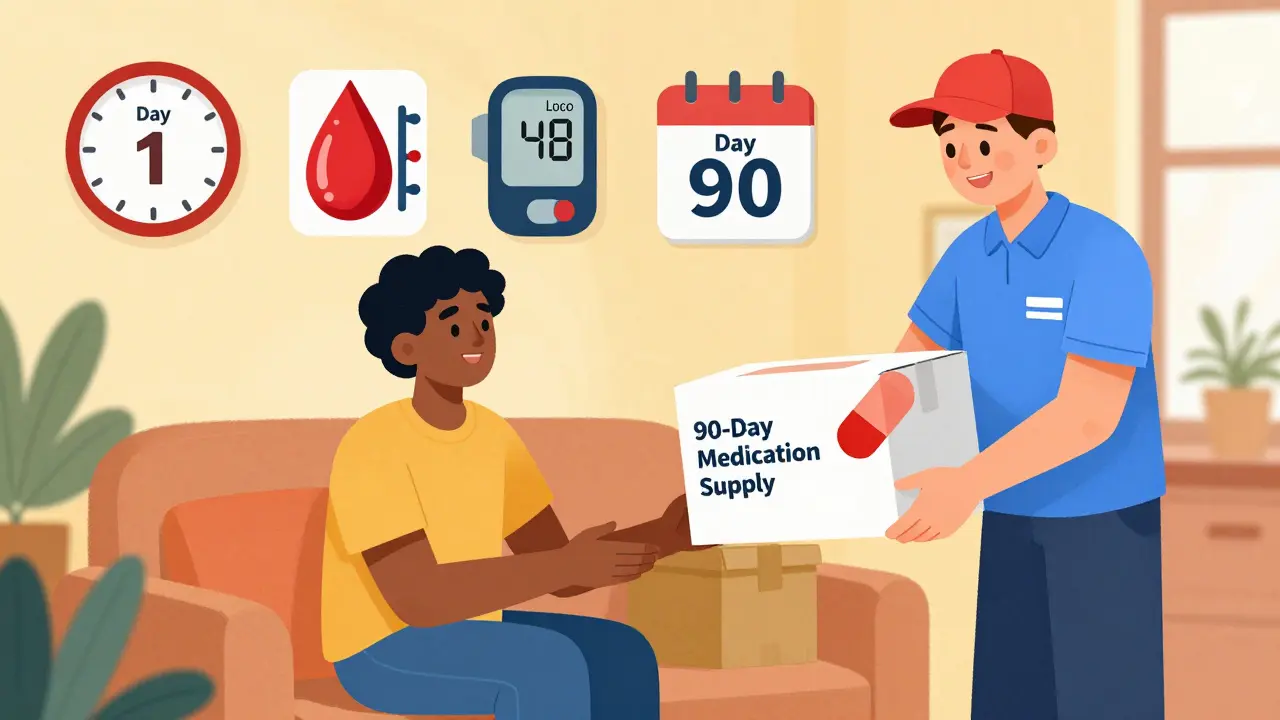
Running out of your blood pressure pills because you couldn’t get to the pharmacy is more than an inconvenience-it’s a health risk. For millions of people managing chronic conditions like diabetes, high cholesterol, or thyroid disease, missing even one dose can lead to hospital visits, complications, or worse. The good news? pharmacy delivery and mail-order services are designed to stop that from happening. They’re not just for busy people or the elderly-they’re for anyone who wants to take their meds without the hassle.
How Mail-Order Pharmacies Actually Work
Mail-order pharmacies aren’t magic. They’re licensed pharmacies, just like the one down the street, but they ship your meds straight to your door. Most offer 90-day supplies instead of the usual 30-day refill. That means fewer trips, fewer copays, and fewer chances to forget. You start by checking if your insurance covers it. Most health plans in the U.S. do-often at no extra cost. If you’re on Medicare, you’re especially likely to have access. Once you confirm coverage, you can transfer your prescriptions. You don’t need to call your doctor. Your current pharmacy can send the info electronically, or you can do it yourself online through your insurer’s portal or the mail-order pharmacy’s website. Once set up, you’ll get your meds in a box. Some come in blister packs labeled by day and time. Others are in bottles with clear labels. Temperature-sensitive drugs like insulin or biologics arrive in insulated packaging with cold packs. You won’t get anything that’s expired or mislabeled. Mail-order pharmacies use robotic systems and double-checks. They’re 23 times more accurate than retail pharmacies, according to PCMA research.Why It Boosts Medication Adherence
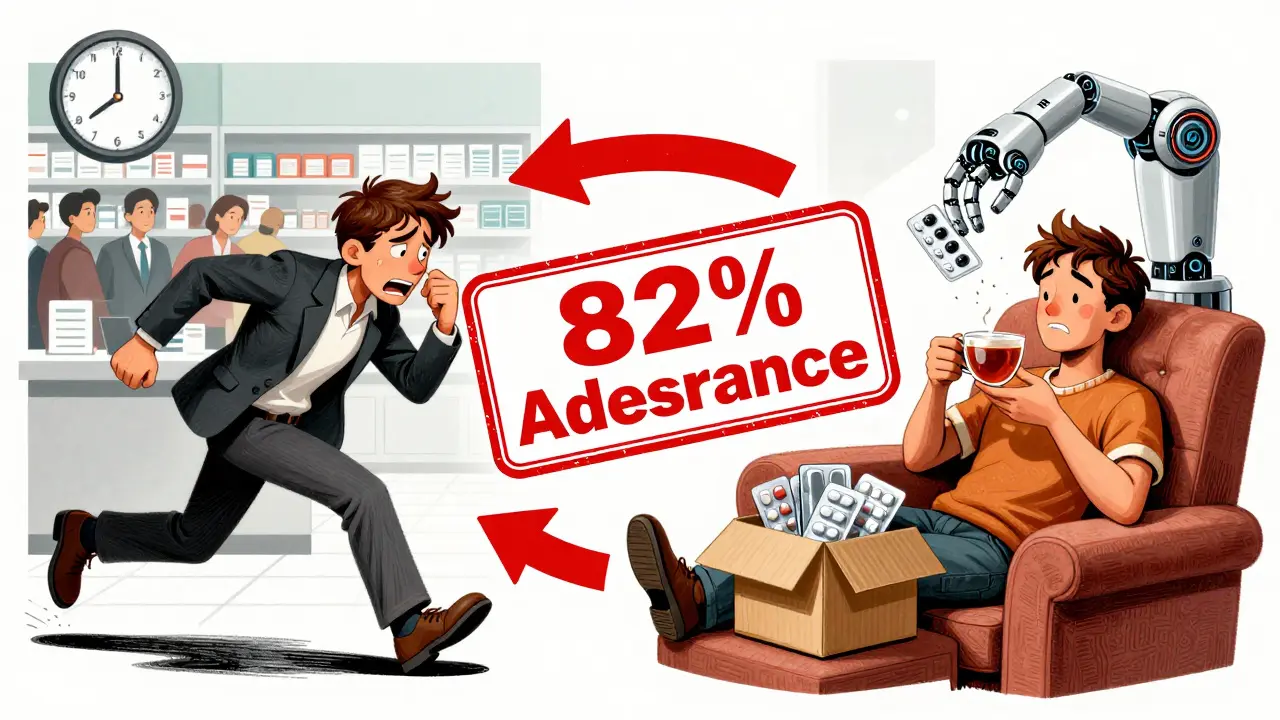
Let’s be honest: taking meds every day is hard. You forget. You’re busy. You run out on a weekend. That’s why 48% of people with chronic conditions don’t take their meds as prescribed, according to CDC data. Mail-order fixes that. When you get 90 days of medication at once, you’re less likely to run out. And the numbers prove it. Patients on 90-day mail-order prescriptions have an 82% adherence rate. At retail pharmacies, with 30-day fills, it’s just 52%. That’s a 30-point gap. That gap means fewer heart attacks, fewer strokes, fewer ER trips. It’s not just about pills. It’s about peace of mind. One Reddit user with MS said mail-order was “life-changing” because they couldn’t leave their house without help. Another said they saved $200 a year just by switching from three 30-day fills to one 90-day supply. That’s not a small amount when you’re on a fixed income.What You Can and Can’t Get
Not every drug can be mailed. Controlled substances like opioids, benzodiazepines, and certain stimulants are still only available at local pharmacies. That’s a federal rule. If your doctor prescribes one of these, you’ll need to pick it up in person. Also, some specialty drugs-like those for rare diseases or cancer-require special handling and may not be shipped by standard mail-order services. These often come through specialty pharmacies that work directly with your insurer. But for most maintenance meds? You’re covered. That includes:- High blood pressure meds (lisinopril, amlodipine)
- Cholesterol drugs (atorvastatin, rosuvastatin)
- Diabetes meds (metformin, glimepiride)
- Thyroid pills (levothyroxine)
- Antidepressants and anti-anxiety meds (sertraline, escitalopram)
- Birth control and hormone therapies
Cost Savings You Can’t Ignore
Here’s the real kicker: mail-order saves money. A lot of it. Let’s say you take a brand-name drug that costs $120 for a 30-day supply at your local pharmacy. Your copay is $40. Three of those? $120 a month. $1,440 a year. Now switch to mail-order. You get 90 days for the price of two copays. So $80 for 90 days. That’s $266.67 a year. You save $1,173.40. That’s more than a month’s rent for some people. Even generics save you. A 90-day supply of metformin might cost $10 at mail-order. At retail? $25 for 30 days. That’s $75 a year vs. $10. That’s 87% less. Most plans let you choose between retail and mail-order. If you’re paying full price, compare. You might be shocked.How to Get Started
It’s easier than you think. Here’s how:- Check your plan. Log into your insurance website or call the member services number. Ask: “Do I have mail-order pharmacy benefits?” If yes, they’ll give you the name of the pharmacy partner-like Express Scripts, CVS Caremark, or OptumRx.
- Transfer your prescriptions. Go to the mail-order pharmacy’s website. Sign up. You’ll need your insurance info and the names of your meds. You can transfer all at once or one by one. Most take 3-5 business days.
- Order your first supply. Pick the 90-day option. Set up auto-refills so you never run out. Most services let you do this online or by phone, 24/7.
- Wait for delivery. Standard shipping is 3-5 days. Some, like Patient Direct Pharmacy, offer next-day delivery if you’re in a hurry.
When Mail-Order Isn’t Right
Mail-order is great-but it’s not for everything. If you need an antibiotic for a sudden infection, don’t wait for a package. Go to your local pharmacy. Same with pain meds after surgery or emergency meds like epinephrine pens. Also, if your meds change often-say, your doctor adjusts your dose every few weeks-mail-order can be a headache. You might end up with pills you don’t need. Retail pharmacies are better for trial-and-error situations. And yes, sometimes packages get lost or delayed. About 1.2% of shipments have issues. That’s rare, but it happens. That’s why experts say: order your refill at least 10 days before you run out. Don’t wait until day 28. That’s how people end up skipping doses.
What People Are Saying
Real users have strong opinions. On Trustpilot, Patient Direct Pharmacy has a 4.7 out of 5 rating. People love the next-day delivery and how they handle workers’ comp claims. University of Michigan students rave about Birdi Pharmacy for its fast service and helpful staff. But not everyone’s happy. Some complain about delays. One user on GoodRx said their insulin took 10 days instead of 5. Another couldn’t change their dose quickly when their doctor updated it. The fix? Stay ahead. Order early. Call if something’s late. Use the 24/7 phone line. Most problems are solved with a quick call.What’s Next for Pharmacy Delivery
The industry is growing fast. In 2022, mail-order handled $102 billion in prescriptions. By 2028, it’ll hit $189 billion. Why? Aging populations. More chronic disease. And better tech. Some companies are testing drone deliveries in rural areas. Others are adding smart packaging that texts you if you miss a dose. UnitedHealthcare uses AI to predict when someone’s likely to skip meds-and sends a reminder before it happens. That’s not sci-fi. It’s happening now. Even big employers are on board. 85% of Fortune 500 companies offer mail-order as part of their health plans. That’s because it works. Fewer sick days. Lower ER use. Healthier employees.Final Thoughts
If you take meds every day for a chronic condition, pharmacy delivery isn’t a luxury-it’s a lifeline. It saves time, money, and most importantly, your health. You don’t need to be old, disabled, or stuck in a rural town to benefit. If you’ve ever missed a dose because you were tired, busy, or couldn’t get to the pharmacy, this is the solution. Start by checking your insurance. Transfer your prescriptions. Order your 90-day supply. Set up auto-refills. And never wait until you’re out to act. Your body doesn’t care if you’re busy. But with mail-order, you don’t have to choose between your life and your meds anymore.Can I use mail-order pharmacy if I don’t have insurance?
Yes. Many mail-order pharmacies, like Patient Direct Pharmacy and Birdi, offer cash pricing that’s often lower than retail pharmacy copays-even without insurance. You can compare prices online before ordering. Some even have discount programs for low-income users.
How long does it take to get my first mail-order prescription?
It usually takes 3-5 business days from the time you submit your transfer request. That includes processing your prescription, filling it, and shipping. If you need meds sooner, ask about expedited shipping options. Some services offer next-day delivery for an extra fee.
Are mail-order pharmacies safe and secure?
Yes. All major mail-order pharmacies are licensed, regulated, and HIPAA-compliant. Your personal and medical info is encrypted. Medications are dispensed by licensed pharmacists using robotic systems that reduce human error. The FDA and state boards monitor them just like retail pharmacies.
Can I still see my local pharmacist if I use mail-order?
Absolutely. In fact, experts recommend keeping a relationship with a local pharmacist. They’re great for quick questions, new prescriptions, or if you need to talk about side effects in person. Mail-order is for maintenance meds. Your local pharmacy handles acute care and counseling.
What if my medication is lost or damaged in transit?
If your package arrives damaged, is missing, or doesn’t arrive at all, contact the mail-order pharmacy immediately. Most will send a replacement at no cost. Keep the packaging and any tracking info. They’ll usually resolve it within 1-2 business days.
Do mail-order pharmacies handle refills automatically?
Yes, most do. When you sign up, you can set up auto-refills so your 90-day supply is automatically processed and shipped before you run out. You’ll get a reminder email or text. You can pause or cancel anytime. This is the easiest way to stay on track.
Can I get my meds delivered on weekends?
Standard delivery is Monday-Friday. But some services offer Saturday delivery for an extra fee. If you need meds on a weekend, plan ahead. Order early enough so your package arrives by Friday. Some pharmacies partner with carriers like UPS or FedEx that deliver on Saturdays.
Is mail-order better than a pharmacy drive-thru?
It depends. Drive-thrus are great for quick 30-day refills if you’re nearby and mobile. But mail-order wins for convenience, cost, and adherence. You save time, money, and never have to leave your house. If you’re on multiple meds, mail-order can sync all your refills to arrive on the same day. Drive-thrus can’t do that.
Lynsey Tyson
December 19, 2025 AT 10:45I switched to mail-order for my blood pressure meds last year and honestly? My life got so much easier. No more rushing to the pharmacy on weekends or forgetting when my refill’s due. I set up auto-refills and now I just get a box every three months like clockwork. Best decision I ever made for my health.
Also saved like $800 a year. That’s a whole vacation fund right there.
Dikshita Mehta
December 20, 2025 AT 05:16As someone who’s been managing diabetes for 12 years, I can confirm mail-order is a game-changer. The blister packs with time labels? Genius. No more mixing up morning vs night pills. And the cold packs for insulin? Perfect. I’ve never had a spoiled dose.
Also, the pharmacy in India I use for my meds ships internationally with tracking. You don’t need to be in the US to benefit.
pascal pantel
December 21, 2025 AT 15:00Let’s be real-this whole mail-order thing is just a cost-cutting scheme by insurers. They don’t care if you get your meds on time, they just want to minimize retail pharmacy reimbursements.
And the ‘23x more accurate’ stat? That’s from a trade group that represents mail-order pharmacies. Source bias much? Also, what about the 1.2% failure rate? That’s 1 in 83 people getting the wrong meds or none at all. That’s not ‘rare’-that’s unacceptable in healthcare.
Gloria Parraz
December 22, 2025 AT 14:34I used to skip my antidepressants because I’d run out on a Tuesday and the pharmacy was closed until Thursday. I’d just… not take them. Until I switched to mail-order.
Now I get my 90-day supply with a reminder text every 30 days. I haven’t missed a single dose in 18 months. My therapist noticed the difference. My partner noticed the difference. I noticed the difference.
This isn’t convenience. This is survival.
Sahil jassy
December 23, 2025 AT 22:06Used to hate waiting for meds but now I love it. Just order once every 3 months and boom done. My mom says same for her thyroid pills. No more driving in snow. No more pharmacy lines. Just chill and wait for the box.
Also the price difference is wild. Metformin was $30 at CVS now its $8. Like how is that even legal
Kathryn Featherstone
December 24, 2025 AT 04:23I’m not a tech person and I was terrified to switch. But I called the mail-order pharmacy’s 24/7 line and a pharmacist walked me through everything. Didn’t feel rushed. Didn’t feel stupid. Just… helped.
Now I don’t even think about refills. It’s just part of my routine. Like brushing my teeth. I wish more people knew this was an option.
Nicole Rutherford
December 24, 2025 AT 06:52Of course it works. People who can’t be bothered to go to the pharmacy shouldn’t be allowed to manage their own meds. This isn’t a convenience-it’s a crutch for people who can’t follow basic health instructions.
And let’s not pretend everyone who uses this is sick. I’ve seen people on mail-order for birth control and anxiety meds like it’s Amazon Prime. It’s dehumanizing.
Chris Clark
December 25, 2025 AT 10:23My cousin in rural Arkansas uses this for his insulin. They had to wait 12 days once because the truck broke down. He had to go to the ER. That’s not ‘rare’-that’s systemic failure.
Also, the drone delivery thing? Cool. But what if you live in a place with no cell service? Or no road? Or no trust in the system? This isn’t for everyone. Stop acting like it is.
Dorine Anthony
December 26, 2025 AT 14:09My dad used to drive 45 minutes to get his meds. Now he gets them delivered. He doesn’t have to ask for rides anymore. Doesn’t have to sit in the waiting room with all the sick people.
He says it’s the first time in 10 years he’s felt like he has control over his own care.
That’s worth more than any savings number.
William Storrs
December 28, 2025 AT 09:17You’re not lazy for using mail-order. You’re smart.
Most people think taking meds daily is just about willpower. It’s not. It’s about systems. And mail-order builds the system for you.
If you’re saving money, staying healthy, and not stressing out every time your bottle’s empty-you’re doing it right. No guilt needed.
James Stearns
December 29, 2025 AT 04:09While the utilitarian advantages of pharmaceutical distribution via postal logistics are ostensibly compelling, one must consider the ontological implications of depersonalized healthcare delivery. The human pharmacist, with his or her nuanced clinical intuition, is being systematically replaced by algorithmic dispensation. This constitutes a profound erosion of the therapeutic alliance.
Furthermore, the commodification of medication adherence through auto-refill protocols risks transforming the patient into a passive recipient of corporate health management protocols. One must ask: Are we healing, or merely optimizing?
Nina Stacey
December 29, 2025 AT 04:10I just want to say I started using this for my anxiety meds and honestly I didn’t think I’d stick with it but it just made everything so much less stressful like I didn’t realize how much mental energy I was spending worrying about running out or forgetting to refill or having to drive when I was having a bad day
and then I got my first box and it had this little note from the pharmacist that said ‘you got this’ and I cried and I know that sounds dumb but it’s the little things
also I spilled coffee on the box and the meds were still fine so like wow
and now my sister is using it too and she said it saved her from missing her birth control last month which she was so scared about
so yeah just saying it’s not just about money it’s about dignity and peace
Kevin Motta Top
December 30, 2025 AT 17:32Mail-order works. No drama. Just send the script, get the meds. Done.
Alisa Silvia Bila
January 1, 2026 AT 02:48My doctor said I could switch to mail-order but I was scared I’d get the wrong dose. Turns out they call you before they ship if anything changes. I didn’t even know that.
Also, I’m on three meds. Now they all come together on the same day. No more juggling bottles. I just grab the box and go. It’s so simple I feel dumb for waiting so long.
Allison Pannabekcer
January 2, 2026 AT 16:09I’ve been helping elderly neighbors set up mail-order for years. One woman, 82, had been skipping her cholesterol meds because she couldn’t get to the pharmacy after her husband passed. She didn’t tell anyone. Just stopped taking them.
When we switched her over, she cried. Not because she was happy-because she finally felt like someone was looking out for her.
That’s what this is. Not convenience. Not savings. It’s care. Quiet, reliable, no-questions-asked care.
And it’s not just for old people. I’m 34, work two jobs, and I use it for my thyroid med. My body doesn’t care if I’m busy. But this system does. And that matters.
William Storrs
January 2, 2026 AT 21:34Just saw someone say mail-order is for lazy people. That’s not true. It’s for people who are already doing 100 things. You’re not lazy for choosing to protect your health. You’re smart.
And if you think your local pharmacist doesn’t have a quota to meet? They do. Mail-order just takes the pressure off both sides.
Stop judging. Start helping.