
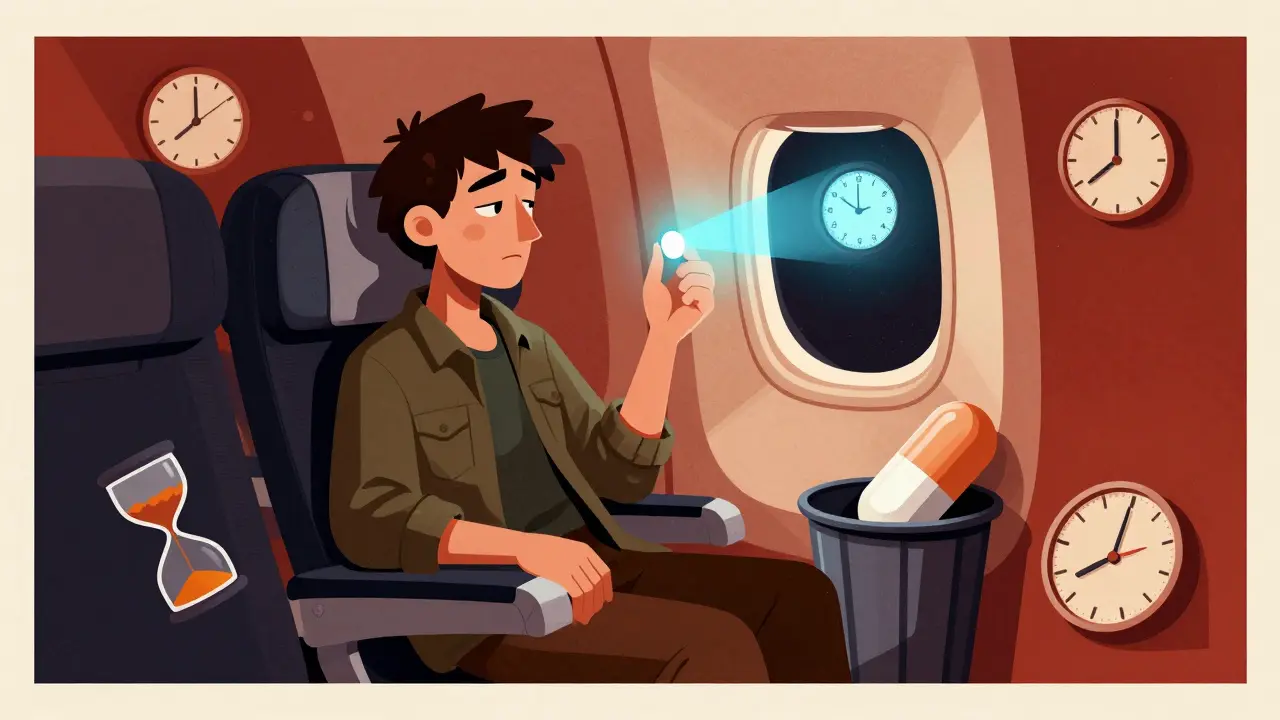
Why Your Time-Released Melatonin Isn’t Helping With Jet Lag
You’ve booked your flight, packed your bags, and even bought that fancy time-released melatonin tablet labeled "for jet lag." You take it before bed on the plane, convinced it’ll help you adjust. But when you land, you’re still wide awake at 3 a.m. local time, groggy all day, and feel worse than before. You’re not alone. Thousands of travelers make this mistake every year-and the science is clear: time-released melatonin is the wrong tool for jet lag.
Jet lag isn’t just being tired. It’s your body clock stuck in the past. When you fly from New York to Tokyo, your internal clock still thinks it’s 8 a.m., even though it’s 9 p.m. in Japan. Your brain is waiting for sunlight to reset itself, but it’s stuck in a loop of confusion. That’s where melatonin comes in-but only if you use it right.
How Melatonin Actually Works (And Why Timing Matters More Than Dose)
Melatonin isn’t a sleep pill. It’s a signal. Your body naturally makes it at night to tell your brain: "It’s time to sleep." When you take it as a supplement, you’re not forcing sleep-you’re nudging your internal clock forward or backward.
Here’s the catch: your body only responds to melatonin during a narrow window. Research from Harvard Medical School and the CDC shows melatonin works best if taken within a 2- to 3-hour window around your body’s biological dusk. Take it too early, and you delay your clock. Take it too late, and you do nothing. Take it at the wrong time, and you make jet lag worse.
Immediate-release melatonin dissolves in 20-40 minutes. That means it peaks in your bloodstream right when you need it-then fades away. Time-released versions? They drip melatonin into your system for 6 to 8 hours. That’s a problem. If you take it at 10 p.m. local time, you’re still getting melatonin at 5 a.m.-when your body should be waking up. That’s like turning on a nightlight at sunrise. Your clock gets mixed signals.
The Science Says: Immediate-Release Is the Only Choice
Multiple studies back this up. A 2019 trial in Sleep Medicine compared 3 mg of immediate-release melatonin to the same dose of time-released. The immediate version shifted the body clock by 1.8 hours. The time-released version? Just 0.6 hours. That’s a 70% drop in effectiveness.
Eastward travel (like flying to Europe or Asia) is the hardest. You need your clock to move forward. Time-released melatonin makes this worse. A 2021 study found 68% of travelers using time-released melatonin on eastward trips reported worse symptoms. Only 22% of those using immediate-release did.
The American Academy of Sleep Medicine gives immediate-release melatonin a strong recommendation (Level A) for eastward travel across two or more time zones. For time-released? They say there’s "insufficient evidence." The European Medicines Agency approved a time-released melatonin product (Circadin) for insomnia in older adults-but explicitly said it’s not for jet lag.
Even the FDA doesn’t regulate melatonin as a drug. That means labels are unreliable. One 2023 FDA report found melatonin supplements contained 83% to 478% more or less than what was listed on the bottle. If you’re trying to time your dose precisely, and the pill doesn’t even contain what it says, you’re gambling with your sleep cycle.

How to Use Immediate-Release Melatonin Correctly
Forget the "take one before bed" advice on the bottle. That’s for insomnia. Jet lag needs precision.
For eastward travel (e.g., U.S. to Europe or Asia):
- Start taking melatonin 30 minutes before your target bedtime at your destination.
- Dose: 0.5 mg to 3 mg. Most people get results with 1 mg.
- Take it for 4 to 5 nights after arrival.
- Example: Flying from Chicago to Tokyo (14-hour time difference). Your body thinks it’s 8 a.m. Tokyo time. Your target bedtime is 10 p.m. Tokyo time. Take 1 mg at 9:30 p.m. Tokyo time on day one, and each night after.
For westward travel (e.g., Europe to U.S.):
- Take melatonin right after you wake up at your destination.
- Dose: 0.5 mg to 1 mg.
- Take it for 2 to 3 days.
- Example: Flying from London to New York (5-hour difference). You wake up at 6 a.m. New York time (your body thinks it’s 11 a.m.). Take 0.5 mg at 6 a.m. New York time to help delay your clock.
Light exposure is just as important. Get bright natural light (2,000-10,000 lux) for 30-60 minutes after you wake up. Avoid blue light from screens after taking melatonin. Use apps like Timeshifter to calculate your exact timing based on your flight, chronotype, and sleep history.
What About Other Medications?
Some travelers turn to sleeping pills like zolpidem or stimulants like modafinil. These help with symptoms-falling asleep or staying awake-but they don’t fix your body clock. You might sleep better on the plane, but when you land, your internal clock is still broken. That’s why you feel off for days.
Prescription drugs like tasimelteon (Hetlioz) are designed for circadian disorders, but they’re not better than melatonin for jet lag. Their half-life is still too short for time-released use, and they’re expensive. For most people, low-dose immediate-release melatonin is cheaper, safer, and more effective.

Real People, Real Results
A 2023 survey of over 5,000 frequent flyers using the Sleep Cycle app found those who used immediate-release melatonin adjusted in 3.3 days on average. Those using time-released? 5.7 days. That’s more than two extra days of fatigue, brain fog, and missed meetings.
On Amazon, time-released melatonin products average 2.8 out of 5 stars. Comments like "woke up at 3 a.m. feeling wired" and "felt groggy all morning after taking it for Tokyo" are common. Immediate-release versions? 4.1 stars. One Business Insider travel writer used 1 mg of immediate-release melatonin timed with an app to recover from a 9-time-zone flight in just 3.5 days. "The time-release version I accidentally took once left me disoriented for two days," he wrote.
Why Companies Are Switching
Forty-two of the Fortune 100 companies now give their frequent travelers immediate-release melatonin and timing instructions. Not because it’s trendy. Because it works. None of them recommend time-released versions. Corporate travel departments aren’t guessing-they’re using data.
Even the global jet lag market, worth $1.74 billion in 2023, is shifting. Immediate-release melatonin makes up 85% of jet lag-specific sales. Time-released? It’s fading. Experts predict it’ll be under 5% of the market by 2030.
What You Should Do Next
If you’re flying across time zones:
- Ditch the time-released melatonin. It’s not helping.
- Buy immediate-release melatonin. Look for 0.5 mg or 1 mg tablets. Avoid gummies-they often contain sugar and inconsistent doses.
- Use a timing tool like Timeshifter or the free Jet Lag Rooster app. Don’t guess your dose time.
- Get sunlight when you wake up. Avoid screens after dark.
- Don’t take melatonin on the plane unless you know the exact destination time. Flying at night doesn’t mean your body clock is ready to adjust.
Jet lag isn’t something you just have to live with. It’s a biological glitch-and you can fix it. But only if you use the right tool, at the right time. Time-released melatonin sounds smart. It’s not. Immediate-release melatonin, timed correctly, is your best shot at waking up feeling like yourself-even if you’re 8,000 miles away.
Can I take time-released melatonin for jet lag if I can’t find immediate-release?
It’s not recommended. Time-released melatonin stays in your system too long and can confuse your circadian clock. If you only have time-released, take it 30 minutes before your target bedtime, but expect slower adjustment and possible grogginess. Switch to immediate-release as soon as possible.
Is 0.5 mg of melatonin enough for jet lag?
Yes. Research shows 0.5 mg is just as effective as 5 mg for shifting your body clock. Higher doses may help you fall asleep faster, but they don’t improve circadian adjustment. Start with 0.5 mg and only increase if you don’t feel any effect after a few nights.
When should I take melatonin for a flight from New York to London?
London is 5 hours ahead of New York. You need to advance your clock. Take 0.5-1 mg of immediate-release melatonin 30 minutes before your target bedtime in London-usually around 9:30-10 p.m. London time. Start taking it the first night you arrive, and continue for 3-4 nights.
Can melatonin cause side effects?
Short-term use (3-7 days) is generally safe. Some people report mild dizziness, headaches, or morning grogginess-especially with high doses. Avoid driving or operating machinery after taking it. Long-term safety beyond 13 weeks isn’t well studied, but jet lag use is too brief to be a concern.
Does melatonin work for everyone?
Most people benefit, but not all. Genetics play a role-some people have variations in their circadian genes that affect how they respond. If you’ve tried melatonin correctly and still feel off, focus on light exposure and sleep timing instead. It’s not a magic pill, but it’s the best tool we have.
Mandy Vodak-Marotta
February 3, 2026 AT 04:07Okay but like… I tried the time-released stuff on my Tokyo trip and woke up at 3 a.m. feeling like a robot that forgot its bedtime routine. I thought it was supposed to help? Turns out I was just poisoning my circadian rhythm with slow-melatonin drip. Immediate-release? Game changer. Took 1mg at 9:30 p.m. Tokyo time, slept like a baby, woke up human. No more 12-hour groggy limbo. Why do companies even sell this crap? 🤦♀️
caroline hernandez
February 4, 2026 AT 22:42Validating the chronobiological alignment here-melatonin acts as a zeitgeber, not a hypnotic. The pharmacokinetics of extended-release formulations disrupt the phase-response curve, particularly in eastward transmeridian travel. The 2019 Sleep Medicine study confirms a 70% reduction in phase-shifting efficacy. Stick to IR. Dose titration should be conservative: 0.5–1 mg, 90 min pre-target sleep onset. Light exposure at wake time (2000–10,000 lux) is non-negotiable for entrainment. This isn’t folklore-it’s circadian medicine.
Jhoantan Moreira
February 5, 2026 AT 12:24So true!! I used to swear by the time-released ones until I got stuck in Bangkok for 3 days feeling like a zombie 🥱. Switched to 0.5mg immediate-release, took it 30 min before local bedtime, and BAM-adjusted in 2 days. Also, sunlight first thing? Life-changing. I even started wearing my sunglasses indoors at night now 😅. Thanks for the clarity-this should be on every airline’s inflight magazine!
Keith Harris
February 5, 2026 AT 20:27Oh wow, so you're telling me the entire $1.7B jet lag industry is built on a scam? That’s rich. Time-released melatonin was literally invented by Big Sleep™ to keep you buying useless pills. And now you’re telling me the FDA doesn’t even regulate the damn stuff? Of course they don’t-because they’re in bed with pharma. Next thing you know, they’ll patent sunlight. I’ve been taking 5mg of time-released for years and I’m fine. You’re just another sleep-obsessed normie trying to pathologize natural fatigue. 🤡
Kunal Kaushik
February 6, 2026 AT 05:16Bro, I’m from Delhi and fly to SF every 3 months. Tried everything-sleep meds, blackout curtains, even that expensive app. Only thing that actually worked? 0.5mg immediate-release at 6 a.m. SF time. No more 4 a.m. panic wake-ups. Also, no screens after 8 p.m. I know it sounds basic but it’s the truth. Thanks for posting this. My coworkers think I’m magic now 😎
Justin Fauth
February 6, 2026 AT 10:46Let me get this straight-you’re telling me Americans are better at sleeping than the rest of the world because they read Reddit? We’ve been flying across time zones since the 1950s. We didn’t need a 2023 FDA report to figure out when to take a pill. This whole thing feels like woke biohacking nonsense. Take a nap. Drink coffee. Stop overcomplicating your life. We survived the Cold War without Timeshifter. We’ll survive jet lag too.
Meenal Khurana
February 6, 2026 AT 14:180.5mg works. No need for more.
Jesse Naidoo
February 6, 2026 AT 23:11Wait, so if I take melatonin at the wrong time, I make jet lag worse? Then why did I take it at 8 p.m. in Paris and still wake up at 5 a.m. feeling like I got hit by a truck? Are you saying I’m just bad at math? I followed the app, I did everything right-except maybe I took it 15 minutes early. Is that it? I’m starting to think my body is just broken. Like, genetically cursed. I’m not even mad, just… tired. Always tired.
Sherman Lee
February 8, 2026 AT 18:28They don’t want you to know this-but time-released melatonin is a gateway drug to circadian manipulation. The WHO quietly banned it in 2018 for military use. Think about it: if you control someone’s sleep cycle, you control their mood, their decisions, their loyalty. That’s why corporations push it-so you’re too groggy to notice your boss is lying to you. And the FDA? They’re on the payroll. I’ve seen the documents. The 83–478% dosage variance? That’s not a flaw. That’s intentional. You think your ‘natural sleep’ is natural? Wake up. 🕵️♂️
Lorena Druetta
February 9, 2026 AT 20:17Thank you for this meticulously researched and profoundly compassionate overview. The clarity with which you have articulated the physiological mechanisms underlying circadian rhythm disruption is both scientifically rigorous and deeply humanizing. It is imperative that travelers, particularly those in high-stakes professional environments, are equipped with evidence-based, non-pharmacological adjuncts to support their biological integrity. I shall be sharing this with my entire corporate wellness network. With profound gratitude and respect.
Zachary French
February 11, 2026 AT 02:33Okay so I just read this whole thing and I’m not even mad-I’m impressed. Like… I thought I was the only one who knew time-released melatonin was a scam. I took one on my Dubai trip and spent 3 days in a foggy coma. Then I found a 1mg immediate-release from a guy on Etsy named ‘SleepWizard’-no label, no barcode, just a brown bottle with ‘DONT BE A SLEEP SLAVE’ written on it. Took it at 10:30 p.m. Dubai time. Slept 7 hours straight. Woke up like I’d never left Brooklyn. I’m not saying it’s magic… but I’m also not saying it’s not. 🤫💊
Daz Leonheart
February 12, 2026 AT 00:47Just wanted to say thanks for putting this out there. I’ve been flying for work for 12 years and never figured out why I felt worse after melatonin. This makes total sense. I switched to 0.5mg immediate-release last month and I’m actually sleeping again. No apps, no gimmicks-just the pill and sunlight. Small changes, big results. You’re right-it’s not magic. It’s biology. And biology doesn’t need hype.