
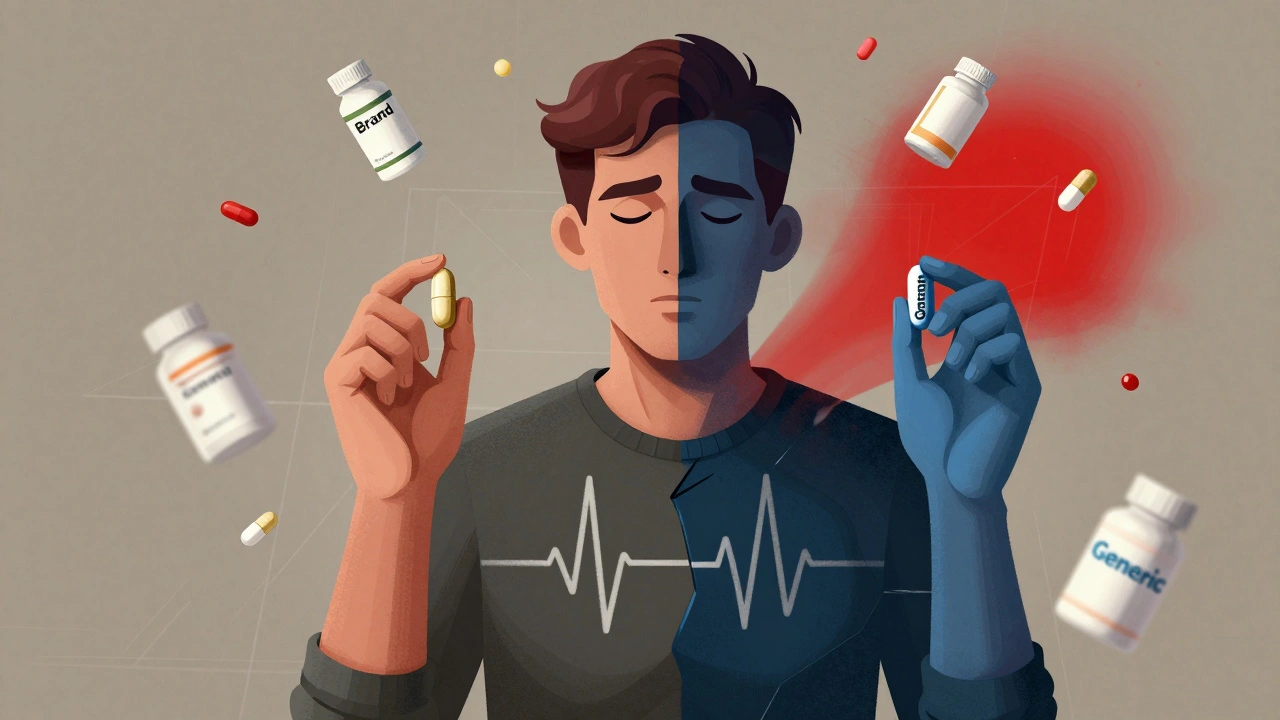
Switching from brand-name drugs to generics is supposed to save money-without sacrificing results. But what happens after six months? Or two years? For millions of people on chronic medications, the real question isn’t whether generics work the same on paper. It’s whether they keep working over time-without hidden risks, worsening symptoms, or dropped adherence.
Why the Switch Feels Safe (But Isn’t Always)
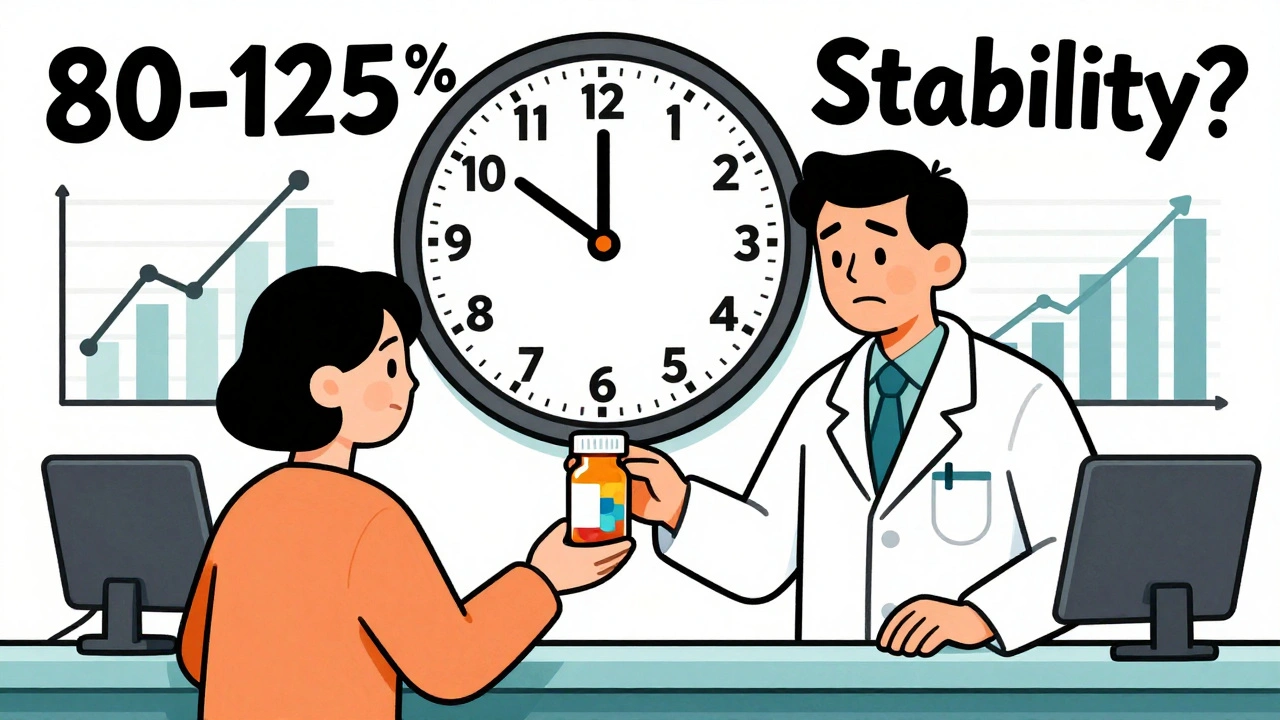
The FDA says generics are bioequivalent. That means their peak concentration and total absorption in the blood fall within 80% to 125% of the brand-name version. Sounds tight, right? But that’s based on a 2- to 4-week study in healthy volunteers. Real patients take these pills for decades. And long-term, small differences add up.
Take blood pressure meds like losartan or valsartan. A 2017 Canadian study tracked patients for a full year after switching to generics. Adverse events-dizziness, fatigue, spikes in blood pressure-went up by 8% to 14% in the first month and stayed higher. The brand-name version had been stable for years. The generic met the FDA’s numbers. But the body didn’t respond the same way.
Same story with epilepsy drugs. A 2013 study found that when patients switched to a different generic version-even one that passed bioequivalence tests-their seizure control worsened. Why? Because pill shape, color, or size changed. Patients got confused. They missed doses. Or worse, they stopped taking them altogether. Over 12 months, persistence dropped by 35%.
Not All Generics Are Created Equal
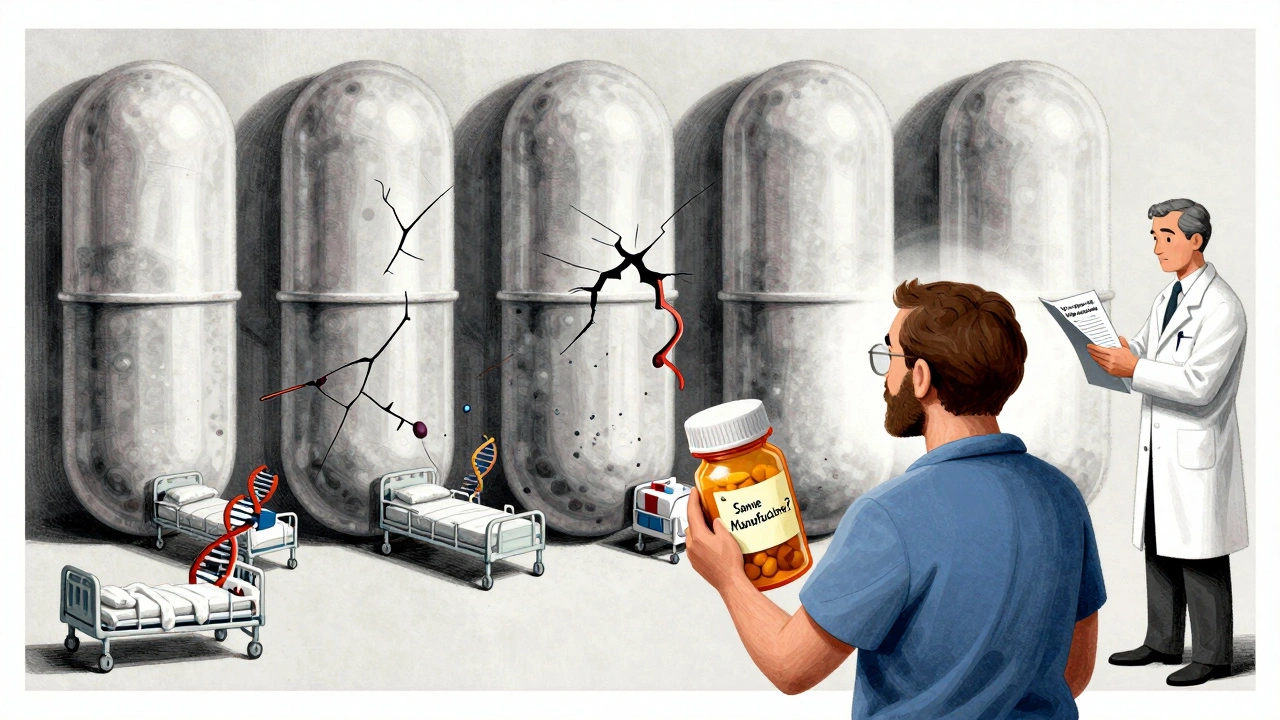
Here’s the part no one talks about: generics aren’t all made the same. A 2021 study from Ohio State University found that generics made in India had 27% more severe adverse events-hospitalizations, disability, even death-than those made in the U.S. The difference wasn’t in the active ingredient. It was in the fillers, the manufacturing process, the purity controls.
One patient on PatientsLikeMe, ‘HeartWarrior42,’ switched from brand-name metoprolol to a generic made overseas. Over 18 months, her heart rate became erratic. She had two hospital visits for arrhythmia. When she switched back to the brand, her rhythm stabilized. Her doctor couldn’t explain it. The lab reports said the generics were identical. But her body knew the difference.
Even within the U.S., not all manufacturers are equal. A single drug can come from five different factories. If your pharmacy switches your prescription from one maker to another every few months, your body never gets used to the new version. That’s why the American Heart Association recommends sticking with one generic manufacturer-if you’re on a narrow therapeutic index drug like warfarin, levothyroxine, or seizure meds.
The Adherence Trap
Generics are cheaper. That’s the whole point. But cheaper doesn’t always mean better adherence. In fact, when patients see their pill change color or shape, they start to doubt it. A 2020 University of Pittsburgh survey found that 61% of patients felt uneasy when their generic looked different. One in five reduced their adherence because they weren’t sure if it was the same drug.
On the flip side, statins are a rare win. A 2006 study showed 77% of patients stayed on generic statins versus 71% on brand-name. Why? Because the cost dropped from $400 a month to $4. That’s life-changing for retirees on fixed incomes. For them, generics didn’t just save money-they saved lives. Hospitalizations for heart attacks and strokes dropped by 8% over five years.
So the answer isn’t simple. For some drugs, generics are a clear upgrade. For others, they’re a gamble.
What the Experts Are Saying
Dr. Aaron Kesselheim from Harvard puts it plainly: ‘Assuming all generics are interchangeable for all patients over the long term? That’s not supported by evidence.’
Dr. Jerry Avorn, also at Harvard, adds: ‘The 80-125% bioequivalence range allows for clinically meaningful differences. Those differences may not show up in a month. But after five years of daily use? They can.’
And then there’s Dr. Corey Nislow from the University of British Columbia. His team found DNA-damaging contaminants in 37% of tested generics. These aren’t acute toxins. They’re slow-builders. They might not cause harm today. But what about in 10 years? We don’t know. And that’s the scary part.
The FDA still says generics are safe. But they’re now requiring 36 months of stability data for drugs used in chronic conditions-up from 24 months. That’s progress. But it’s still not enough. Most long-term studies don’t exist.
How to Protect Yourself
If you’re on a chronic medication and your pharmacy switches you to a generic, here’s what to do:
- Ask which manufacturer made your pill. Write it down. Don’t assume it’s the same next month.
- Don’t let your pharmacy switch you without telling you. Many states allow automatic substitution. You have the right to say no.
- Monitor your symptoms. If you feel worse-more fatigue, dizziness, heart palpitations, seizures, mood swings-don’t brush it off. Track it. Bring it to your doctor.
- Request consistency. If you’re on a narrow therapeutic index drug (epilepsy, thyroid, blood thinners, heart rhythm meds), ask for the same generic brand every time. If your insurance won’t cover it, ask for a medical exception.
- Use the same pharmacy. Chain pharmacies often switch manufacturers to cut costs. Independent pharmacies are more likely to stick with one source.
One patient, ‘SeniorHealth456,’ wrote on Healthgrades: ‘My statin went from $400 to $4. My cholesterol’s been stable for five years. No issues.’ That’s the success story. But it’s not universal.
The Bigger Picture
Generics saved $1.67 trillion between 2008 and 2017. That’s real money. For people without insurance, they’re life-saving. But the system is built on speed and cost-not long-term safety.
Pharmacy benefit managers (PBMs) force switches to save a few cents per pill. They don’t care if you end up in the hospital six months later. And most doctors don’t track which generic manufacturer you’re on. Electronic records rarely include that detail.
That’s changing. The National Quality Forum now says manufacturers should be tracked in medical records. But only 35% of U.S. health systems do it. In Europe, Germany and France require 24 months of stability data before allowing generics for chronic conditions. The U.S. is still catching up.
When to Stick With Brand
You don’t have to switch. If your brand-name drug is working, and you can afford it-even with insurance-there’s no rush. The goal isn’t to use generics for the sake of savings. It’s to stay healthy.
For these conditions, think twice before switching:
- Antiepileptic drugs (phenytoin, carbamazepine, valproate)
- Thyroid meds (levothyroxine)
- Blood thinners (warfarin)
- Heart rhythm drugs (amiodarone, digoxin)
- Immunosuppressants (cyclosporine, tacrolimus)
These drugs have a narrow therapeutic window. A 10% difference in absorption can mean the difference between control and crisis.
For statins, blood pressure pills, or diabetes meds like metformin? Generics are usually fine. But even then, watch for changes in how you feel.
The Bottom Line
Generics aren’t good or bad. They’re tools. And like any tool, their value depends on how you use them.
For many, they’re a lifeline. For others, they’re a risk. The key isn’t to avoid generics. It’s to control the switch. Know what you’re taking. Track your body’s response. Don’t let cost-cutting decisions override your health.
If your medication works, don’t fix it. If you’re switched without warning, speak up. And if you notice something off-fatigue, mood changes, worsening symptoms-don’t wait. Go back to your doctor. Bring your pill bottle. Ask: ‘Is this the same one I was on?’
Long-term health doesn’t come from a price tag. It comes from consistency, awareness, and a voice that won’t stay silent.
Jennifer Anderson
December 6, 2025 AT 12:42i switched my levothyroxine to a generic last year and my energy dropped so hard i thought i was dying. my doctor said 'it's the same chemical' but my body was like NOPE. i went back to brand and now i can actually get out of bed. also, my pill went from white oval to blue triangle and i swear i felt weird just seeing it.
Sadie Nastor
December 6, 2025 AT 15:23omg yes!! 🙌 i had the same thing with my blood pressure med. switched to generic and started getting dizzy every time i stood up. thought i was going to pass out at the grocery store. turned out the filler was different and my body just... rejected it. now i ask for the exact brand every time. pharmacy thinks i'm crazy but hey, i'm alive 😅
Kyle Flores
December 7, 2025 AT 08:02as someone who’s been on warfarin for 12 years, this is spot on. i’ve had two different generics switch on me in the same year. one time my INR spiked to 5.8. i almost bled out. the pharmacist said 'they’re both FDA approved'-yeah, but one’s from India and the other’s from Ohio. i now have a note in my chart that says 'NO SUBSTITUTIONS.' if your doctor doesn’t get it, find a new one.
Ryan Sullivan
December 7, 2025 AT 21:48The entire premise of this post is dangerously misinformed. Bioequivalence is a statistically validated metric. If your 'body knows the difference,' you're either placebo-driven or noncompliant. The 80-125% range is not a loophole-it's a pharmacokinetic boundary derived from decades of peer-reviewed trials. To suggest that fillers cause arrhythmias is pseudoscience masquerading as patient advocacy. Also, 'HeartWarrior42' is clearly a Reddit sock puppet.
Wesley Phillips
December 9, 2025 AT 16:00lol at the guy who thinks generics are 'unsafe' 🤡 i take generic metformin and my A1c is lower than ever. also my pharmacist switched me to a new maker and i didn’t even notice. you people are so obsessed with pills you forget they’re just chemicals. if you’re feeling weird, maybe it’s your anxiety? or your diet? or your cat staring at you? 🐱
Olivia Hand
December 11, 2025 AT 15:13the 2021 Ohio State study on Indian-made generics? i read that paper. the real issue wasn’t the fillers-it was the lack of GMP compliance in certain facilities. and yes, some US-made generics are just as bad if they’re from the cheapest bidder. but the bigger problem? PBMs. they don’t care about your INR, your seizure threshold, or your heart rhythm. they care about the $0.03 they save per pill. and your doctor? they’re not even looking at the manufacturer code on the bottle. this isn’t about fear. it’s about systemic neglect.
Desmond Khoo
December 11, 2025 AT 16:19my mom’s on levothyroxine and we made her pharmacy print the manufacturer on the label. now she knows if it’s Teva or Mylan. no more guessing. also, we track her symptoms in a little notebook. it’s low tech but it works. if you’re on one of those high-risk meds, just do the work. your life’s worth it 💪❤️
Nancy Carlsen
December 13, 2025 AT 10:04thank you for writing this. i’m a nurse in rural Texas and i see this every day. patients switch to generics, get worse, and blame themselves. they don’t know they have the right to refuse substitution. i’ve had to fight insurance companies to get a patient their original brand. it’s exhausting. but if we don’t speak up, nothing changes. y’all need to know: your voice matters. ask for the manufacturer. track your symptoms. and if they push back? say 'no.' you’re not being difficult-you’re being smart. 🌟