
When you take a pill for high blood pressure, you expect every tablet to be exactly the same. That’s because small-molecule drugs are made in a lab using chemical reactions - they’re like copies of a blueprint, identical down to the last atom. But when it comes to biologics and biosimilars, that expectation doesn’t hold. These drugs are made from living cells - not chemicals - and that changes everything. Between each batch, or lot, there are tiny, natural differences. Not because the manufacturer made a mistake. Because biology itself is messy.
Why Biologics Are Never Identical
Biologics are large, complex molecules - often proteins or antibodies - produced inside living cells like Chinese hamster ovary cells. These cells don’t follow a rigid recipe. They’re alive. They respond to tiny shifts in temperature, nutrient levels, pH, and even the air they’re exposed to. As a result, every batch of a biologic drug contains millions of slightly different versions of the same protein. Some molecules might have an extra sugar molecule stuck on. Others might have a different amino acid folded in just right. These are called post-translational modifications, and they’re normal.The U.S. Food and Drug Administration (FDA) calls this lot-to-lot variability. It’s not a flaw. It’s a fact of life - literally. The same thing happens with the original brand-name biologic and every biosimilar that follows. In fact, the FDA says: ‘A lot of a reference product and biosimilar can contain millions of slightly different versions of the same protein or antibody.’ That’s not a bug - it’s the system working as designed.
Biosimilars Aren’t Generics - And Here’s Why
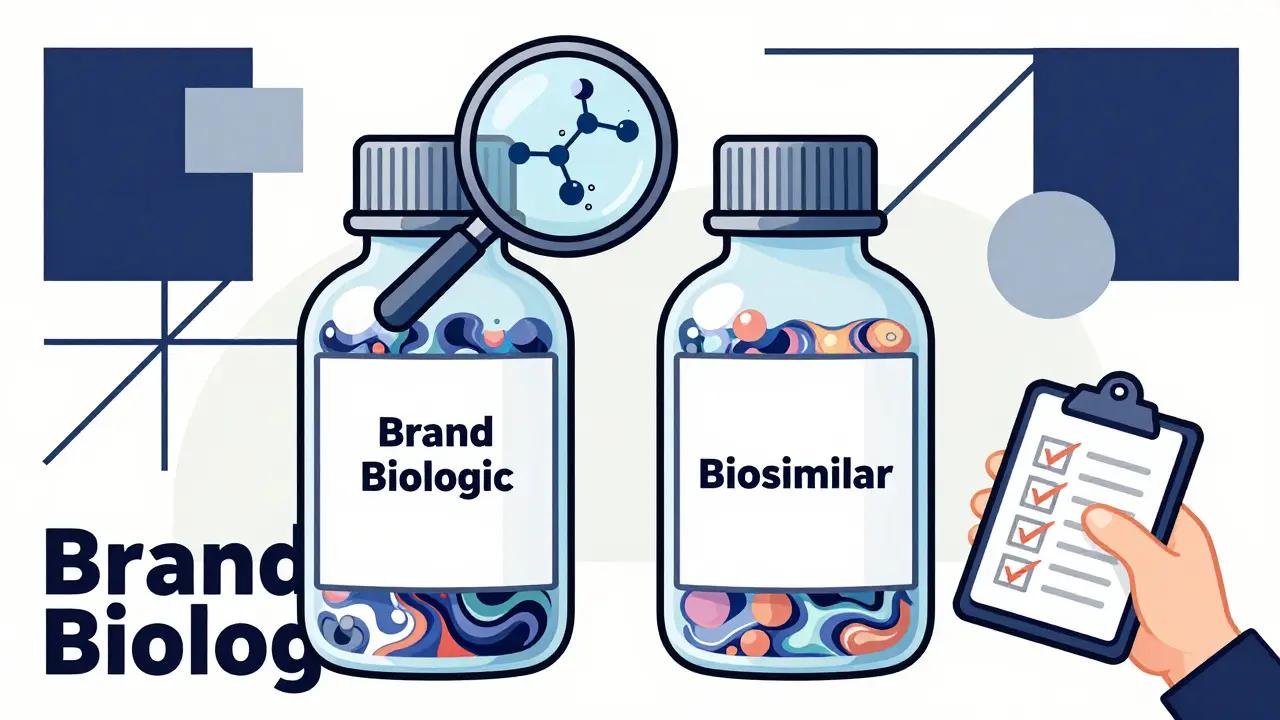
You’ve probably heard that biosimilars are like generics for biologics. That’s misleading. Generics for pills like metformin or atorvastatin must be chemically identical to the brand-name version. They’re exact copies. Biosimilars? They’re highly similar, but not identical. And that’s by design.The FDA clearly states: ‘Biosimilars Are Not Generics.’ Why? Because you can’t copy a living cell’s output the way you copy a chemical compound. A generic aspirin tablet has the same active ingredient, same dose, same shape. A biosimilar to Humira (adalimumab) might have 99.9% structural similarity - but that 0.1% difference? It’s still millions of tiny variations in sugar chains, folding, or charge. These differences are too small to affect safety or effectiveness - but they’re there.
This is why the approval path is so different. Generics follow the ANDA pathway - just prove bioequivalence and you’re done. Biosimilars go through the 351(k) pathway, created by Congress in 2010. That means manufacturers must run hundreds of analytical tests, cell-based functional assays, animal studies, and sometimes clinical trials - all to show that despite the natural variation, their product performs just like the original.
How Regulators Handle the Chaos
The FDA doesn’t demand perfection. They demand consistency. Their job isn’t to eliminate variability - it’s to make sure it doesn’t cross a line. Every biosimilar applicant must show they’ve built controls into their manufacturing process to keep variation within a narrow, safe range. That range is defined by comparing their lots to the reference product’s lots. If the biosimilar’s variation pattern matches the original’s - and the clinical outcomes are the same - it gets approved.For a biosimilar to become interchangeable - meaning a pharmacist can swap it for the brand without asking the doctor - the bar is even higher. The manufacturer must prove that switching back and forth between the biosimilar and the original doesn’t increase risk or reduce effectiveness. That means running studies where patients alternate between the two drugs over months. Only 12 out of 53 approved biosimilars in the U.S. as of May 2024 have this designation.
What Happens in the Lab When Lots Change
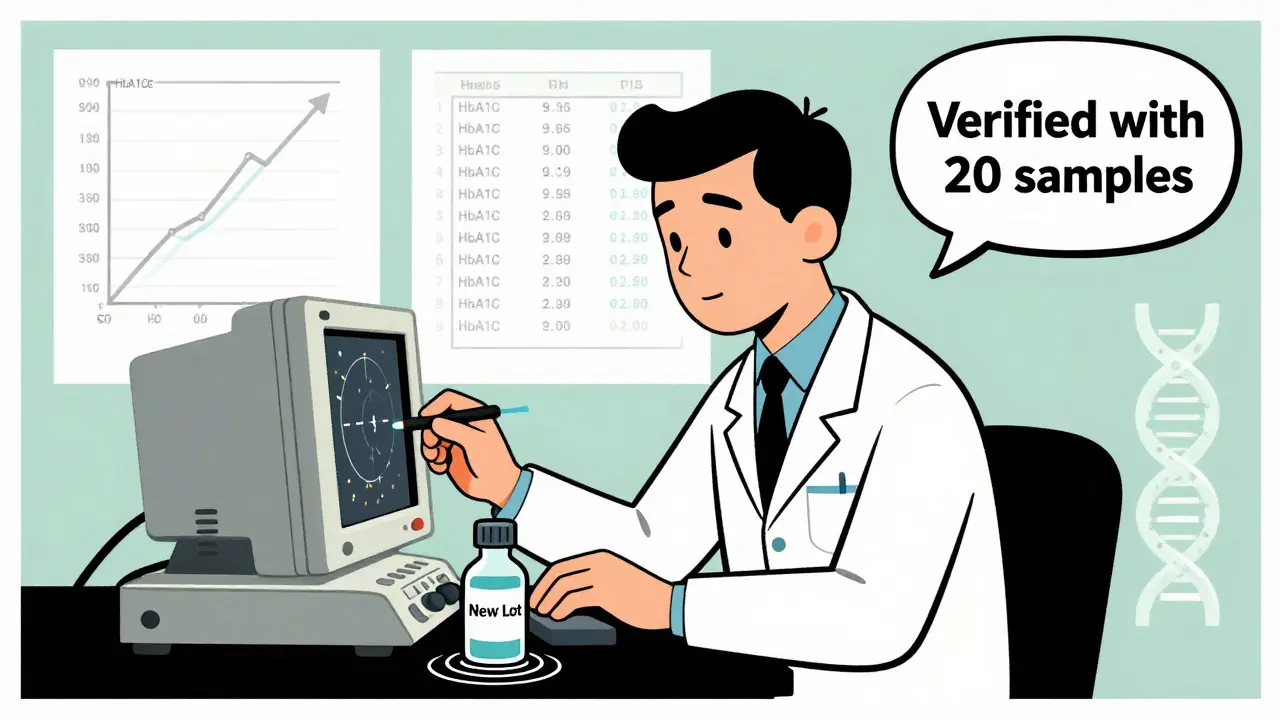
It’s not just patients who feel the ripple of lot-to-lot variability. Labs do too. If your hospital uses a test reagent made from a biologic - say, a protein that detects HbA1c levels for diabetes - and they switch to a new lot, results might shift. Not because the patient’s blood changed. Because the reagent did.A 2022 survey by the Association for Diagnostics & Laboratory Medicine found that 78% of lab directors consider lot-to-lot variation a ‘significant challenge.’ Why? Because quality control materials don’t always behave the same way as real patient samples. A QC sample might show no change between lots, but patient results could jump by 0.5% - enough to affect treatment decisions for someone with diabetes or heart disease.
That’s why labs run verification tests. They take 20 or more patient samples, test them with the old lot and the new lot, and compare the results. If the difference falls within a pre-set tolerance - usually based on analytical precision - they approve the new lot. It’s time-consuming. In smaller labs, this process eats up 15-20% of technical staff time each quarter. And if they miss it? A patient might get a false high or low reading. That’s not theoretical. It’s happened.
How Manufacturers Keep Things Stable
Biotech companies don’t just hope for consistency. They engineer it. They use advanced analytics - mass spectrometry, chromatography, capillary electrophoresis - to map every possible variation in a molecule. They track glycosylation patterns, oxidation levels, deamidation, and aggregation. They build statistical models to predict how changes in fermentation conditions affect the final product.One key rule they follow: ‘Between-reagent lot variation ≤ analytical variation / (n + 1).’ That’s a mouthful, but it means: if your testing method can detect a 2% difference, and you test 10 samples, your new lot can’t vary more than 2% divided by 11 - so about 0.18%. It’s strict. It’s science. And it works.
They also use moving averages - a method first proposed in 1965 - to monitor long-term trends in patient test results. If a new lot causes a slow drift in lab values across hundreds of patients, it shows up before any single test flags it. That’s how you catch subtle shifts before they become problems.
The Big Picture: Why This Matters
The global biosimilars market hit $10.6 billion in 2023 and is expected to hit $35.8 billion by 2028. That growth isn’t happening despite variability - it’s happening because we’ve learned to manage it. Patients with rheumatoid arthritis, Crohn’s disease, or cancer now have access to life-saving treatments at a fraction of the cost. In the U.S., biosimilars now make up about 32% of all biologic prescriptions by volume.But there’s a catch. As biologics get more complex - think antibody-drug conjugates or cell therapies - variability becomes harder to control. A single molecule might have hundreds of possible modifications. The FDA says this will be the next frontier. And they’re right. The tools we use today - mass spectrometers, AI-driven analytics - are getting better. But biology? It’s still biology.
What’s clear is this: lot-to-lot variability isn’t something to fear. It’s something to understand. It’s not a weakness of biosimilars. It’s the nature of biologics. And if we manage it right - with science, not suspicion - we can keep patients safe while lowering costs.
What Patients Should Know
If you’re prescribed a biosimilar, you don’t need to worry. The FDA has approved it based on a mountain of data showing it works just like the original. If you’re switched to a new lot of your drug - whether it’s the brand or the biosimilar - your doctor doesn’t need to do anything. The variation is built in, monitored, and controlled.But if you notice something off - a new side effect, a sudden change in how you feel - tell your doctor. It’s rare, but not impossible. And if you’re on a test that tracks your condition (like HbA1c or drug levels), make sure your lab is tracking lot changes. Ask them: ‘Do you verify reagent lots before using them?’ If they say no, that’s a red flag.
Bottom line: Biosimilars aren’t cheaper because they’re less effective. They’re cheaper because we’ve figured out how to make complex molecules without the brand-name markup. And lot-to-lot variability? It’s just part of the deal.
Is lot-to-lot variability a sign of poor quality in biosimilars?
No. Lot-to-lot variability is a natural part of producing biologics, whether they’re brand-name or biosimilar. It’s not a defect - it’s expected. The FDA requires manufacturers to prove that these variations stay within a safe, consistent range that doesn’t affect safety or effectiveness. In fact, the original brand-name biologic has the same variability. Biosimilars must match that pattern, not eliminate it.
Can I be switched between a biosimilar and the brand-name drug safely?
Only if the biosimilar has the FDA’s ‘interchangeable’ designation. These products have passed extra testing to prove that switching back and forth - even multiple times - doesn’t increase risk or reduce effectiveness. Not all biosimilars are interchangeable. Check your prescription or ask your pharmacist. If it’s not labeled interchangeable, your doctor must specifically prescribe the biosimilar.
Why do labs need to verify reagent lots every time they change?
Because biological reagents can change slightly between lots, and those changes can affect patient results - even if quality control samples look fine. A reagent lot that gives accurate results for control samples might still give a 0.5% bias in real patient blood. That small shift could change a diagnosis or treatment plan. Verification with real patient samples ensures the new lot won’t mislead clinicians.
Are biosimilars less effective than the original biologic?
No. Over 50 biosimilars have been approved in the U.S. since 2015, and studies consistently show they work just as well as the original. Patients on biosimilars for conditions like rheumatoid arthritis, Crohn’s disease, and cancer have the same response rates, side effect profiles, and long-term outcomes. The slight natural variations don’t translate into clinical differences.
Will my insurance cover biosimilars?
Yes, and often they’re preferred. Most insurance plans encourage or require biosimilars because they cost 15-35% less than the original biologic. Some plans won’t cover the brand-name drug unless you’ve tried the biosimilar first. Check your formulary or ask your pharmacist. The savings add up - for you and the system.
What’s the difference between a biosimilar and a biologic?
A biologic is the original, brand-name drug made from living cells - like Humira or Enbrel. A biosimilar is a copy of that biologic, made after the patent expires. They’re not identical, but they’re highly similar and work the same way. Biosimilars go through a different approval process than generics because they’re too complex to copy exactly. Think of it like two hand-knitted sweaters: same pattern, same wool, but tiny differences in stitch tension. Both keep you warm.
What Comes Next
The future of biologics is getting more complex. New drugs like antibody-drug conjugates, fusion proteins, and gene therapies are emerging. These aren’t just proteins - they’re intricate machines made of multiple components. Controlling variability in these will be harder. But the tools are improving. AI is helping predict how small changes in manufacturing affect the final product. New analytical techniques can now detect changes at the single-molecule level.What won’t change? The principle: biology is variable, but it’s manageable. We don’t need perfect copies. We need consistent performance. And with the right science, the right regulation, and the right communication - we’re getting there.
Diana Stoyanova
January 7, 2026 AT 13:40Okay but let’s be real - if your body can handle 100 different versions of your own proteins every day, why are we freaking out about a 0.1% variation in a drug? Biology is messy. That’s not a bug, it’s the feature. I’ve been on biosimilars for RA for 5 years and I’m still standing, laughing, and drinking coffee like a normal human. 🤷♀️
Jenci Spradlin
January 8, 2026 AT 23:51lol i always thought biosimilars were just cheap knockoffs til i read this. turns out they’re like handmade sweaters vs factory ones - same warmth, different stitch patterns. also, my lab tech told me they have to retest every new lot like it’s a new baby. wild.
Elisha Muwanga
January 9, 2026 AT 23:04It’s appalling that the FDA allows this level of inconsistency in life-saving medications. In Germany, they demand precision. In Japan, they enforce uniformity. Here, we celebrate ‘biological chaos’ as if it’s some kind of virtue. This isn’t innovation - it’s regulatory surrender.
Maggie Noe
January 11, 2026 AT 02:19Imagine if your iPhone battery varied 0.1% between charges… you’d return it. But somehow, when it’s your immune system? ‘Oh it’s biology!’ 😒 I get it, but… still. 🤔
Gregory Clayton
January 11, 2026 AT 19:07Y’all are overthinking this. My cousin got switched to a biosimilar and now she’s not crying in the bathroom every morning from pain. Who cares if the sugar chains are slightly different? If it works, it works. Stop overanalyzing and let people live.
Catherine Scutt
January 12, 2026 AT 01:59People who don’t understand this are the same ones who think ‘natural’ means ‘better.’ This isn’t herbal tea. It’s precision medicine built on chaos. If your lab doesn’t verify reagent lots, they’re not just sloppy - they’re dangerous.
tali murah
January 12, 2026 AT 10:37Oh look, another article glorifying corporate loopholes. The FDA doesn’t ‘manage variability’ - they just lower the bar until the drug passes. And yet somehow, the brand-name version gets to be the ‘gold standard’ while the biosimilar is the ‘imperfect copy.’ Double standards much?
Pooja Kumari
January 13, 2026 AT 16:33Actually, this reminds me of when I was in Mumbai and we had to switch insulin lots every three months. My aunt’s sugar levels would spike for two weeks after each change - no one told us why. We thought it was her diet. Turns out, it was the lot. And no one in the clinic even tracked it. I cried for days. This isn’t just theory - it’s real pain, real fear, real neglect. 💔
Jacob Paterson
January 14, 2026 AT 09:37Wow. So you’re telling me the entire system is built on trusting that a 0.1% difference won’t kill someone? That’s not science - that’s Russian roulette with a syringe. And you wonder why people don’t trust medicine anymore?
Angela Stanton
January 15, 2026 AT 23:41Post-translational modifications? Glycosylation heterogeneity? Aggregation profiles? Yeah, we track all of it via LC-MS/MS with isotopic labeling and multivariate statistical process control (SPC) - but only if you have a $2M lab. Most community hospitals? They’re flying blind. The system is broken because the cost of verification isn’t subsidized. It’s not about biology - it’s about underfunding.
Johanna Baxter
January 16, 2026 AT 10:58I got switched to a biosimilar and my face broke out in hives. My doctor said ‘it’s probably stress.’ I know better. This isn’t normal. They should test this stuff on real people before they roll it out. Not just ‘statistical models.’ I’m not a data point.
Jerian Lewis
January 16, 2026 AT 16:42Lot-to-lot variability is just another reason we need universal healthcare. If you’re paying $10k a month for a biologic, you shouldn’t have to worry about whether your insurance switched you to a different batch. This isn’t science. It’s capitalism.