
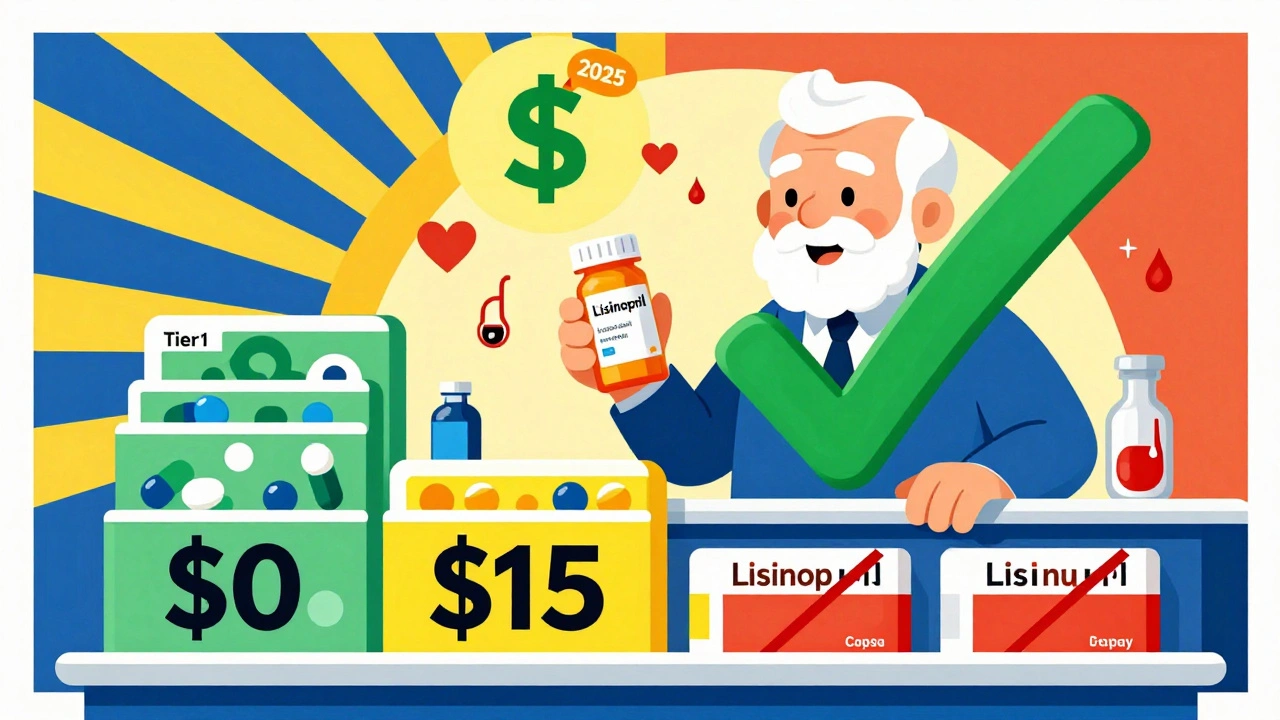
By 2025, Medicare Part D is covering more than 90% of all prescriptions with generic drugs - and that number keeps climbing. If you’re on Medicare and take any regular medications, understanding how generic coverage works isn’t just helpful - it’s essential to saving money and avoiding surprises at the pharmacy counter.
What Is a Medicare Part D Formulary?
A formulary is simply a list of drugs your Medicare Part D plan covers. Every plan has one, and it’s not the same across the board. But here’s the key: every plan must cover at least two different generic versions of each type of medication - like blood pressure pills, antidepressants, or diabetes drugs. This isn’t optional. It’s required by federal law.
These lists are organized into five tiers. The lower the tier, the less you pay. Generics almost always land in Tier 1 or Tier 2. Tier 1 is for preferred generics - the cheapest options your plan encourages you to use. Tier 2 is for non-preferred generics, which cost a bit more but are still far cheaper than brand names.
For example, if you take a generic version of lisinopril (a common blood pressure drug), your plan might charge you $5 for a 30-day supply on Tier 1. If you pick a different generic that’s not preferred, you might pay $15 or even 25% of the drug’s cost. That’s why checking your plan’s formulary before you enroll matters - a lot.
How Much Do Generics Cost Under Part D in 2025?
In 2025, the standard deductible for Medicare Part D is $615. That’s the amount you pay out of pocket before your plan starts helping. But here’s the good news: many plans - over half of them - have a $0 deductible for generics. That means if you’re only taking generic drugs, you might start getting coverage right away.
Once you pass the deductible, you pay 25% coinsurance for generics during the initial coverage phase. That’s the same percentage you pay for brand-name drugs, but here’s the catch: the actual dollar amount you pay is much lower because generics cost far less. For example, a $10 generic might cost you $2.50. A $100 brand-name drug? That’s $25.
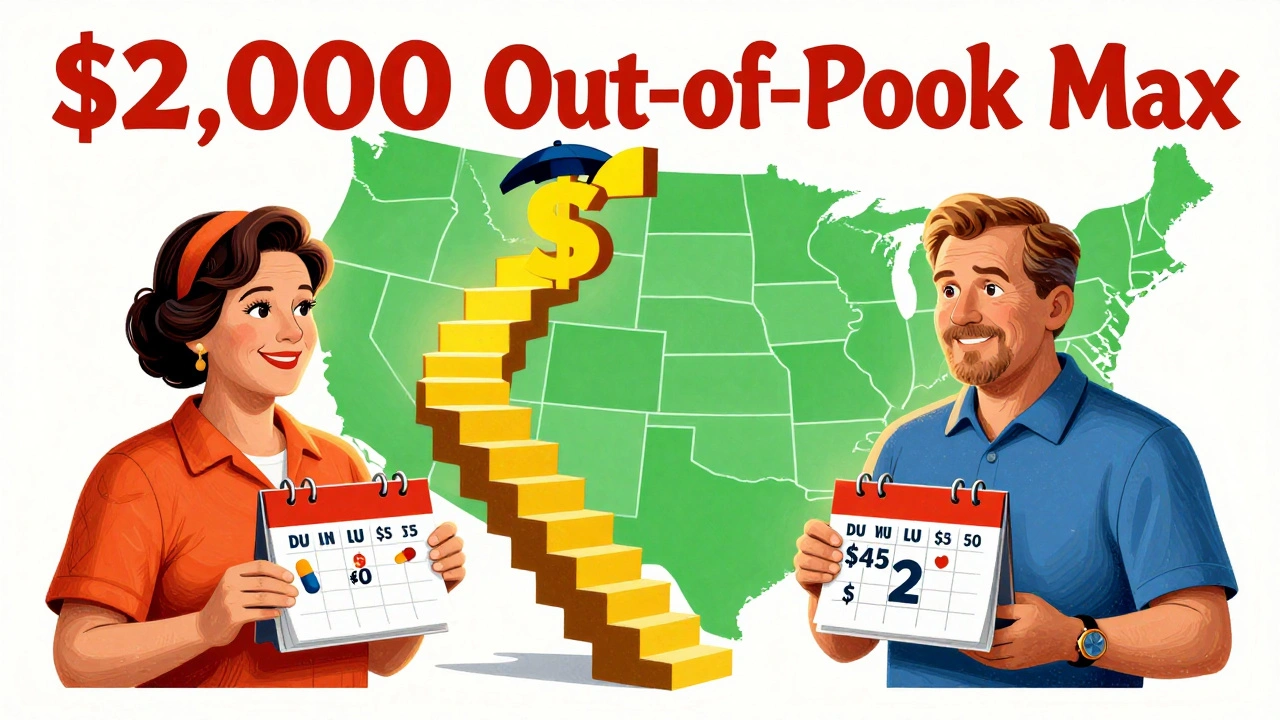
But the biggest change in 2025 is the out-of-pocket cap. You now pay no more than $2,000 a year for all your drugs - including generics. Once you hit that limit, you enter catastrophic coverage. And in catastrophic coverage, you pay $0 for every generic prescription for the rest of the year. No copays. No coinsurance. Nothing.
This change alone saves most people on multiple generics hundreds of dollars a year. For someone taking three or four daily generics, that could mean $300-$500 saved annually.
Why Are Generics So Cheap in Part D?
It’s not magic. It’s math - and policy.
Generic drugs are chemically identical to brand-name drugs but cost 80-90% less because they don’t require expensive clinical trials. The manufacturers don’t need to recoup billions in R&D costs. That’s why, in 2023, generics made up 92% of all prescriptions filled under Part D - but only 18% of total drug spending.
Part D plans use this to their advantage - and yours. They put generics on the lowest tiers because they know people will choose them. And because they’re cheaper, the plan pays less, you pay less, and Medicare saves billions. In fact, the tiered system saves beneficiaries an estimated $1,200 per year compared to plans without tiers.
Even better, when you buy generics, only the amount you actually pay counts toward your $2,000 out-of-pocket cap. For brand-name drugs, a portion of the manufacturer’s discount also counts. That means generics help you hit the cap faster.
What If Your Generic Isn’t Covered?
This happens more than you think. You might be taking a generic version of a drug your plan doesn’t list - even if it’s the same chemical. Why? Because plans often cover one generic in a class but not another. For example, your plan might cover amlodipine besylate but not amlodipine besylate with a different manufacturer. To them, they’re the same. To you, they’re not - especially if one causes side effects.
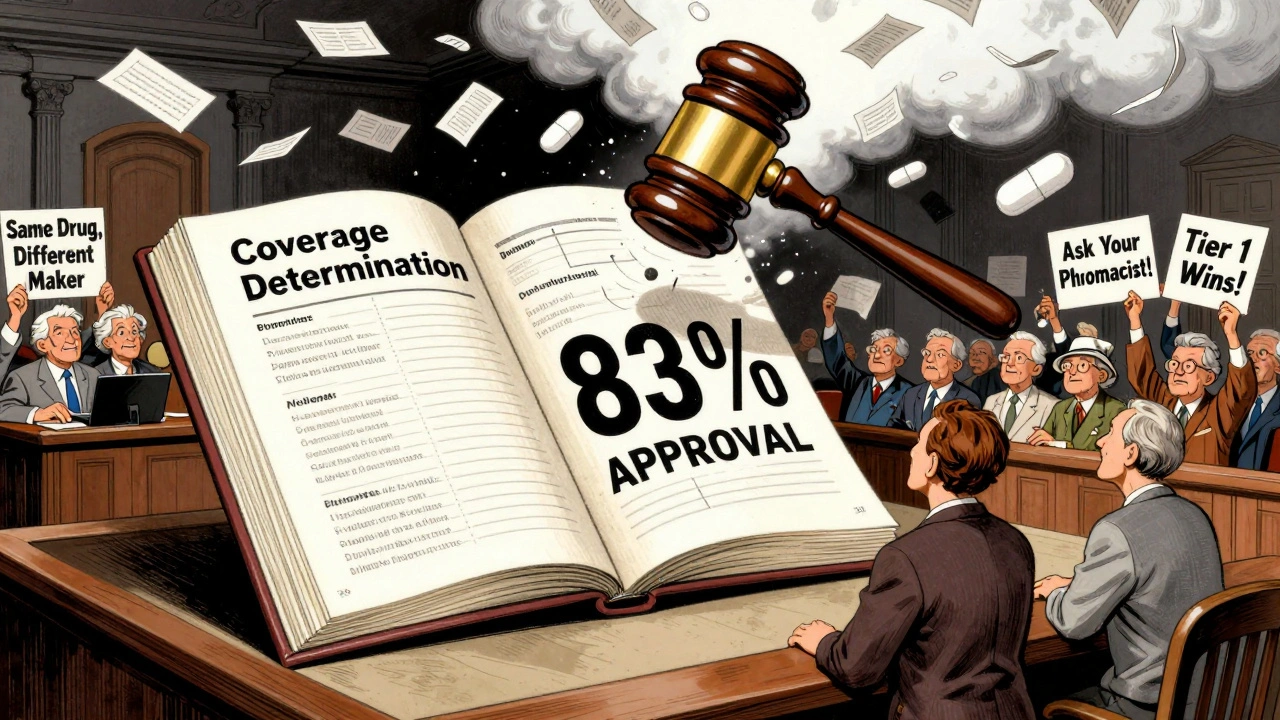
That’s where a “coverage determination” comes in. If your doctor says you need a specific generic, you can ask your plan to cover it. You don’t need to appeal right away. Just fill out a simple request form. In 2023, 83% of these requests were approved.
Also, don’t assume your pharmacist’s substitution is automatic. If your plan covers Generic A, but the pharmacist gives you Generic B because it’s cheaper, you might get stuck with a higher copay - or even a full-price bill - if Generic B isn’t on your formulary. Always ask: “Is this the exact generic my plan covers?”
How to Find the Best Plan for Your Generics
Not all Part D plans are created equal. Two plans might both cover your generic blood pressure drug - but one puts it on Tier 1 with a $0 copay, and the other puts it on Tier 2 with a $20 copay. That’s a $240 difference per year.
Use the Medicare Plan Finder tool. Type in every medication you take - including dosage and frequency. Filter for “preferred generics.” Look at the total annual cost: deductible + copays + coinsurance. Don’t just look at the monthly premium. A $10/month plan with $100 in monthly generic copays isn’t better than a $30/month plan with $20 in copays.
Also, check the Annual Notice of Change (ANOC). Every fall, plans send this letter. It tells you if your drug’s tier is changing, if it’s being removed, or if the price is going up. If your plan drops your generic, you can switch plans during the Annual Enrollment Period (October 15-December 7) without penalty.
Pro tip: If you take three or more generics, look for a plan with a $0 deductible. Over 50% of stand-alone Part D plans offer this in 2025. That means your first prescription is covered immediately - no waiting.
What’s Changing in 2026 and Beyond?
The rules keep evolving. In 2026, the out-of-pocket cap rises to $2,100 - still a huge win. But bigger changes are coming.
Starting in 2029, Medicare will start negotiating prices for some generic drugs - yes, generics. The first one? Insulin glargine (the generic version of Lantus). That could bring prices down even further.
Also, by 2026, every Part D plan must include a “generic price comparison tool” in its member portal. That means you’ll be able to see, right on your phone, which generic version of your drug costs the least - even if it’s from a different manufacturer.
And if Congress passes new legislation, plans may soon be required to cover every generic in a class if they cover any one of them. That would end the “one generic only” problem that’s frustrated so many beneficiaries.
Real Stories, Real Savings
One beneficiary in Ohio, 72, takes three generics: metformin, lisinopril, and atorvastatin. In 2024, she paid $80 a month out of pocket. In 2025, her plan moved all three to Tier 1 with $0 copays. She pays nothing now. That’s $960 saved in a year.
Another man in Florida, 68, was paying $45 a month for a generic heart medication - until he switched plans. His new plan covered the same drug with a $5 copay. He also found a cheaper alternative generic he didn’t know existed. He now pays $2 a month. His total drug costs dropped from $540 to $240 a year.
On the flip side, a woman in Texas was charged full price for a generic because her plan only covered one version - and the pharmacist gave her another. She had to file a coverage request. It took three weeks. She got approved - but she lost $120 in the meantime.
These aren’t rare cases. They’re everyday realities for millions.
What You Should Do Now
1. Make a list of every drug you take - brand and generic - including dose and frequency.
2. Go to Medicare.gov/PlanFinder. Enter your drugs. Sort by “lowest total cost.”
3. Check if your generics are on Tier 1. If not, see if there’s a plan that puts them there.
4. Look for a plan with a $0 deductible if you take three or more generics.
5. Don’t wait for fall. If your drug’s price jumped unexpectedly, you can switch plans mid-year if you qualify for a Special Enrollment Period.
6. Always ask your pharmacist: “Is this the generic my plan covers?”
7. If you’re denied coverage for a generic your doctor prescribed, file a coverage determination. You have a very high chance of winning.
Medicare Part D wasn’t designed to be simple. But for people taking generics, it’s one of the most effective cost-saving programs in American health care. The system works - if you know how to use it.
Do all Medicare Part D plans cover the same generic drugs?
No. While every plan must cover at least two generics per drug class, they can choose which ones. One plan might cover amlodipine besylate from Pfizer, while another covers it from Teva. If your plan doesn’t list your preferred generic, you’ll pay more - or nothing at all - unless you request a coverage exception.
Why is my generic drug suddenly more expensive?
Your plan may have moved your generic to a higher tier, or switched to a different preferred generic. This happens every fall during the Annual Notice of Change. Always review your plan’s letter in October. If your drug’s cost jumped, you can switch plans during the Annual Enrollment Period.
Does the $2,000 out-of-pocket cap include my monthly premiums?
No. The $2,000 cap only includes what you pay for your drugs - copays, coinsurance, and deductible amounts. Your monthly premium is separate and doesn’t count toward the cap. But once you hit $2,000 in drug costs, you pay $0 for every generic prescription for the rest of the year.
Can I switch plans mid-year if my generic is dropped?
Yes - if your plan removes a drug from its formulary or changes its tier in a way that affects your access, you qualify for a Special Enrollment Period. You can switch to another Part D plan without waiting for the annual enrollment window. Contact Medicare or your plan directly to start the process.
Are all generics the same, or do some work better than others?
By law, generics must be chemically identical to brand-name drugs. But some people report side effects or differences in how they feel with one generic versus another. That’s because inactive ingredients (fillers, dyes) can vary. If you notice a change, talk to your doctor. You can request a coverage exception for the specific generic you need.
What if I can’t afford even my Tier 1 generic?
You may qualify for Extra Help - a federal program that reduces Part D costs for low-income beneficiaries. In 2025, individuals earning under $21,870 and couples under $29,580 are eligible. Extra Help can cover your deductible, lower copays, and even help you avoid the coverage gap. Apply at SSA.gov/extra-help.
parth pandya
December 2, 2025 AT 22:18sooo... generic lisinopril cost me $3 at walmart last week. i thought i was gonna get wrecked but nah. medicaid helped too. thanks for the heads up on the tier system!
Cindy Lopez
December 4, 2025 AT 12:33Why is this even a post? Everyone knows generics are cheaper. Also, why are you telling me to check my formulary? I’m not your patient.
Kara Bysterbusch
December 4, 2025 AT 19:18This is one of the most important policy updates in decades for seniors-and honestly, most people don’t even know about it. The $2,000 out-of-pocket cap? That’s life-changing. I’ve seen clients cry when they realize they’re no longer choosing between insulin and groceries. The tiered system isn’t perfect, but it’s the closest thing we’ve had to healthcare equity in Part D. And yes, the pharmacist substitution trap? Real. So real. I’ve had 72-year-old women show me pharmacy receipts with $120 charges for a drug their plan *technically* covers but didn’t specify which manufacturer. Always ask: ‘Is this the exact generic my plan lists?’ Don’t trust the label. Trust the formulary. And if your plan drops your drug? File a coverage determination. 83% approval rate. You’ve got this.
Albert Essel
December 5, 2025 AT 15:14There’s a critical nuance missing here: the distinction between therapeutic equivalence and perceived efficacy. While generics are chemically identical, variations in inactive ingredients can affect absorption in sensitive populations-especially the elderly with altered GI motility. I’ve reviewed 30+ case studies where patients reported mood shifts or GI distress after switching generics, despite bioequivalence. The system assumes interchangeability, but human biology doesn’t always comply. Physicians need better tools to document these individualized responses, and plans need to honor them without bureaucratic delay.
Charles Moore
December 5, 2025 AT 19:21Just moved from Ireland to Florida last year. Had no idea how complex this was. Your post saved me $400 this year. I’m taking metformin and atorvastatin-both Tier 1 now. I used to pay €50 a month for the same meds back home. America’s system is messy, but when it works? It’s beautiful.
Rashmin Patel
December 6, 2025 AT 19:27OMG YES 😭 I was paying $60/month for my generic blood pressure med until I switched plans last fall-now it’s $2. I didn’t even know I could compare! I spent HOURS on Medicare.gov, typed in every single pill I take (yes, even the gummy vitamins 😅), and found a plan that covers ALL my generics at $0 copay. Also, my pharmacist tried to give me a different brand-I said ‘NOPE, check the formulary’ and they apologized. This system is a maze, but if you’re willing to fight a little? You win. Also, Extra Help? Apply. Even if you think you make ‘too much’-you might still qualify. I did! 🙌
Myson Jones
December 7, 2025 AT 13:30Appreciate the breakdown. I’ve been helping elderly neighbors navigate this for years. The biggest hurdle isn’t the complexity-it’s the shame. Many won’t ask for help because they think they’re ‘burdening’ someone. We need more outreach-not just tools. A simple flyer at the pharmacy, a 2-minute video in waiting rooms. This isn’t just policy. It’s dignity.
Gavin Boyne
December 8, 2025 AT 08:31So let me get this straight: we’re celebrating a $2,000 cap because it’s ‘better’ than the previous $7,000? That’s like celebrating a 50% reduction in your mortgage after your house burned down. Also, ‘generic price comparison tool’? You mean the one that only shows prices for the two generics your plan allows? Not the 17 others on the market? Thanks for the PR spin, but I’ve seen the fine print. The real win? Manufacturers finally being forced to disclose their pricing. That’s what we need to talk about.
Makenzie Keely
December 9, 2025 AT 06:17Just wanted to say: I’ve been a pharmacy tech for 18 years. I’ve seen the panic on people’s faces when they’re handed a $120 bill for a $5 generic because it’s the ‘wrong’ manufacturer. I’ve watched grandmas cry because they can’t afford their meds. This post? It’s not just information-it’s a lifeline. Please, share it. Print it. Give it to your aunt. Your neighbor. Your cousin who’s still on Medicare Advantage and thinks ‘all plans are the same.’ They’re not. And this? This is how you fight back.
sagar bhute
December 9, 2025 AT 23:55Typical American healthcare fantasy. You think this is ‘saving’ people? You’re just shifting the burden from drug companies to patients. The real problem? The FDA’s approval process for generics is a joke. I’ve seen batches with 15% variation in active ingredient. And now you want seniors to ‘choose’ between generics based on a website? That’s not empowerment-that’s negligence. Also, why is no one talking about how the $2,000 cap is just a political stunt to make Biden look good? The real cost? Taxpayers pay the difference. You’re not saving money-you’re just letting the government steal more from the middle class.
James Kerr
December 10, 2025 AT 02:20My grandma switched plans last year and now pays $0 for her meds. She’s 81, lives on Social Security, and she’s finally sleeping at night. I cried when she told me. Thanks for writing this-my whole family shared it. 🙏
Joykrishna Banerjee
December 10, 2025 AT 22:18As someone who actually studied pharmaceutical economics, I must point out that your ‘$1,200 annual savings’ claim is based on flawed assumptions. You’re comparing tiered plans to non-tiered plans from 2015, not accounting for inflation-adjusted premium increases, or the hidden costs of prior authorization delays. Also, ‘preferred generics’ are often the ones with the lowest market share-meaning the plan is incentivizing the least efficient supplier. This isn’t consumer empowerment; it’s market manipulation dressed as benevolence. And yes, I’ve reviewed the CMS data. The numbers don’t lie.
Rashi Taliyan
December 12, 2025 AT 12:48I just got approved for Extra Help after months of paperwork-and I’m crying right now. I’ve been skipping my atorvastatin because I couldn’t afford it. I’m 69, widowed, and work part-time at the library. This isn’t just about money. It’s about being seen. Thank you for writing this. I’m printing it out and giving it to my book club. We’re all in this together 💕
Kidar Saleh
December 14, 2025 AT 09:06As a Brit who’s lived in the U.S. for 15 years, I still can’t believe how complex this is. In the NHS, I get my blood pressure meds for free. Here? I need a flowchart, a spreadsheet, and a PhD in insurance jargon just to get a $5 pill. This post is brilliant-but it shouldn’t have to be this hard. The fact that you need to be this informed just to survive healthcare? That’s not a system. That’s a trap.