
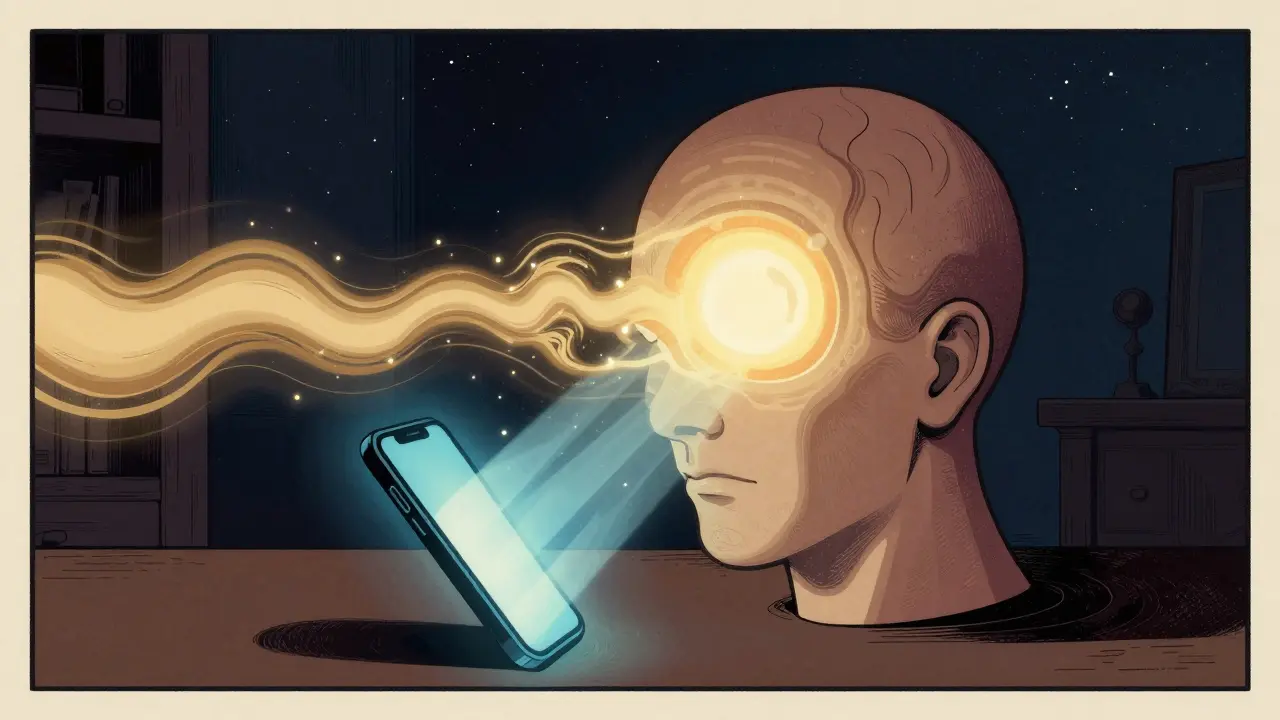
Most people think melatonin is a sleeping pill. It’s not. It’s a melatonin signal - your body’s way of saying, "It’s dark. Time to wind down."
If you’ve ever taken melatonin and felt nothing, you’re not alone. Many people pop a 5mg or 10mg tablet at midnight, lie awake, and blame the supplement. But the problem isn’t melatonin. It’s how and when they’re using it.
Back in 1958, a Yale scientist named Aaron B. Lerner isolated melatonin from cow pineal glands. Since then, we’ve learned it’s not about forcing sleep. It’s about syncing your internal clock. Your pineal gland releases melatonin naturally as soon as the sun sets - usually between 9 and 10 p.m. Levels peak around 2 a.m., then drop before dawn. Exposure to light, especially blue light from phones or LED screens, shuts it off instantly. That’s why scrolling in bed makes falling asleep harder.
How Melatonin Actually Works in Your Brain
Melatonin doesn’t knock you out like Ambien or benzodiazepines. Those drugs boost GABA, a calming neurotransmitter, to sedate you. Melatonin works differently. It binds to two receptors in your brain’s master clock - the suprachiasmatic nucleus (SCN). The MT1 receptor tells your body to lower core temperature by about 0.4°C. That drop is one of the strongest signals your brain uses to initiate sleep. The MT2 receptor shifts your internal timing - telling your body whether it’s time to go to bed earlier or later.
This is why timing matters more than dose. Take melatonin at 11 p.m., and you might delay your rhythm - making you feel groggy in the morning. Take it at 7 p.m., and you advance it - helping you fall asleep earlier. Studies show that taking melatonin 2-3 hours before your desired bedtime is the sweet spot for resetting your clock.
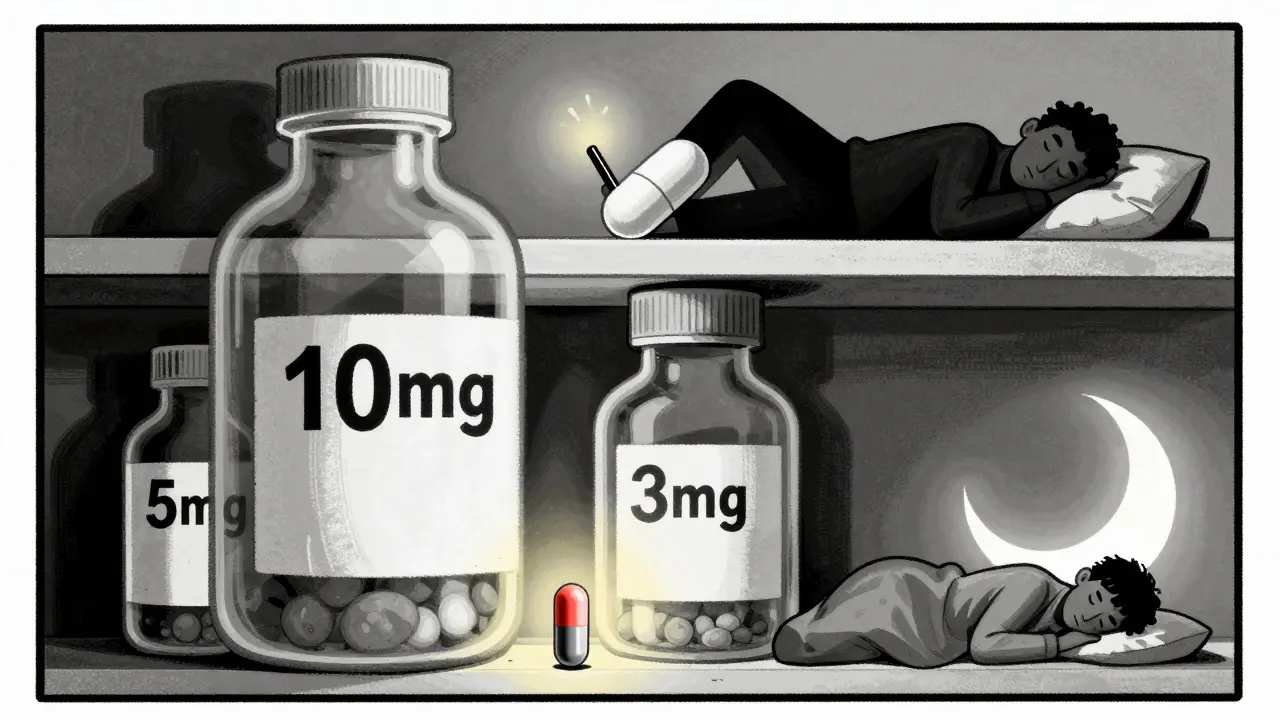
Physiological levels in the body are tiny - around 0.1 to 0.3 mg. Yet most over-the-counter supplements in the U.S. contain 3 mg, 5 mg, or even 10 mg. That’s like using a firehose to water a houseplant. Higher doses don’t mean better sleep. In fact, they increase side effects: vivid dreams, next-day grogginess, headaches. A 2023 analysis of 3,147 user reviews found that doses above 1 mg raised side effect risk without improving sleep quality.
When Melatonin Actually Works - And When It Doesn’t
Melatonin isn’t a cure-all for insomnia. If you lie awake at 2 a.m. because your mind is racing, melatonin won’t help much. But if your body just doesn’t know it’s time to sleep - that’s where it shines.
Jet lag: Eastward travel is the hardest. Your body thinks it’s still 10 p.m. when it’s actually 1 a.m. in your new time zone. Taking 0.5 mg melatonin at local bedtime for 2-3 days before and after travel can cut adjustment time from 5 days to 2. A verified Amazon review from a nurse who flew from New York to London said: "Took 1 mg at London bedtime. Slept through the night on day one. No jet lag."
Delayed sleep phase syndrome (DSPS): This is common in teens and young adults who naturally fall asleep at 2 a.m. or later. Melatonin, taken 2-3 hours before desired bedtime (say, 9 p.m. if you want to sleep at 11 p.m.), can shift your rhythm forward by up to 40 minutes over 2-3 weeks. A Reddit user reported: "Took 0.5 mg at 9 p.m. every night. In three weeks, I was falling asleep at 11 p.m. without effort."
Shift work: If you work nights and sleep during the day, melatonin can help your body recognize "night" even when it’s bright outside. Taking it 30-60 minutes before your scheduled sleep time improves sleep quality and duration.
But for general insomnia - trouble staying asleep, waking up too early, anxiety-driven wakefulness - melatonin has little to no benefit. The Cochrane Review analyzed 19 studies and found melatonin only reduced sleep onset time by 7 minutes on average. Prescription sleep aids cut it by 20-30 minutes. Melatonin isn’t a replacement for cognitive behavioral therapy for insomnia (CBT-I), which remains the gold standard.
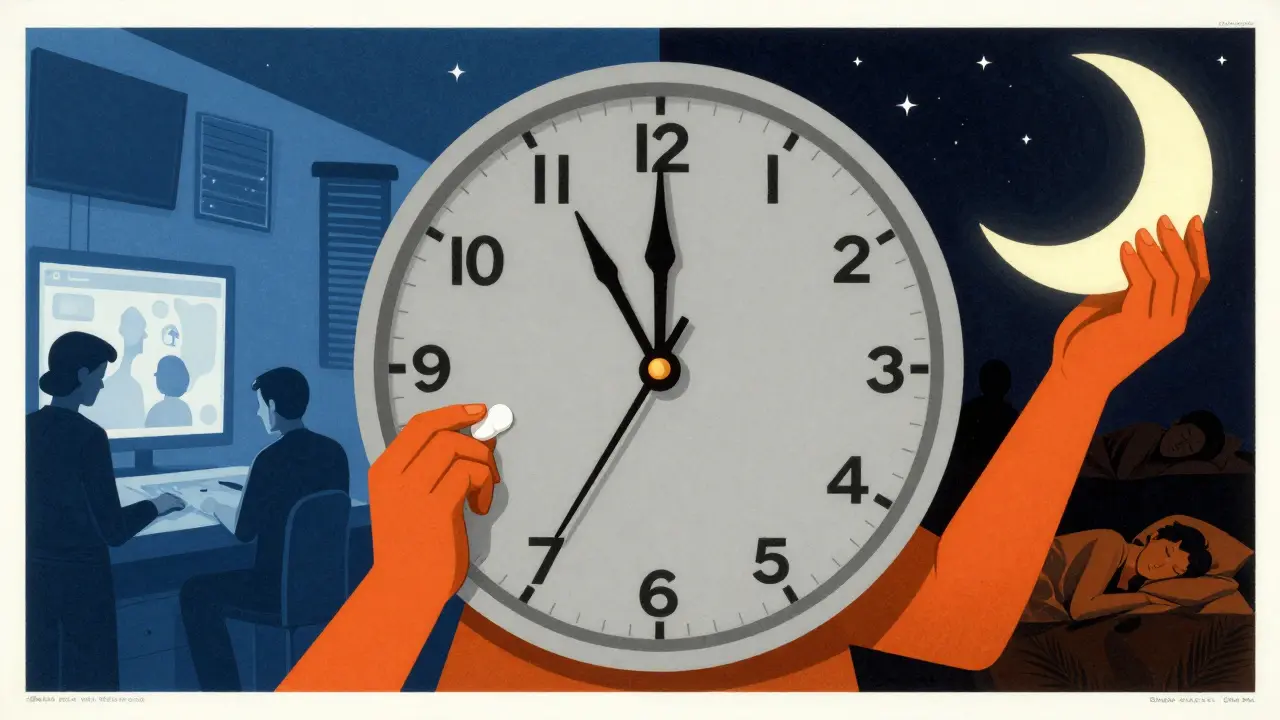
The Dose and Timing Trap
The biggest mistake people make? Taking too much, at the wrong time.
Here’s what works based on real-world data and clinical guidelines:
- Start with 0.3-0.5 mg. That’s close to what your body naturally produces. Most supplements sell 3 mg or more - you don’t need it.
- Take it 2-3 hours before bedtime. Not right before. Not after dinner. Two to three hours. That gives it time to reach your brain and trigger the circadian shift.
- For jet lag eastward: Take it at local bedtime for 2-3 days before and after travel.
- For jet lag westward: Take it at local bedtime after arrival.
- For DSPS: Take it 2-3 hours before desired bedtime, every night for 2-4 weeks.
Side effects are mild but real. About 28% of users report morning drowsiness. 22% have unusually vivid dreams or nightmares. 15% get headaches. These spike above 1 mg. And yes - 41% of regular users on Reddit’s biohacking forum reported diminishing results after 4-8 weeks. That suggests your receptors may get less sensitive over time. Cycling off for a few weeks can help reset sensitivity.
Why Supplements Are a Wild West
In the U.S., melatonin is sold as a dietary supplement. That means the FDA doesn’t test it for purity, potency, or consistency. A 2022 ConsumerLab test of top-selling brands found melatonin content ranged from 83% to 478% of what was listed on the label. One supplement labeled "1 mg" had 4.8 mg. Another had 0.1 mg - barely enough to register.
Even worse, many products contain serotonin, a hormone that can cause serious side effects when combined with antidepressants. A 2023 Consumer Reports analysis found only 28% of top-selling melatonin products gave clear instructions on when to take it.
In the UK and much of Europe, melatonin is a prescription drug. Only one formulation - Circadin, a 2 mg prolonged-release tablet - is approved for insomnia in people over 55. That’s because the European Medicines Agency demands quality control. You can’t buy a 10 mg melatonin gummy with added sugar and chamomile on the NHS.
What’s Next for Melatonin?
Researchers aren’t done. New drugs like agomelatine (used in Europe for depression) and tasimelteon (for blind people with no light perception) target melatonin receptors more precisely. These avoid the "shotgun" approach of plain melatonin supplements.
The NIH is funding 17 ongoing trials looking at melatonin for Alzheimer’s, long COVID sleep issues, and even IBS. Early results suggest circadian disruption might be a root cause - not just a symptom - of many chronic conditions.
But for now, melatonin’s best use remains simple: a low-dose, well-timed signal to help your body know when it’s night. It’s not magic. It’s biology.
Realistic Expectations
Don’t expect melatonin to turn you into a sleep machine. It won’t fix stress, anxiety, caffeine overload, or poor sleep hygiene. But if your body’s clock is out of sync - due to travel, night shifts, or a late-night habit - melatonin can be a gentle, safe tool to help reset it.
Try this: Get a 0.5 mg tablet. Take it at 7 p.m. if you want to sleep at 10 p.m. Do it for 7 nights. No more. No extra. See if your body starts feeling sleepy earlier. If not, it’s probably not your clock. It’s something else.
And if you’re still awake at 2 a.m.? Put the phone down. Turn off the lights. Breathe. Your body already knows how to sleep. It just needs the right signal.
Can melatonin help with insomnia?
Melatonin helps very little with general insomnia - trouble staying asleep or waking up too early. It’s designed to reset your internal clock, not induce sleep. For insomnia, cognitive behavioral therapy for insomnia (CBT-I) is far more effective. Melatonin may help only if your insomnia is tied to a delayed sleep phase or circadian rhythm disorder.
Is 5 mg of melatonin too much?
Yes. The body naturally produces only 0.1-0.3 mg. Studies show doses above 1 mg offer no extra benefit and increase side effects like morning grogginess, vivid dreams, and headaches. Most over-the-counter supplements in the U.S. are 3-10 mg - far too high. Start with 0.3-0.5 mg.
When should I take melatonin for jet lag?
For eastward travel (e.g., U.S. to Europe), take 0.5 mg at local bedtime 2-3 days before and after your trip. For westward travel (e.g., Europe to U.S.), take it at local bedtime after you arrive. This helps your body adjust faster than waiting days to naturally reset.
Can melatonin cause dependency?
No, melatonin doesn’t cause physical dependence like benzodiazepines or sleep pills. But some users report reduced effectiveness after 4-8 weeks of daily use, likely due to receptor desensitization. Cycling off for 1-2 weeks can restore sensitivity. It’s not addictive, but it’s not meant for long-term daily use without a circadian rhythm issue.
Are melatonin supplements regulated?
In the U.S., melatonin is sold as a dietary supplement, so the FDA doesn’t test for purity or potency. Testing found some products contain 5x more or less than labeled. In the UK and EU, melatonin is a prescription drug (Circadin), with strict quality control. Always choose brands that provide third-party testing (like USP or NSF) if buying in the U.S.
Does melatonin work for shift workers?
Yes. Shift workers who sleep during the day often struggle to fall asleep because their bodies think it’s daytime. Taking 0.5-1 mg melatonin 30-60 minutes before daytime sleep - while keeping the room dark and quiet - can improve sleep quality and duration. It’s one of the most effective non-prescription tools for shift work disorder.
Henry Jenkins
January 26, 2026 AT 04:25Man, I used to take 10mg like it was candy until I read this. Now I stick to 0.5mg at 7 p.m. and it’s night and day. No more waking up feeling like I got hit by a truck. Turns out my body wasn’t broken - I was just drowning it in synthetic noise.
Also, the part about blue light shutting off melatonin? Yeah, I finally unplugged my phone before bed. No more 2 a.m. doomscrolling. My sleep quality’s been stable for three weeks now. Who knew the solution was this simple?
Dan Nichols
January 26, 2026 AT 08:23Renia Pyles
January 27, 2026 AT 06:28Rakesh Kakkad
January 27, 2026 AT 09:05Respected sir, I am from India and I have been using melatonin for my night shift work since 2021. I follow the protocol strictly: 0.5 mg at 6:30 a.m. before daytime sleep. My sleep efficiency has improved from 62% to 89%. I do not use emojis. I do not exaggerate. This is data-driven.
However, I must caution: many Indian brands sell melatonin with undisclosed serotonin. I lost a colleague to serotonin syndrome. Please verify third-party certification. Safety first.
Nicholas Miter
January 28, 2026 AT 08:39George Rahn
January 30, 2026 AT 01:06Let us not be fooled by the cult of the low-dose. The Western pharmaceutical-industrial complex has conditioned us to fear potency. In ancient Vedic tradition, the pineal gland was called the 'third eye' - a gateway to cosmic rhythm. To reduce melatonin to milligrams is to reduce the soul to a chemical equation.
My grandfather in rural Kansas took 10mg nightly and lived to 98. He never saw a doctor. He watched the sun set and went to bed. That is wisdom. Not some NIH spreadsheet.
Ashley Karanja
January 31, 2026 AT 23:15Okay but the neurobiology here is *so* fascinating - MT1 and MT2 receptor binding triggering thermoregulatory shifts via the SCN? That’s not just sleep hygiene, that’s circadian epigenetics in action. And the fact that receptor desensitization occurs after 4-8 weeks? That’s why cycling matters - it’s not addiction, it’s homeostatic adaptation. We’re talking about a hormone that evolved over 600 million years to respond to photoperiods, not Instagram notifications.
Also, the FDA’s laissez-faire approach to supplements is a public health disaster. Imagine if every OTC vitamin had 5x the labeled dose. We’d be in chaos. And yet here we are, dosing kids with 5mg melatonin gummies like they’re gummy bears. It’s a tragedy wrapped in a Walmart aisle.
Karen Droege
February 2, 2026 AT 13:10I used to be the person who took melatonin at midnight and yelled at the ceiling. Then I found out I had DSPS. Took 0.5mg at 8:30 p.m. every night for three weeks. Now I fall asleep at 10:30 p.m. like a normal human. No pills. No magic. Just timing.
And yes - the vivid dreams? Wild. I dreamed I was a dolphin in a library. But I’d take that over another night of staring at the ceiling. This isn’t a fix-all - it’s a reset button. And if your reset button is broken? Maybe it’s not the button. Maybe it’s the whole damn system.
Robin Van Emous
February 2, 2026 AT 21:47Angie Thompson
February 4, 2026 AT 10:28rasna saha
February 5, 2026 AT 06:21Ashley Porter
February 5, 2026 AT 09:44shivam utkresth
February 5, 2026 AT 09:56Kipper Pickens
February 6, 2026 AT 02:26