
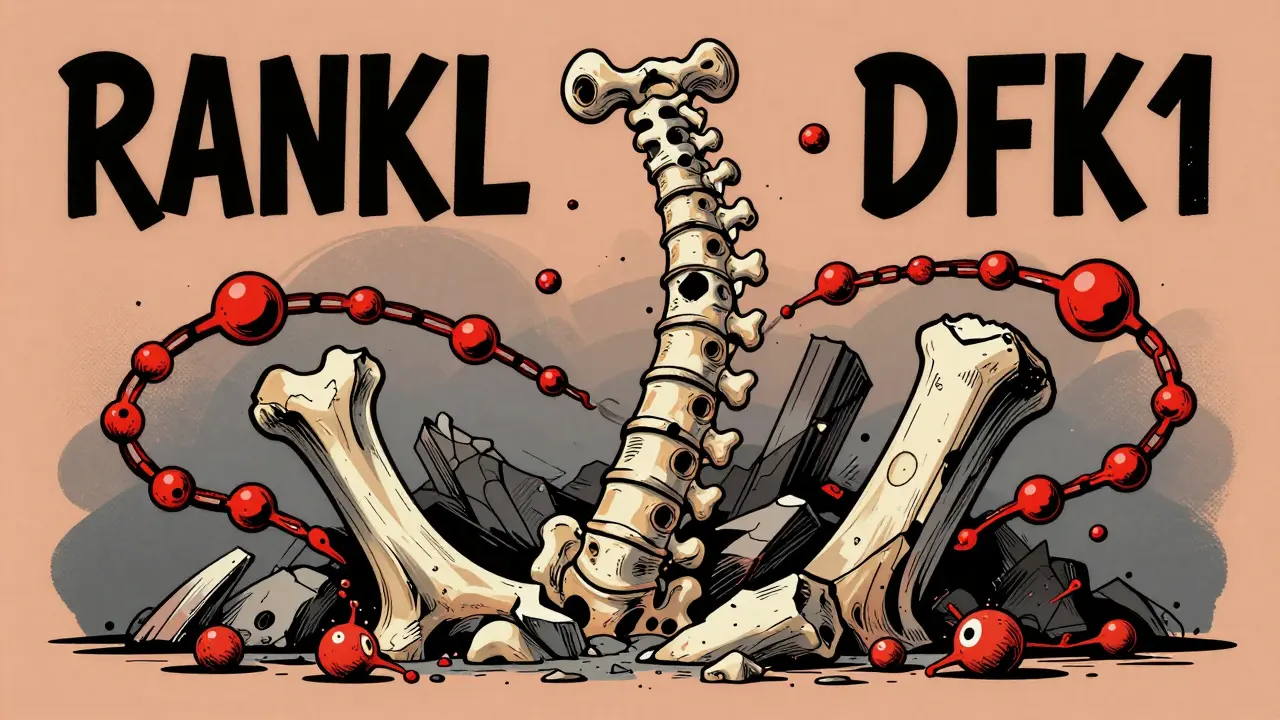
When someone is diagnosed with multiple myeloma, the focus often lands on the cancer cells multiplying in the bone marrow. But for most patients, the most painful, life-limiting problem isn’t the cancer itself-it’s what it’s doing to their bones. Over 80% of people with multiple myeloma develop severe bone damage, and for many, it’s the reason they’re hospitalized, unable to walk, or stuck in constant pain. The disease doesn’t just weaken bones-it eats them away from the inside out, creating holes that look like they’ve been punched out by a drill. This isn’t ordinary osteoporosis. It’s multiple myeloma bone disease, and it’s a silent killer in plain sight.
How Myeloma Turns Your Bones Into Swiss Cheese
Your bones aren’t just static structures. They’re alive, constantly being broken down and rebuilt. Osteoclasts chew away old bone. Osteoblasts lay down new bone. In healthy people, these two teams work in perfect balance. In multiple myeloma, that balance shatters. Myeloma cells flood the bone marrow and send out chemical signals that turn osteoclasts into overzealous demolition crews. At the same time, they shut down osteoblasts, stopping new bone from forming. The result? Bone loss with no repair. This isn’t random. Myeloma cells trigger a specific molecular cascade. One key player is the RANKL/OPG pathway. RANKL is a signal that tells osteoclasts to activate. OPG is the brake that stops it. In myeloma patients, RANKL spikes while OPG drops-sometimes by three to five times. That’s like removing the brake pedal and flooring the gas. Another major villain is DKK1, a protein secreted by myeloma cells that blocks the Wnt pathway, which osteoblasts need to rebuild bone. Patients with DKK1 levels above 48.3 pmol/L have more than three times the number of bone lesions compared to those with lower levels. Even osteocytes-the most common bone cells, making up 95% of all bone tissue-are pulled into the chaos. They start pumping out sclerostin, another blocker of bone formation. In myeloma patients, sclerostin levels average 28.7 pmol/L, compared to 19.3 pmol/L in healthy people. It’s not just cancer cells attacking bone. It’s the entire bone environment turning against itself.The Toll on Patients: Fractures, Pain, and Hospital Stays
The damage isn’t theoretical. It’s measurable in broken bones, emergency rooms, and lost quality of life. About 28% to 38% of myeloma patients suffer a pathological fracture-something as simple as bending over or stepping off a curb can snap a rib or vertebra. Spinal cord compression happens in 5% to 10% of cases, sometimes leading to paralysis. Hypercalcemia, caused by too much calcium leaching from destroyed bone, affects 25% to 30% of patients and can cause confusion, kidney failure, or even coma. Bone complications are the second most common reason myeloma patients end up in the hospital-right after infections. On average, each hospital stay for a bone-related issue lasts over eight days. And the pain? It’s relentless. A 2023 Reddit thread with 147 patient comments found that 68% still had significant bone pain even after starting standard treatment. Many describe it as a deep, aching, throbbing pain that doesn’t respond to regular painkillers. Then there are the side effects of the drugs meant to fix it. Bisphosphonates, the long-standing treatment, can cause kidney damage. About 22% of patients need dose adjustments because their creatinine clearance drops below 60 mL/min. One in five experiences low calcium levels. And a terrifying 42% of patients on long-term therapy develop medication-related osteonecrosis of the jaw (MRONJ)-a condition where the jawbone starts dying, often requiring surgery and months of dental care.
Current Standard Treatments: Bisphosphonates and Denosumab
For over two decades, the go-to drugs for myeloma bone disease have been bisphosphonates-zoledronic acid or pamidronate. Both are given as monthly IV infusions. They work by sticking to bone surfaces and killing osteoclasts. Studies show they reduce skeletal-related events by 15% to 18% compared to placebo. But they don’t rebuild bone. They only slow the destruction. Denosumab, approved in the U.S. in 2010, is a newer option. It’s a monoclonal antibody that directly blocks RANKL, cutting off the signal that activates osteoclasts. It’s given as a monthly shot under the skin, which many patients prefer over IV infusions. A 2021 Mayo Clinic study found 74% of patients liked denosumab better for convenience. But it’s expensive-$1,800 per dose versus $150 for generic zoledronic acid. And like bisphosphonates, it doesn’t fix what’s already broken. It just stops things from getting worse. Both drugs carry the same risk: MRONJ. That’s why guidelines now require all patients to see a dentist within 30 days of starting treatment. No fillings, no extractions, no invasive procedures once therapy begins. Even brushing too hard can trigger it.The New Wave: Drugs That Actually Heal Bone
The real breakthrough isn’t just stopping bone loss-it’s making bone grow back. And that’s where novel agents come in. The most promising are the anti-sclerostin drugs. Sclerostin is the body’s natural brake on bone formation. By blocking it, you remove the brake-and let osteoblasts rebuild. Romosozumab, one of these drugs, showed a 53% increase in bone mineral density at the spine in a 2021 trial with 49 myeloma patients. Another, blosozumab, cut bone resorption markers by 47%. In the same trial, patients reported a 35% improvement in pain scores on the Brief Pain Inventory. Then there’s DKN-01, an anti-DKK1 therapy. In a 2020 trial with 32 patients, it lowered bone resorption markers by 38%. It’s not just about numbers-it’s about healing. In animal models, these drugs didn’t just slow damage; they filled in holes in the bone. Even drugs targeting the Notch pathway, like nirogacestat, are showing promise. In preclinical studies, they reduced osteolytic lesions by 62%. These aren’t just lab curiosities. They’re entering real-world trials. The FDA-backed BONE-HEAL trial, launched in 2023, is testing romosozumab in 450 myeloma patients to see if it can truly reverse bone damage.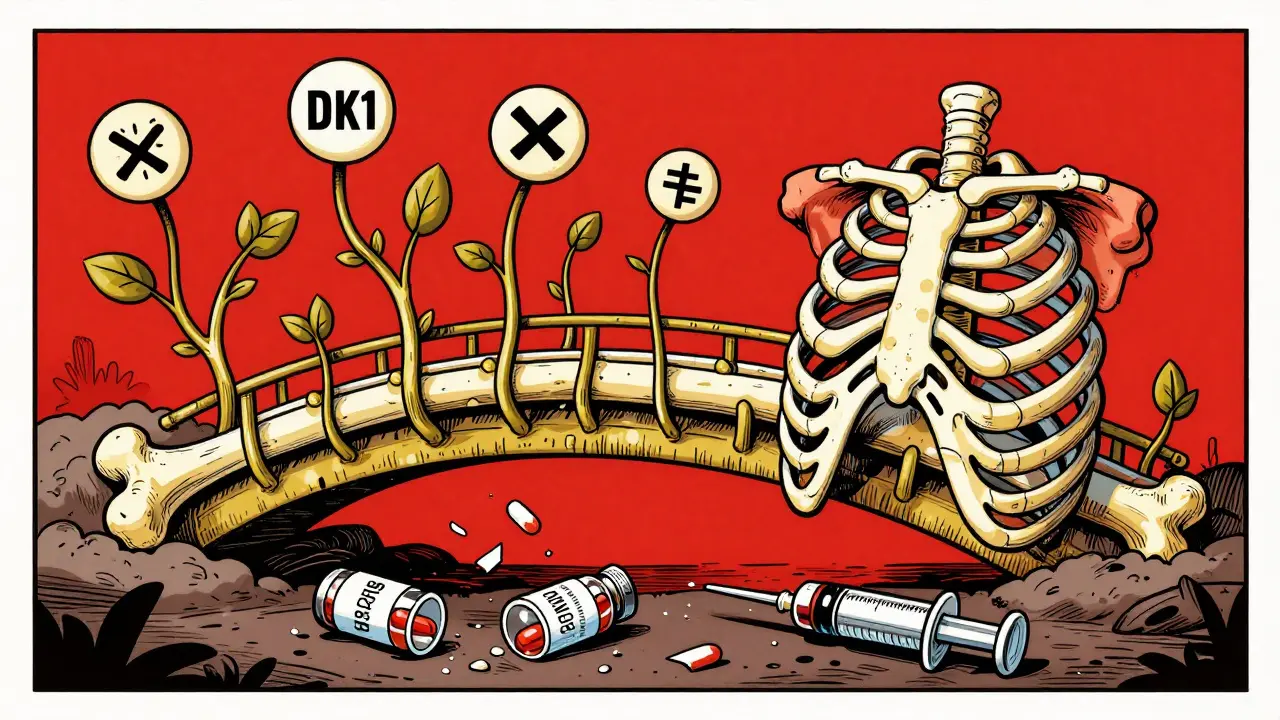
Why These Drugs Aren’t Everywhere Yet
You’d think these breakthroughs would be standard by now. But they’re not. Why? First, no anti-sclerostin or anti-DKK1 drug has yet proven it extends survival. Dr. Kenneth Anderson of Dana-Farber warned in 2020 that we still lack biomarkers to tell which patients will benefit most. Without survival data, insurers won’t cover them. Romosozumab is approved for osteoporosis, but not yet for myeloma. Second, side effects are tricky. Anti-sclerostin drugs can cause dangerous drops in calcium. About 12% of patients need close monitoring and supplements. Gamma-secretase inhibitors cause severe rashes in nearly 70% of trial participants. Odanacatib, a cathepsin K inhibitor, was pulled from development in 2016 because it raised stroke risk. Third, access is uneven. In the U.S., denosumab is used in 78% of cases. In Europe, it’s only 42%. In Asia, bisphosphonates still dominate at 89%. Cost, reimbursement rules, and lack of specialist training hold back adoption.What’s Next: The Future of Bone Healing in Myeloma
The next five years will change everything. Researchers are now developing bispecific antibodies that attack myeloma cells while simultaneously blocking bone-destroying signals. Alnylam is testing RNA therapies to silence DKK1 production-early results show 65% reduction in the protein. And new imaging tools, like whole-body low-dose CT and PET-CT, are now standard at diagnosis to catch bone damage before it’s severe. The goal isn’t just to prevent fractures anymore. It’s to heal them. Dr. Brian Durie of the International Myeloma Foundation predicts that by 2030, we’ll be reversing bone damage routinely-not just slowing it. That means patients won’t just survive longer. They’ll live better, with fewer breaks, less pain, and more mobility. Right now, the standard of care is still bisphosphonates and denosumab. But if you’re newly diagnosed, ask your doctor: Are you monitoring my bone turnover markers? Are we considering clinical trials for bone-healing agents? The answer could change not just how long you live-but how well you live.What is the most common bone problem in multiple myeloma?
The most common bone problem is osteolytic lesions-holes in the bone that look like they’ve been punched out on X-rays. These happen because myeloma cells trigger excessive bone breakdown while stopping new bone formation. Over 80% of patients develop these lesions, and they often lead to fractures, pain, and spinal cord compression.
Do bisphosphonates heal myeloma bone damage?
No, bisphosphonates like zoledronic acid only slow down bone destruction. They don’t rebuild bone or fix existing holes. That’s why many patients still experience pain and fractures even while on treatment. Newer drugs like romosozumab are being tested to actually restore bone density.
What is denosumab, and how is it different from bisphosphonates?
Denosumab is a monoclonal antibody that blocks RANKL, a key signal that activates bone-destroying cells. Unlike bisphosphonates, which are given as monthly IV infusions, denosumab is a simple monthly shot under the skin. Many patients prefer it for convenience. But like bisphosphonates, it doesn’t rebuild bone-it only prevents further loss.
Can myeloma bone disease be reversed?
Until recently, the answer was no. But now, drugs like romosozumab and DKN-01 are showing that bone healing is possible. In clinical trials, anti-sclerostin agents increased bone mineral density by over 50%. While these aren’t yet standard, they’re in late-stage trials and represent the first real hope for reversing damage, not just preventing it.
What are the risks of bone-targeting drugs?
All bone-targeting drugs carry risks. Bisphosphonates and denosumab can cause osteonecrosis of the jaw (MRONJ), especially if you have dental work after starting treatment. Anti-sclerostin drugs like romosozumab can cause low calcium levels in about 12% of patients. Gamma-secretase inhibitors often cause severe rashes. Always get a dental checkup before starting therapy and monitor calcium levels closely.
How do I know if I’m a candidate for a novel agent?
You may be a candidate if you have multiple bone lesions, persistent pain despite standard therapy, or if you’re newly diagnosed and want to explore options beyond bisphosphonates. Talk to your oncologist about clinical trials for anti-sclerostin, anti-DKK1, or Notch inhibitors. Biomarkers like DKK1 and sclerostin levels can help identify who’s most likely to benefit.
Teresa Marzo Lostalé
December 29, 2025 AT 01:33It's wild how the body turns on itself like this. I never thought about osteocytes being dragged into the chaos-like they're trapped in a war they didn't sign up for. The way myeloma hijacks biology at every level… it’s less like a cancer and more like a systemic betrayal.
And the fact that we’re finally seeing drugs that don’t just slow the damage but actually rebuild? That’s the kind of science that gives me hope. Not just survival-recovery.
Celia McTighe
December 30, 2025 AT 19:17This is one of those posts that makes you stop scrolling. Thank you for writing this with so much care. I’ve seen friends go through this and the pain descriptions? Exactly right. No one talks about how the bone pain feels like it’s inside your marrow, not just on the surface.
Also-yes to asking about clinical trials. Too many patients think they’re stuck with what’s ‘standard.’ But the future is here, even if it’s not on the pharmacy shelf yet. 💪❤️
Debra Cagwin
January 1, 2026 AT 15:51For anyone newly diagnosed: please, please talk to your oncologist about bone turnover markers. DKK1, sclerostin, CTX-they’re not just jargon. They’re clues. And if your doctor doesn’t mention them, ask. You deserve to know if you’re a candidate for something that could actually heal you, not just delay the inevitable.
Also, dental checkups before starting any bone drug? Non-negotiable. I’ve seen too many people lose teeth because no one warned them. Don’t be one of them.
Ellen-Cathryn Nash
January 2, 2026 AT 23:02Let’s be real-pharma doesn’t care about bone healing unless it’s profitable. Romosozumab’s approved for osteoporosis? Sure. But for myeloma? ‘Not yet.’ Meanwhile, patients are still getting IV infusions that cost $150 and do nothing but stall the clock. This isn’t science lagging-it’s capitalism dragging its feet.
And don’t get me started on how MRONJ is treated like a footnote. ‘Oh, just don’t get a tooth pulled.’ Like that’s a choice when your jaw’s crumbling.
Bradly Draper
January 3, 2026 AT 14:01I didn’t know any of this. My dad had myeloma. He never talked about the bone pain. Just said he was ‘tired.’ Now I get it. Thank you for explaining it so clear.
Samantha Hobbs
January 4, 2026 AT 14:47Wait so if I get denosumab, I can’t even floss hard? Like, is that a real thing? 😳 I’m gonna need a whole new life routine.
Sydney Lee
January 4, 2026 AT 18:50Of course, the real issue isn’t the drugs-it’s the failure of medical education. Why are we still teaching residents to treat myeloma bone disease like a secondary concern? It’s the primary cause of morbidity! The fact that anti-sclerostin agents aren’t standard is a scandal. A travesty. A grotesque dereliction of duty by oncology institutions.
And don’t even get me started on how the FDA prioritizes survival metrics over quality-of-life outcomes. This isn’t medicine-it’s actuarial science dressed in white coats.
Hakim Bachiri
January 4, 2026 AT 21:16Let me guess-someone’s gonna say ‘but what about cost?!’ Oh, I know. ‘It’s too expensive!’ Like we haven’t spent trillions on wars we didn’t win, but we can’t afford to fix bones? And why is it that when it’s a rich person with osteoporosis, romosozumab’s fine-but when it’s a myeloma patient? ‘Not approved.’ Bullshit.
Also, DKK1? That’s not a protein-it’s a villain in a Marvel movie. And we’re letting it win?!
Kelsey Youmans
January 6, 2026 AT 09:19As someone who works in global health policy, I’m struck by the disparity in access. In the U.S., 78% use denosumab. In Asia, 89% still rely on bisphosphonates. This isn’t a scientific gap-it’s an equity crisis. We have therapies that can restore bone integrity, yet millions lack even the baseline care.
And yet, when I speak at conferences, the conversation rarely turns to distribution. It’s always ‘what’s next?’-never ‘who gets it?’
Gran Badshah
January 7, 2026 AT 00:37Bro, I read this whole thing and I’m just sitting here like… so we’re saying the bone is like a house and myeloma is the termites, but the drugs are just patching the walls? And now there’s a new paint that actually grows new wood?
That’s wild. I’m telling my cousin who’s in chemo right now.
Ryan Touhill
January 7, 2026 AT 08:35There’s a quiet arrogance in assuming that ‘new drugs’ will solve everything. The truth? Most patients never even get to the point of considering romosozumab. Many are too frail. Too old. Too uninsured. Too overwhelmed. We talk about bone healing like it’s a technical problem. But it’s a human one.
And until we fix the system that leaves patients begging for trials, all the science in the world won’t change the fact that most won’t see it.
ANA MARIE VALENZUELA
January 8, 2026 AT 02:32Let’s cut the sugar-coating: if you’re still on bisphosphonates in 2024 and you’re not in a trial for bone-healing agents, your oncologist is either lazy, uninformed, or doesn’t care enough to push for you.
Don’t be the patient who ‘just accepted’ the standard. Ask for DKK1 testing. Ask for sclerostin. Ask for a referral to a myeloma center. If they say no, get a second opinion. Your bones are worth fighting for.
oluwarotimi w alaka
January 8, 2026 AT 10:20you know what they dont tell you? this whole thing? its a big pharma scam. they make you think its about healing but really they just want you to keep buying the next drug. why? because if your bones heal? then they dont need to keep giving you shots every month. and who pays? YOU. the system is rigged. dont trust the doctors. they work for the lab. ask for the real data. its all lies.