
When you take a medication like warfarin, levothyroxine, or digoxin, even a tiny change in how much of the drug gets into your bloodstream can mean the difference between effective treatment and a life-threatening reaction. These are narrow therapeutic index drugs - and they demand far more precision than most generics ever have to meet.
What Makes a Drug a Narrow Therapeutic Index (NTI) Drug?
A narrow therapeutic index means the gap between a safe, effective dose and a toxic or ineffective one is razor-thin. The FDA defines NTI drugs as those with a therapeutic index of 3 or less - meaning the toxic dose is only three times higher than the effective dose. For comparison, most drugs have a therapeutic index of 10 or more.
Drugs like phenytoin, lithium carbonate, tacrolimus, and theophylline fall into this category. Take warfarin: if your blood level is just 10% too high, you risk dangerous bleeding. If it’s 10% too low, you could get a stroke. There’s no room for error. That’s why regulators don’t treat these like regular generics.
Why Stricter Bioequivalence Rules Exist
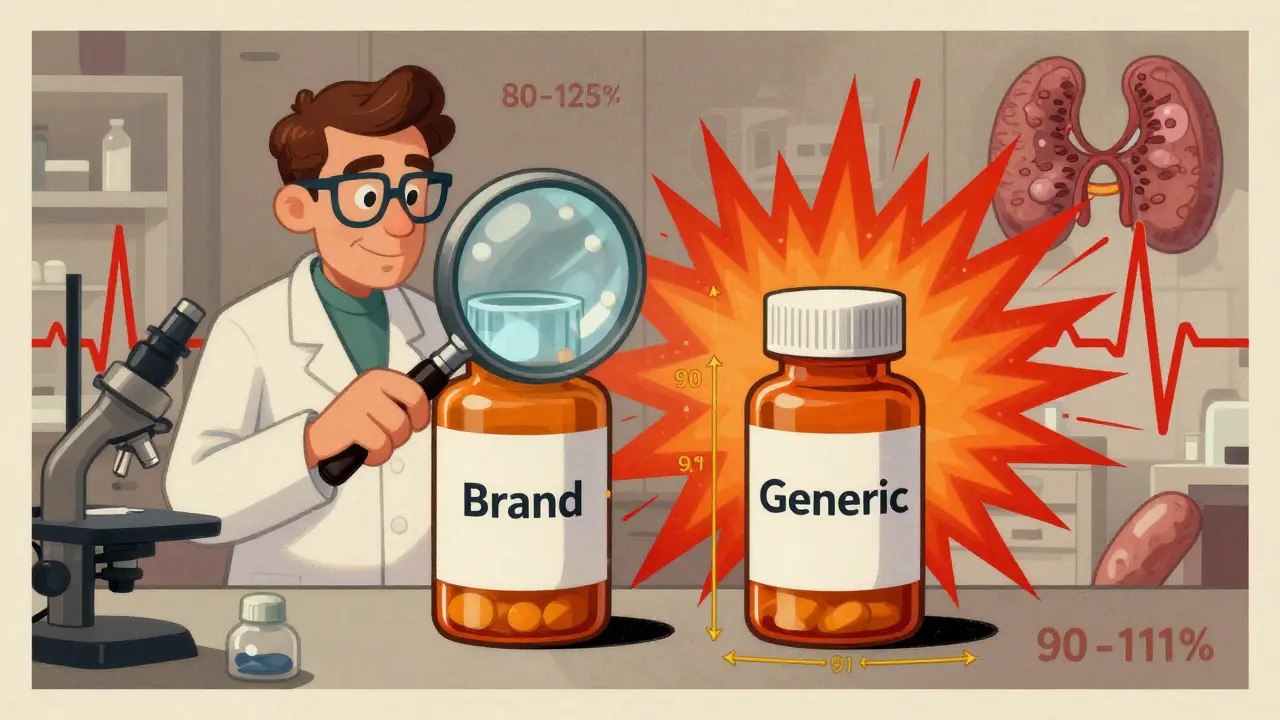
Bioequivalence is how regulators check if a generic drug performs the same way as the brand-name version. For most drugs, the standard is simple: the generic’s absorption (measured by AUC and Cmax) must fall within 80% to 125% of the brand. That’s wide enough to account for normal biological differences.
But for NTI drugs, that 80-125% range is too loose. A 15% drop in absorption might push a patient into the danger zone. So regulators tightened the rules - dramatically.
The FDA’s current approach for NTI drugs requires three things:
- Reference-scaled average bioequivalence (RSABE): The acceptable range adjusts based on how much the original drug varies from person to person. If the brand drug has high variability, the generic can too - but only up to a point.
- Variability comparison: The generic’s variability must not exceed 2.5 times the brand’s. This stops manufacturers from making a drug that works inconsistently, even if the average dose looks right.
- Unscaled average bioequivalence: Even after scaling, the generic must still stay within 80-125% of the brand. It’s a double safety net.
This isn’t just theory. A 2017 study in the American Journal of Transplantation showed that generic tacrolimus met these criteria and performed just as safely as the brand in kidney transplant patients. Real-world outcomes matched.
How Other Agencies Compare
The FDA’s method is complex - and intentional. Other regulators took simpler paths.
The European Medicines Agency (EMA) uses a fixed 90-111% range for NTI drugs. No scaling. No variability tests. Just a tighter window. Health Canada uses 90.0-112.0% for AUC.
Why the difference? The FDA’s approach was built on real pharmacometric modeling - it accounts for how the drug behaves in the body, not just averages. The EMA’s method is easier to apply but doesn’t adjust for drug-specific variability. For some NTI drugs, like phenytoin, the FDA’s method is more protective. For others with low variability, it might be overkill.
Industry experts are split. Dr. Leslie Benet from UCSF calls the FDA’s method scientifically sound. But Dr. Lawrence Lesko from the University of Florida warns that too much stringency could block generics entirely - raising prices and limiting access.
Cost and Complexity of Meeting the Standards
Testing a generic NTI drug isn’t cheap. Standard bioequivalence studies cost $300,000-$700,000. For NTI drugs, it’s $500,000-$1 million. Why? Because the FDA requires larger studies - 36 to 54 volunteers instead of 24 to 36. And they need a fully replicated crossover design: each person takes both the brand and generic multiple times, under controlled conditions.
That’s a big barrier for small manufacturers. Many generic companies simply avoid NTI drugs because the return on investment is uncertain. As a result, generic market share for NTI drugs hovers around 68%, compared to 90% for non-NTI drugs.
But the cost of not doing it right is higher. In 2019, a study in Circulation: Cardiovascular Quality and Outcomes tracked over 10,000 warfarin patients. Those switched to generic versions had no increase in bleeding or clotting events. The data proved: when the right standards are used, generics are safe.
Which Drugs Are Classified as NTI?
The FDA doesn’t publish a single official list. Instead, they issue product-specific guidance for each NTI drug as it comes up. As of 2023, they’ve issued formal bioequivalence guidance for 15 drugs, including:
- Warfarin
- Levothyroxine
- Digoxin
- Phenytoin
- Tacrolimus
- Carbamazepine
- Lithium carbonate
- Sirolimus
- Theophylline
- Valproic acid
These drugs are used in critical conditions: epilepsy, heart transplants, thyroid disorders, and blood clotting. One misstep can cost a life.
IQVIA estimates NTI drugs generate $45 billion in U.S. sales annually. That’s a huge market - but also a high-stakes one.
What’s Changing in 2024-2026?
The FDA is moving toward a more systematic way to classify NTI drugs. Right now, they decide case by case. Starting in 2024, they plan to use quantitative thresholds - like the 3:1 therapeutic index cutoff - to automatically flag drugs as NTI. This will bring more transparency.
There’s also talk of global harmonization. The EMA, Health Canada, and the FDA are all working toward aligning their NTI standards. If they succeed by 2026, generic manufacturers could save 15-20% on development costs by using one standardized study design worldwide.
For now, the FDA’s approach remains the gold standard - even if it’s harder and more expensive. It’s designed to protect patients who can’t afford even a small mistake.
What This Means for Patients and Prescribers
Patients on NTI drugs shouldn’t fear generics. When the drug meets FDA standards, it’s just as safe. But switching between different generic brands - even if both are approved - can be risky. Each generic might use slightly different fillers or manufacturing processes. That’s why many doctors stick to one brand or generic version for the long term.
Always talk to your pharmacist before switching. If you’re on levothyroxine or warfarin, ask: “Is this the same generic I’ve been taking?” Consistency matters more than cost.
And if you’re a prescriber: know which drugs are NTI. Don’t assume all generics are interchangeable. Use therapeutic drug monitoring when possible - especially when switching formulations.
Final Thought: Safety Over Speed
Generic drugs saved the U.S. healthcare system over $300 billion in 2023. But NTI drugs aren’t like other generics. They’re high-risk, high-reward. The stricter rules aren’t bureaucracy - they’re a safeguard. They exist because someone once died from a 5% difference in blood concentration.
The goal isn’t to block generics. It’s to make sure that when a patient takes a generic NTI drug, they get the same outcome as if they’d taken the brand - every single time.
Helen Leite
January 24, 2026 AT 21:51THE GOVT IS LYING ABOUT GENERIC DRUGS!!! 🤫💉 I heard they’re secretly replacing the active ingredient with chalk and sugar to control our minds! My cousin’s dog took a generic warfarin and started barking in Morse code!! 🐶💻
Sawyer Vitela
January 25, 2026 AT 11:11NTI drugs need tighter standards. End of story.
Michael Camilleri
January 26, 2026 AT 11:27People don’t get it. We’re not talking about aspirin here. We’re talking about life or death. Some folks want cheap pills but they’d rather die than pay $5 extra. That’s not freedom. That’s selfishness wrapped in a Walmart bag.
lorraine england
January 27, 2026 AT 22:24I’m a nurse and I’ve seen patients panic when their generic switch changes the pill color. It’s not just the meds-it’s the psychology. Consistency = peace of mind. Always stick with one brand or generic. And yes, I’ve had patients cry because their new pill looked ‘wrong’.
Himanshu Singh
January 28, 2026 AT 00:58Great post! 🙏 It reminds me how medicine isn’t just chemistry-it’s trust. When someone’s life depends on a pill, the system owes them certainty. The FDA’s approach isn’t overkill-it’s compassion in action.
Sushrita Chakraborty
January 28, 2026 AT 22:24While the FDA’s approach is scientifically rigorous, it is also economically burdensome for small manufacturers. A harmonized global standard, as proposed, would be a pragmatic advancement-balancing safety, accessibility, and equity. The EMA’s fixed range, though less nuanced, may be preferable in low-resource settings where monitoring is limited.
Jamie Hooper
January 29, 2026 AT 10:06so like… if i take a generic thyroxine and my hair falls out… is that my fault? or the FDA’s? 🤔
Dolores Rider
January 29, 2026 AT 19:27They’re hiding the truth. The pharmaceutical giants don’t want you to know that the ‘brand’ version is just repackaged generics with a fancy label. They’re using NTI rules as a smokescreen to keep prices high. I’ve got receipts. 📄👁️
asa MNG
January 30, 2026 AT 02:06bro i took generic digoxin last year and my heart felt like it was doing the cha-cha… then i switched back to brand and boom… steady as a rock. i dont care if it cost 20 bucks more. my heart aint a lab rat. also why do they make the pills different colors?? is it to mess with our heads?? 🤯💊
Tommy Sandri
January 31, 2026 AT 13:22The regulatory framework for narrow therapeutic index drugs represents a necessary calibration between public health imperatives and pharmaceutical innovation. While cost barriers are real, the clinical consequences of suboptimal bioequivalence are demonstrably severe. The FDA’s methodology, though complex, reflects a mature pharmacometric understanding of inter-individual variability. Global alignment remains desirable, but must not compromise patient safety.