

If you have asthma and reach for ibuprofen or aspirin for a headache, you could be walking into a silent danger zone. For about 7% of people with asthma, these common painkillers don’t just fail to help-they can trigger a life-threatening asthma attack. This isn’t an allergy in the usual sense. It’s a condition called NSAID-Exacerbated Respiratory Disease, or NERD. And if you’re not aware of it, you might keep making the same dangerous mistake over and over.
What NERD Really Feels Like
Imagine this: you take a pill for a migraine, and within 30 minutes, your nose starts running like a faucet. Your chest tightens. Your breathing turns shallow and wheezy. You can’t catch your breath. You’re not sick with a cold. You didn’t eat something strange. You just took a painkiller-and your body reacted like it was under attack.
This is NERD in action. It’s not rare. In fact, among people with asthma who also have chronic nasal polyps or long-term sinus trouble, up to half may have it. Symptoms usually show up within 30 minutes to three hours after taking an NSAID. The reaction isn’t mild. It’s often severe enough to land people in the ER with bronchospasm, swelling in the airways, and full-blown asthma exacerbation.
Many patients don’t realize what’s happening at first. They think it’s a cold, an allergy to pollen, or even stress. One woman in Edinburgh told her doctor she’d been having "seasonal asthma flare-ups" every winter-until she remembered she always took ibuprofen for her sore neck after shoveling snow. Once she stopped, her symptoms vanished.
Who’s at Risk?
NERD doesn’t hit everyone the same. It’s not random. The people most likely to develop it share a few key traits:
- They have asthma and chronic rhinosinusitis with nasal polyps
- They’re female
- They’re between 30 and 50 years old
- They’ve had asthma for years, often with poor control
- They’re overweight or have a history of smoking
Most people are diagnosed in their 30s or 40s. It’s rare under age 20. And while men can get it too, about 70% of diagnosed cases are in women. The link with nasal polyps is especially strong. If you’ve had recurring polyps removed multiple times and still struggle with breathing, NERD should be on your doctor’s radar.
Why Do NSAIDs Trigger This?
It’s not about being allergic to the pill. It’s about what happens inside your body after you swallow it.
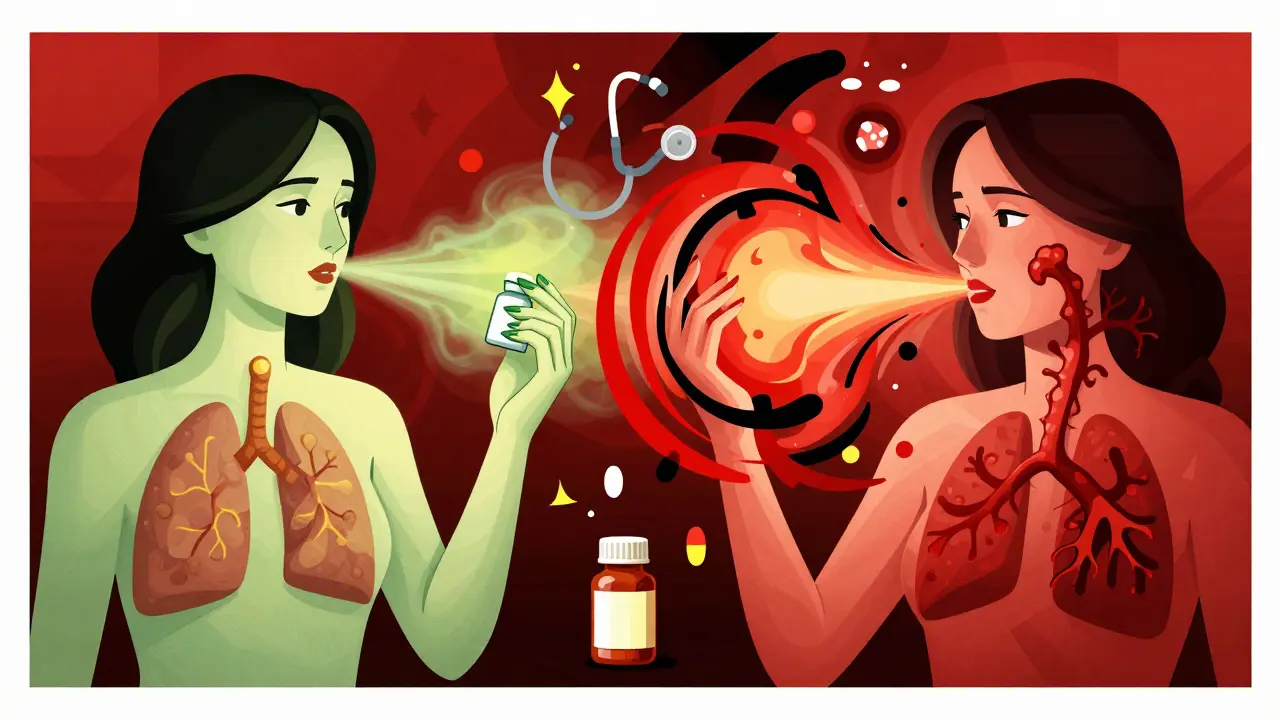
NSAIDs like aspirin, ibuprofen, and diclofenac block an enzyme called COX-1. That’s how they reduce pain and inflammation. But in people with NERD, blocking COX-1 throws off a delicate chemical balance. Instead of making protective anti-inflammatory molecules like prostaglandin E2, your body starts pumping out huge amounts of leukotrienes-powerful chemicals that cause airway tightening, mucus buildup, and swelling.
Studies show that people with NERD already have lower levels of protective prostaglandins in their nasal and lung tissue. When NSAIDs hit, it’s like pulling the plug on your body’s natural safety net. The result? Your airways go into overdrive.
This is why acetaminophen (paracetamol) is usually safe-it doesn’t block COX-1 the same way. And drugs like celecoxib, which only target COX-2, are often tolerated too.
What Medications Are Safe?
Not all painkillers are created equal. Here’s what you need to know:
- AVOID: Aspirin, ibuprofen, naproxen, diclofenac, ketoprofen, indomethacin-any traditional NSAID.
- Usually SAFE: Acetaminophen (paracetamol) at doses under 1000mg per dose. Most NERD patients tolerate this well.
- Often SAFE: Celecoxib (Celebrex) and other COX-2 inhibitors. These are less likely to trigger reactions, but not risk-free.
- NEVER ASSUME: Cold and flu remedies, menstrual pain relievers, and topical gels often contain NSAIDs. Check the label.
Many people don’t realize that some migraine pills, arthritis creams, and even children’s fever reducers contain ibuprofen or aspirin. A patient in Glasgow ended up in hospital after using a "natural" muscle rub that listed menthol and methyl salicylate-a form of aspirin. She didn’t know it counted.
What About Aspirin Desensitization?
There’s one exception to the "never take NSAIDs" rule: aspirin desensitization.
This is a controlled medical procedure done in a hospital setting. Over several hours, you’re given tiny, increasing doses of aspirin under close supervision. If you tolerate it, your body can be trained to handle it without triggering a reaction.
For some people, this is life-changing. Studies show it can reduce nasal polyp regrowth, improve asthma control, and even cut down on steroid use. But it’s not for everyone. It’s only offered at specialist centers, and you need to be stable on your asthma meds first. It’s also not a cure-you still need to keep taking daily aspirin to maintain the effect.
How to Protect Yourself
Knowledge is your best defense. Here’s what to do:
- Get tested if you have asthma + nasal polyps or chronic sinusitis. Ask your doctor about NERD.
- Keep a list of all your medications-prescription, OTC, and topical. Show it to every new doctor.
- Learn to read labels. Look for: ibuprofen, aspirin, naproxen, diclofenac, ketoprofen, salicylate, methyl salicylate.
- Carry a medical alert card or app listing your NSAID sensitivity.
- If you’ve had a reaction before, avoid all NSAIDs-even if it was years ago. The sensitivity doesn’t go away.
One woman in Edinburgh started carrying a small card in her wallet that says: "NSAID SENSITIVE. NO IBUPROFEN, ASPIRIN, OR NAPROXEN. ACETAMINOPHEN OK." She says it’s saved her from three emergency visits.
What to Do If You Have a Reaction
If you take an NSAID and feel your chest tightening, nose running, or throat closing:
- Stop taking the medication immediately.
- Use your rescue inhaler if you have one.
- Call emergency services if breathing doesn’t improve within minutes.
- Don’t wait to see if it "gets better." This isn’t a mild reaction.
Even if you’ve had a mild reaction before, the next one could be worse. NERD reactions are unpredictable.
Bottom Line
NSAID sensitivity isn’t something you can ignore. It’s not just about avoiding a few pills-it’s about understanding how your body reacts to common medicines. If you have asthma, especially with nasal polyps or chronic sinus trouble, you’re at higher risk. Don’t assume painkillers are harmless. Talk to your doctor. Get tested. Learn what’s safe. And never take a new medication without checking the ingredients.
There’s no shame in being cautious. In fact, it’s the smartest thing you can do.
Can I take acetaminophen if I have NERD?
Yes, acetaminophen (paracetamol) is generally safe for most people with NERD at standard doses (up to 1000mg per dose). About 90-95% of patients tolerate it without issue. However, a small number (5-10%) may still react, especially at higher doses. Always start with the lowest effective dose and monitor your breathing.
Is celecoxib safe for people with NSAID-sensitive asthma?
Celecoxib (Celebrex) is a COX-2 selective inhibitor and is usually tolerated by people with NERD because it doesn’t block COX-1. Clinical studies show it’s much safer than traditional NSAIDs. But it’s not 100% risk-free. Always use it under medical supervision, especially if you’ve had severe reactions before.
Can children develop NSAID-sensitive asthma?
Yes, but it’s rare. Most cases are diagnosed in adults between 30 and 50. However, studies show short-term use of NSAIDs like ibuprofen can increase asthma exacerbation risk in children-even those without NERD. The risk is higher with repeated use. If your child has asthma, stick to acetaminophen for fever or pain unless your doctor says otherwise.
Why do I react to NSAIDs but not to other painkillers?
It’s not about the painkiller itself-it’s about how it works. NSAIDs like aspirin and ibuprofen block COX-1, which triggers a chain reaction in your airways that leads to inflammation and tightening. Acetaminophen doesn’t block COX-1 the same way. COX-2 inhibitors like celecoxib avoid this pathway entirely. So it’s a biochemical issue, not a general allergy.
How do I know if I have NERD and not just a bad reaction to one pill?
If you’ve had a reaction to one NSAID, you’ll likely react to all of them. NERD isn’t about one drug-it’s about the whole class. If you’ve had multiple episodes of wheezing, nasal congestion, or chest tightness after taking different NSAIDs, it’s likely NERD. A specialist can confirm this with a controlled aspirin challenge test in a hospital setting.
Can I still use NSAIDs if I only take them occasionally?
No. Even occasional use can trigger a severe reaction. NERD isn’t dose-dependent in the way you might think. Some people react to very low doses, like a single 75mg aspirin. There’s no safe "occasional" threshold. Avoid all NSAIDs completely unless you’ve been medically desensitized.
Are there any new treatments for NERD?
Yes. Researchers are exploring drugs that boost protective molecules like LXA4, which are low in NERD patients. Biologics used for severe asthma, like anti-IL5 drugs (mepolizumab, benralizumab), are also showing promise in reducing nasal polyps and improving breathing in NERD. Aspirin desensitization remains the most proven long-term therapy for those who qualify.
Lindsey Wellmann
January 9, 2026 AT 02:24OMG I DIDN’T KNOW THIS 😱 I took ibuprofen for my headache last week and woke up gasping like a fish out of water… thought it was just stress. Turns out I’ve had nasal polyps for years and never connected the dots. My doctor just confirmed NERD. I’m now carrying that card in my wallet like the Edinburgh lady. Saved my life. 🙏💔
Drew Pearlman
January 9, 2026 AT 16:24You know, I’ve been thinking about this a lot lately-not just as a medical issue, but as a metaphor for how we treat our bodies. We reach for quick fixes without understanding the deeper systems we’re disrupting. NSAIDs aren’t the enemy; it’s the ignorance around them. We’ve been conditioned to pop pills like candy, but our bodies aren’t machines with reset buttons. This isn’t just about asthma-it’s about listening. Really listening. And if you’ve ever felt your breath catch after a painkiller, maybe it wasn’t coincidence. Maybe it was your body screaming in a language we’ve forgotten how to hear.
Meghan Hammack
January 11, 2026 AT 05:45Y’all. STOP. Just STOP. If you have asthma and you’re still using Advil? Put it down. Right now. Go check your medicine cabinet. Look at every bottle. I swear, half the cold meds in my house had ibuprofen in them. I almost died once. Don’t be me. Acetaminophen is your BFF. Save yourself. 💪❤️
Maggie Noe
January 13, 2026 AT 01:29It’s fascinating how modern medicine gives us solutions without context. We’re told to take NSAIDs for inflammation, but never taught what inflammation *is*-or how suppressing one pathway can unravel an entire biological symphony. NERD isn’t an anomaly; it’s a warning sign. A red flag that our approach to pain is fundamentally flawed. We treat symptoms like enemies, not signals. Maybe the real question isn’t ‘what drug is safe?’ but ‘why are we so eager to silence our bodies?’
Alicia Hasö
January 14, 2026 AT 03:49To everyone reading this: if you’re living with asthma and chronic sinus issues, please, please, please talk to your allergist or pulmonologist about NERD. This isn’t fearmongering-it’s life-saving knowledge. I’ve seen patients go from ER visits every month to living normally after just one conversation and a label on their pharmacy profile. You are not alone. There is help. You deserve to breathe without fear. Take action today. Your future self will thank you.
Heather Wilson
January 15, 2026 AT 06:54So let me get this straight-you’re telling me people with asthma are just too lazy to read labels? And now we’re supposed to treat them like fragile porcelain? This isn’t a medical crisis, it’s a failure of personal responsibility. If you can’t check the ingredients of a pill you’re about to swallow, maybe you shouldn’t be trusted with a pharmacy card. Also, aspirin desensitization? Sounds like a scam to get people hooked on daily aspirin. Who’s paying for this ‘research’?
Chris Kauwe
January 15, 2026 AT 07:13Let’s be real-this whole NERD thing is just Big Pharma’s way of pushing acetaminophen and celecoxib. COX-2 inhibitors are expensive. Acetaminophen? Cheap. Who benefits? The corporations. Meanwhile, we’re told to avoid NSAIDs like they’re poison, but no one mentions that acetaminophen causes liver damage in 10x more people than NSAIDs cause asthma attacks. The fear is manufactured. The data is cherry-picked. Wake up. Your body is not a lab rat.
Ian Long
January 17, 2026 AT 01:38Heather, I hear your skepticism, but you’re missing the point. This isn’t about corporate greed-it’s about real people who showed up in the ER gasping after taking a painkiller they thought was harmless. I had a cousin who almost died from this. She didn’t know her muscle rub had aspirin in it. She thought ‘natural’ meant safe. People aren’t lazy-they’re misinformed. And if we can prevent even one ER visit with better awareness, isn’t that worth it? Let’s stop blaming victims and start fixing the system.
Pooja Kumari
January 18, 2026 AT 08:44I’ve been living with asthma since I was 5, and I’ve been taking ibuprofen for 20 years. I didn’t know this was even a thing. Now I’m scared. I feel like my whole life has been a lie. Every headache I’ve ever had, every period cramp, every sore muscle-I could’ve been killing myself slowly. I’m crying right now. I need to go check my medicine cabinet. I need to call my doctor. I need to tell my mom. I need to tell everyone. I don’t know what to do. I’m so scared.