
Doctors prescribe generics every day, but many still hesitate. Why? It’s not because the science is unclear. It’s because the message never landed right.
In 2023, 90% of all prescriptions filled in the U.S. were for generic drugs. That’s not a small shift-it’s the new normal. Yet, studies show nearly half of physicians still don’t fully trust the data. Patients ask, "Is this really the same?" and doctors often don’t have a simple, confident answer ready.
The Food and Drug Administration (FDA) is the federal agency responsible for regulating drug safety and efficacy in the United States. Also known as U.S. FDA, it has been running its Generic Drugs Education Program since 2008, with major updates in 2022 and 2023. These aren’t just brochures-they’re tools built for real clinical use.
What Makes a Generic Really the Same?
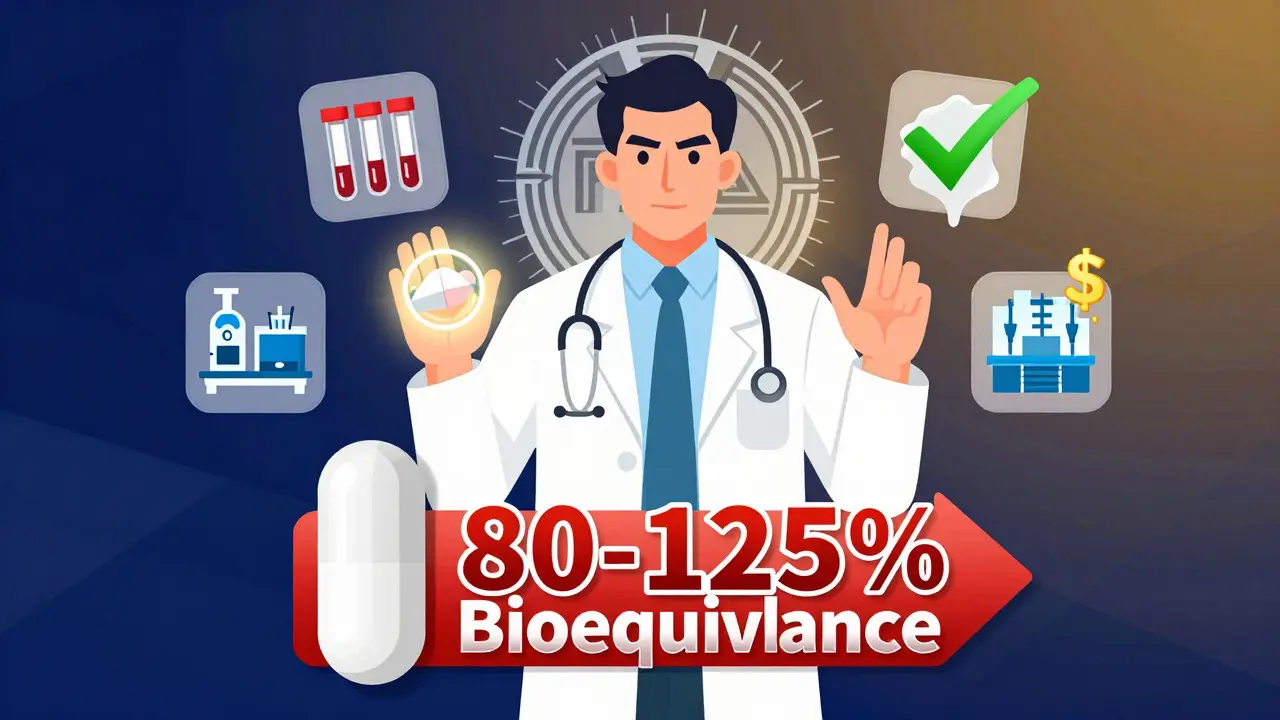
It’s not magic. It’s math. The FDA requires generics to prove they deliver the same amount of active ingredient into the bloodstream as the brand-name version, within a tight range: 80% to 125%. That’s called bioequivalence. It’s not a guess. It’s tested in 24 to 36 healthy volunteers using blood samples over time. The same manufacturing standards apply-same purity, same stability, same quality checks.
Here’s what most doctors don’t realize: the FDA analyzes over 12,000 adverse event reports for generics every year. In 2022, those numbers were nearly identical to brand-name drugs. No spike. No hidden risk. Just the same safety profile.
The Abbreviated New Drug Application (ANDA) is the regulatory pathway through which generic drug manufacturers seek approval from the FDA to market a generic version of a brand-name drug. This process skips redundant animal and clinical trials because the original drug’s safety and effectiveness are already proven. The generic only needs to prove it behaves the same way in the body.
Why Do Patients Doubt Generics?
It’s not about science-it’s about perception. A 2021 FDA survey found 42% of Hispanic patients worried generics were less effective. Patients with household incomes under $25,000 were 3.7 times more likely to stop taking their meds because of cost. They didn’t stop because the drug didn’t work. They stopped because they were scared.
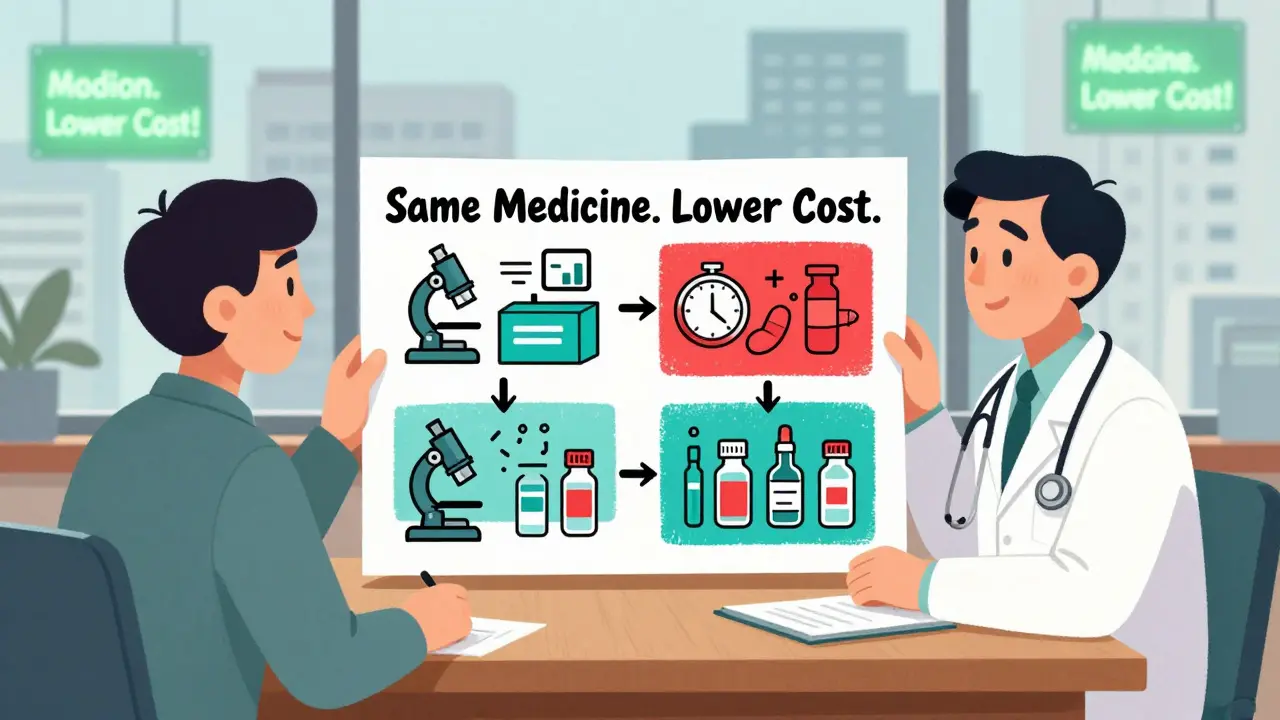
Doctors who use the FDA’s Generic Drugs Stakeholder Toolkit is a collection of educational materials, including infographics, social media templates, and patient handouts, designed to help prescribers explain generic drug equivalence to patients. report better outcomes. One rural family physician in Nebraska saw her generic prescribing rate jump from 62% to 89% in 18 months-just by showing patients a simple infographic comparing brand and generic manufacturing lines.
The toolkit includes a 431 KB PDF called "What Makes a Generic the Same as a Brand-Name Drug?" It uses plain language and visuals to show how both types go through identical inspections. No hidden factories. No lower standards. Just the same active ingredient, in the same form, with the same shelf life.
Cost Isn’t Just a Number-It’s a Treatment Decision
Dr. Aaron Kesselheim from Harvard put it plainly: for a $300/month brand-name drug, switching to generic saves the patient $262.50 a month. That’s not a discount. That’s a lifeline.
The American College of Physicians says cost is the #1 reason patients skip doses. And when they skip doses, their condition worsens. Hospital visits go up. Emergency care spikes. The system pays more. The patient pays more-in health, not just cash.
Doctors who get trained in generic prescribing are 2.3 times more likely to start cost conversations with patients. Not because they’re pressured by insurers. Because they know the science. And they know their patients.
Where the Education Falls Short
Here’s the problem: most of these resources sit in PDF form. They’re not in your EHR. You can’t pull them up while you’re talking to a patient. A 2023 KLAS Research report found only 37% of major electronic health record systems-like Epic or Cerner-have pop-up alerts or embedded guides for generics.
Physicians say it plainly: "I need this in my Epic alert box, not as a PDF I have to hunt for." That’s not laziness. That’s workflow.
And it gets worse with complex generics. Inhalers, topical creams, injectables-these aren’t simple pills. The science is harder. The equivalence thresholds are narrower. Yet, only 42% of prescribers use the educational materials available for these drugs. The FDA’s 2023 report says we’re still missing the mark.
What Actually Works in Practice
Kaiser Permanente did something simple: they embedded the FDA’s generic drug facts directly into their Epic system. When a doctor typed in a brand-name drug, a pop-up appeared: "This generic is FDA-approved. Equivalent. Costs $275 less per month." Within six months, brand-name prescribing dropped 18.7%.
That’s not magic. That’s integration.
Another study found physicians need about 22 minutes of focused education to overcome their skepticism. Not a 2-hour lecture. Not a webinar. Just 22 minutes of clear, visual, data-driven explanation.
The CDC recommends a three-step approach:
- 15-minute training on how generics are approved
- Add a simple prompt to intake forms: "Any concerns about switching to a generic?"
- Share monthly feedback: "Your generic prescribing rate is 85%-above your peers."
That last one matters. Doctors respond to benchmarks. We all do.
The Bigger Picture: Why This Isn’t Going Away
From 2010 to 2020, generics saved the U.S. healthcare system $2.29 trillion. The next five years? Another $1.87 trillion. That’s not a prediction. That’s a projection based on patent expirations already on the books.
Medicare Part D is now offering financial incentives to plans that educate prescribers on therapeutic alternatives. That means more resources, more pressure, more integration.
And now, the FDA is piloting an API that pushes real-time generic data directly into EHRs. Early results? A 15.2% increase in generic prescribing among participating doctors in just six months.
It’s not about replacing brands. It’s about matching science with practice.
What You Can Do Today
You don’t need to wait for your hospital to update its system. Start here:
- Download the FDA’s Prescriber Flyer is a one-page reference guide for physicians that explains the regulatory standards and safety profile of generic medications. (142 KB PDF). Keep it on your desk.
- Use the infographic. Show it to patients. Don’t just hand it out-point to the 80-125% range and say, "That’s the same as saying you’re getting 99.7% of the same effect."
- Ask your EHR vendor: "Can we integrate FDA generic data into our alerts?"
- Start one conversation this week: "I know you’ve heard rumors about generics. Let me show you what the FDA actually requires."
It’s not about convincing everyone. It’s about giving the right information to the right people at the right time. And the tools are already here.
| Resource | Primary Focus | Format | Key Feature |
|---|---|---|---|
| FDA Prescriber Flyer | Regulatory science | Printable one-pager | Includes QR codes to Spanish-language resources |
| Generic Drugs Stakeholder Toolkit | Patient communication | 12 templates, 5 cards, 3 infographics | Designed for 6th-8th grade reading level |
| CDC Opioid Guideline | Pain management integration | Policy document with prescribing tips | Notes 78% of opioid prescriptions can switch to generic |
| EMA (Europe) Materials | Dissolution profile equivalence | Guidelines, not visual tools | Uses different testing standards for certain drugs |
Frequently Asked Questions
Are generics really as safe as brand-name drugs?
Yes. The FDA requires generics to meet the same strict manufacturing standards as brand-name drugs. They must contain the same active ingredient, strength, dosage form, and route of administration. The agency reviews over 12,000 adverse event reports annually for generics and finds no safety differences compared to brand-name versions. The same inspectors audit both types of facilities.
Why do some doctors still prefer brand-name drugs?
Many doctors were trained in an era when generics were less common and less trusted. Some recall early issues with older generics, like inconsistent absorption in the 1980s. But those problems were fixed decades ago. Today, the science is solid. The hesitation often comes from lack of exposure to current data, not clinical experience. Education that includes real-world outcomes-like cost savings and adherence rates-helps shift those views.
Can I trust generics for chronic conditions like high blood pressure or diabetes?
Absolutely. Studies tracking thousands of patients with hypertension and type 2 diabetes show no difference in outcomes between brand-name and generic versions of drugs like lisinopril, metformin, or atorvastatin. The FDA’s bioequivalence standard ensures the drug works the same way in the body. In fact, many large health systems now require generics as first-line treatment for these conditions because of proven effectiveness and lower cost.
What’s the difference between a generic and an authorized generic?
An authorized generic is made by the original brand-name company but sold under a generic label-often at a lower price. It’s identical in every way to the brand-name version: same factory, same formula, same packaging (minus the brand name). Many doctors don’t realize this exists, and patients often think it’s a different drug. It’s not. It’s the same drug with a different sticker.
How can I start using these resources in my practice?
Start small. Print the FDA Prescriber Flyer and put it in your exam rooms. Use the infographic during consultations. Ask your EHR vendor if they can integrate FDA data into your system. Attend one continuing education session on generics. You don’t need to overhaul your practice. Just begin one conversation at a time.
What’s Next for Prescriber Education?
The future isn’t just about more handouts. It’s about smarter tools. AI is already being tested to generate personalized explanations for patients based on their concerns. One pilot showed a 29-point increase in acceptance when the message was tailored to individual fears.
Legislation is catching up too. With 44 states now requiring pharmacists to substitute generics unless the doctor says "do not substitute," the pressure on prescribers to understand and communicate this clearly is growing.
The data is clear. The tools exist. The savings are real. What’s missing is consistent, embedded education. And that’s something every doctor can start fixing today-just by opening one PDF, showing one chart, and asking one question.
Dylan Patrick
March 13, 2026 AT 18:42Doctors: stop overcomplicating it. Show. Don't tell.
Kathy Leslie
March 14, 2026 AT 00:21we need to stop treating this like a science debate and start treating it like a human issue.
Amisha Patel
March 14, 2026 AT 18:32the real gap isn't science. it's storytelling.
Elsa Rodriguez
March 15, 2026 AT 11:25doctors are literally more scared of a $3 pill than a $260 one.
it's not about the drug. it's about ego. and fear. and lazy habits.
someone please slap a pop-up into epic already.
Serena Petrie
March 16, 2026 AT 05:35Buddy Nataatmadja
March 16, 2026 AT 19:53we're over-engineering trust.
mir yasir
March 17, 2026 AT 04:52Stephanie Paluch
March 17, 2026 AT 20:44my mom stopped taking her blood pressure med because she thought the generic was 'fake'.
we need to fix this. like, yesterday.
can we just put a little FDA badge on the pill bottle? 🙏
tynece roberts
March 18, 2026 AT 14:06one nurse asked me if the generic was 'the real stuff'... i just handed her the flyer.
we're not fighting ignorance. we're fighting neglect.
and yeah, i misspelled 'infographic' in my head like 5 times while typing this lol
Jimmy V
March 20, 2026 AT 03:04Here’s the truth: the FDA doesn’t approve generics because they’re cheap. They approve them because they’re identical.
And if you’re still prescribing brand-name when a generic exists? You’re not being careful. You’re being expensive.
Get the flyer. Show it. Move on.
Tim Schulz
March 20, 2026 AT 10:29the FDA has been doing this for 15 years.
you're not a scientist. you're a glorified pharmacy technician with a stethoscope.
get with the program. or get out. 🤷♂️
Jinesh Jain
March 21, 2026 AT 00:09but here, the fear is cultural. not scientific.
we need to fix the story, not the science.
douglas martinez
March 22, 2026 AT 01:49Scott Smith
March 22, 2026 AT 19:55that's not education. that's connection.
and it takes 22 seconds, not 22 minutes.