
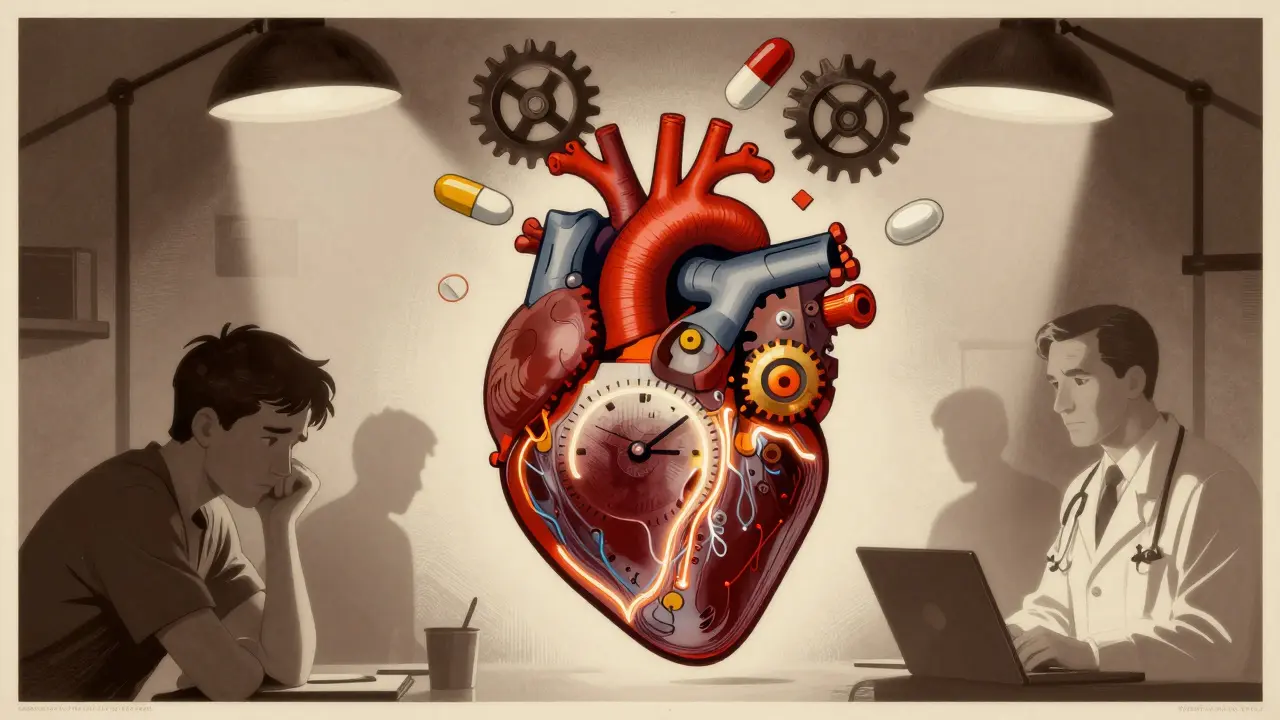
ADHD Stimulant Cardiac Risk Assessment
When you’re prescribed a stimulant for ADHD, you’re not just getting a pill to help you focus. You’re getting a powerful drug that changes how your heart beats. Most people never think twice about it - until something goes wrong. And that’s when the real questions start: Is this safe? Could this trigger a dangerous heart rhythm? Are there better options?
What Happens Inside Your Heart When You Take Stimulants?
Prescription stimulants like Adderall, Ritalin, and Vyvanse work by boosting dopamine and norepinephrine in the brain. But they don’t stop there. These chemicals also flood your bloodstream, hitting your heart like a surge of adrenaline. Your heart rate might climb by a few beats per minute. Your blood pressure might nudge up slightly. For most people, that’s no big deal.
But for some, it’s enough to tip the scales. Stimulants interfere with the electrical signals that keep your heartbeat steady. They block potassium channels, slow down sodium flow, and mess with calcium handling - all critical parts of how heart cells recharge between beats. The result? Longer QT intervals, early after-depolarizations, and a higher chance of chaotic rhythms like ventricular tachycardia.
It’s not theoretical. A 2021 study tracking adults over 66 found that within 30 days of starting stimulants, the risk of ventricular arrhythmia tripled. That’s not common - but it’s real. And it’s not just older adults. Even young people with no prior heart issues can be at risk if they have hidden genetic vulnerabilities or undiagnosed structural problems.
Prescription vs. Illicit: A Huge Difference in Risk
Not all stimulants are created equal. Prescription ADHD meds are carefully dosed and monitored. Illicit drugs like cocaine and methamphetamine? They’re unpredictable, often laced with other chemicals, and taken in far higher doses.
Cocaine blocks multiple ion channels at once, turning the heart into a ticking time bomb. Studies show cocaine users are 2.5 to 4.5 times more likely to suffer ventricular arrhythmias than non-users. Methamphetamine does something similar - it weakens the heart muscle over time and creates electrical chaos. Both can lead to sudden cardiac arrest, even in people who seem perfectly healthy.
Prescription stimulants carry much lower risk - but it’s not zero. Amphetamines like Adderall tend to have a slightly stronger effect on the heart than methylphenidate (Ritalin, Concerta). That’s why some doctors prefer methylphenidate for patients with borderline blood pressure or a family history of heart rhythm problems.
Who’s Really at Risk?
Not everyone needs to worry. But some people should be extra cautious.
- Anyone with a personal or family history of sudden cardiac death before age 50
- People diagnosed with long QT syndrome, hypertrophic cardiomyopathy, or congenital heart defects
- Those who’ve had unexplained fainting, chest pain, or palpitations
- Adults over 65 starting stimulants for the first time
- Patients with existing high blood pressure or heart disease
Here’s the catch: many of these conditions don’t show symptoms until it’s too late. That’s why a thorough medical history matters more than a routine ECG. If your dad dropped dead at 48 from an undiagnosed heart condition, you need to know that before you start a stimulant.
The American Heart Association and American Academy of Pediatrics don’t recommend routine ECGs for everyone. Why? Because the absolute risk is low. But they do say: if you have red flags, get checked. No exceptions.
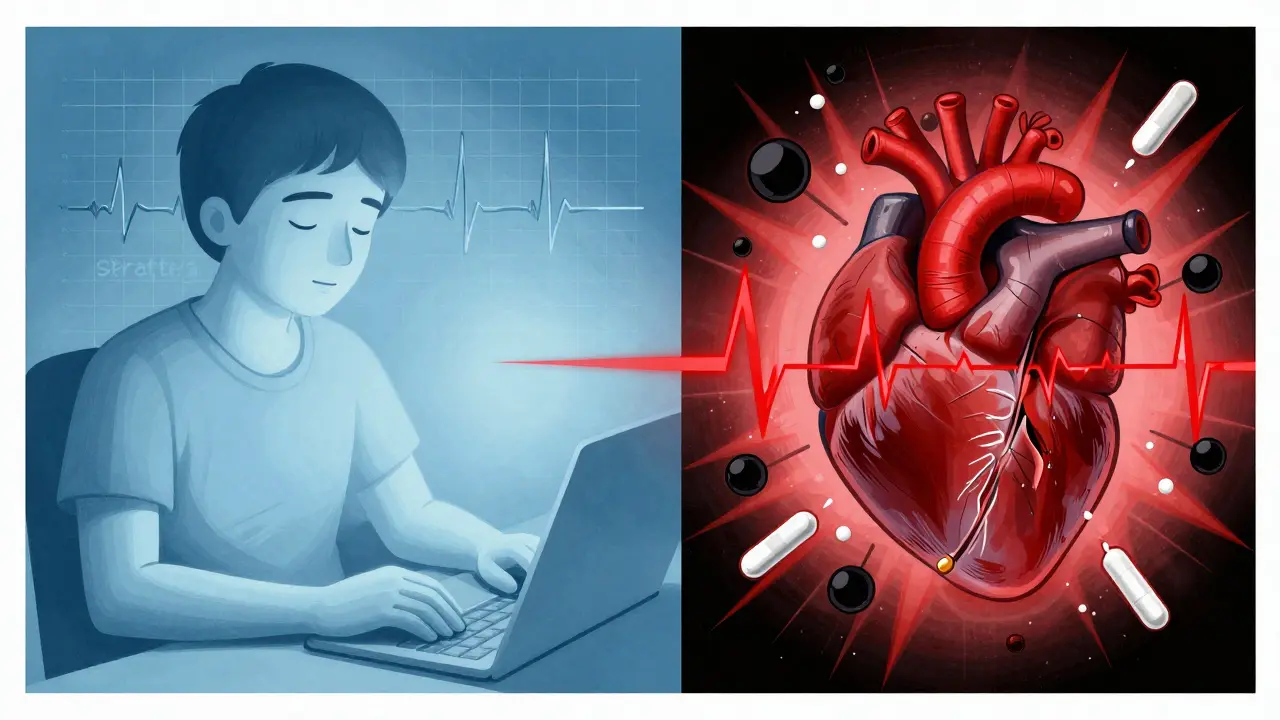
How Doctors Assess Risk - And What You Should Ask
Good clinicians don’t just write a prescription. They ask questions.
They want to know:
- Have you or any close relative ever had sudden cardiac death, unexplained fainting, or seizures?
- Do you ever feel your heart racing for no reason?
- Have you ever been told you have a heart murmur or high blood pressure?
- Are you taking any other medications - including over-the-counter cold pills or supplements?
They check your blood pressure and pulse before starting treatment. Then again after one to three months. And every six to twelve months after that. If your blood pressure climbs above the 95th percentile for your age and height, they’ll pause the medication.
If you’re over 65 or have a known heart condition, they’ll refer you to a cardiologist. An ECG or even an echocardiogram might be ordered. It’s not paranoia - it’s precaution.
Ask your doctor: "Based on my history, am I in a higher-risk group? What signs should I watch for?" If they brush you off, get a second opinion.
What If You’re Already on Stimulants? Should You Stop?
No. Not unless you’re having symptoms.
Most people take stimulants for years without any heart issues. The real danger isn’t the medication itself - it’s ignoring warning signs. If you start feeling your heart skip, flutter, or pound out of rhythm, don’t wait. See your doctor. Get an ECG. Don’t assume it’s just anxiety.
And if you’ve been on stimulants for years without problems? That’s a good sign. But keep monitoring. The March 2024 ACC study showed that long-term use can slowly lead to heart muscle changes - even in young adults. It’s not common. But it’s real. That’s why annual checkups matter.
Stopping your medication abruptly can cause withdrawal, depression, or a rebound in ADHD symptoms. Never quit without talking to your prescriber.
Alternatives to Stimulants - What Actually Works
If your heart is a concern, there are non-stimulant options. They’re not as fast-acting. They’re not as powerful. But they’re safer for your heart.
- Atomoxetine (Strattera): A selective norepinephrine reuptake inhibitor. It doesn’t affect heart rate or blood pressure much. Response rate? About 50-60%. Takes 4-8 weeks to kick in.
- Guanfacine (Intuniv): Originally a blood pressure pill. It calms the prefrontal cortex, helping with focus and impulse control. Side effects: drowsiness, low blood pressure. Works well for kids and teens.
- Clonidine (Kapvay): Similar to guanfacine. Often used for ADHD with hyperactivity or sleep issues. Can cause dizziness or dry mouth.
These aren’t magic bullets. They don’t work for everyone. But for someone with a family history of arrhythmias, they’re the smart choice.
Some people try behavioral therapy alone. It helps - especially with organization and time management. But for moderate to severe ADHD, it’s rarely enough on its own. Combine it with non-stimulant meds for the best results.
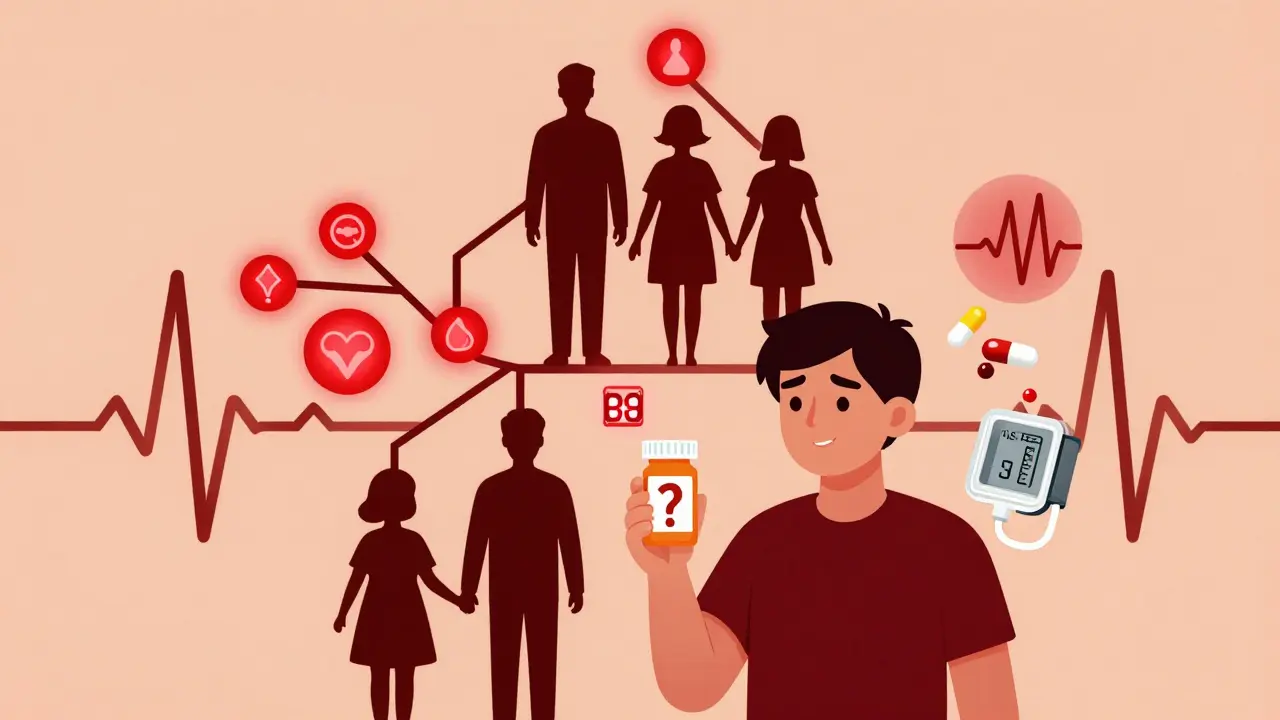
The Bigger Picture: Benefits vs. Risks
Let’s be clear: stimulants change lives. They help kids finish school. They help adults keep jobs. They reduce the risk of accidents, substance abuse, and depression in people with untreated ADHD.
A 2011 study of over 1.2 million children and young adults found the absolute risk of serious heart events was extremely low - less than one in 100,000 per year. That’s lower than the risk of being struck by lightning.
But low risk isn’t zero risk. And when you’re talking about your heart, even small risks matter.
The goal isn’t to scare you off stimulants. It’s to make sure you’re not blindsided. If you have no heart issues, the benefits likely outweigh the risks. But if you have red flags, you owe it to yourself to explore safer options.
What’s Coming Next?
Research is moving fast. Scientists are looking for genetic markers that predict who’s more likely to develop arrhythmias on stimulants. Early work points to variations in adrenergic receptor genes - the same ones that control how your body responds to adrenaline.
The American College of Cardiology is expected to release updated guidelines in late 2025. They’ll likely push for more personalized risk assessment - not blanket bans, not routine ECGs for everyone, but smarter screening based on individual history, age, and symptoms.
For now, the message is simple: Know your history. Monitor your body. Talk to your doctor. And don’t assume your heart is fine just because you’re young or feel fine.
Can ADHD stimulants cause sudden cardiac death?
The risk is extremely low - less than one in 100,000 people per year. But it’s not zero. Most cases occur in people with undiagnosed heart conditions like long QT syndrome or hypertrophic cardiomyopathy. That’s why a detailed family and personal medical history is critical before starting stimulants.
Do I need an ECG before starting Adderall or Ritalin?
Routine ECGs aren’t required by major guidelines. But if you have symptoms like fainting, chest pain, palpitations, or a family history of sudden cardiac death before age 50, you should get one. Your doctor should assess your risk first - and if there’s any doubt, refer you to a cardiologist.
Are non-stimulant ADHD meds less effective?
Yes, generally. Stimulants work for 70-80% of people. Non-stimulants like Strattera, Intuniv, or Kapvay work for about 50-60%. They take longer to kick in - weeks instead of days. But they’re much safer for your heart. For people with cardiac risks, the trade-off is worth it.
Can I switch from Adderall to a non-stimulant safely?
Yes - but not overnight. Your doctor will slowly reduce your stimulant dose while gradually introducing the new medication. Stopping stimulants suddenly can cause severe fatigue, depression, or ADHD rebound. A careful transition over several weeks is essential.
What symptoms should I watch for while on stimulants?
Call your doctor if you experience: chest pain, dizziness, fainting, palpitations (feeling your heart race or skip), shortness of breath without exertion, or unusual fatigue. These aren’t normal side effects - they’re warning signs. Don’t wait. Get checked.
Next Steps: What to Do Right Now
- If you’re on a stimulant and have no heart issues: Keep your annual checkups. Monitor your blood pressure at home if possible.
- If you have a family history of sudden cardiac death or heart disease: Ask your doctor for a cardiac evaluation - even if you feel fine.
- If you’re experiencing heart symptoms: Don’t ignore them. Get an ECG. Talk to a cardiologist.
- If you’re considering stimulants and have cardiac risk factors: Discuss non-stimulant options like Strattera or Intuniv. They’re not perfect, but they’re safer.
- If you’re a parent of a child with ADHD: Ask the doctor about family cardiac history. Don’t assume your child is fine just because they’re young.
Your heart doesn’t lie. Neither should your treatment plan.
Stewart Smith
December 31, 2025 AT 23:31Man, I’ve been on Adderall for 8 years and never thought twice about my heart until my cousin had that weird episode last year. Now I get annual ECGs just to be safe. Better safe than sorry, right?
Also, side note: my doc never asked about family history. Kinda wild when you think about it.
Retha Dungga
January 2, 2026 AT 12:11heart is a wild thing 🫀
we pump blood but no one asks how it feels
stimulants? yeah they buzz
but what about the quiet ones who just... stop?
we need more listening, less prescribing 💭
Joy Nickles
January 2, 2026 AT 18:55OMG I CANT BELIEVE PEOPLE JUST TAKE THESE PILLS LIKE CANDY??!!
you know what happened to my neighbor? he was 32, fit, ran marathons, took Vyvanse for 'focus'... and BOOM-cardiac arrest. no warning. no ECG. just... gone.
and now his wife is suing the doctor? like, why? because he didn't ask about his dad's death at 45? DUH. WHY WOULD YOU NOT TELL THEM??
also-why are we still using amphetamines in 2025? we have AI now. we can do better.
PS: I'm not anti-ADHD. I have it. but I take Strattera. and I'm alive. and I'm not a zombie. so... yeah.
Emma Hooper
January 3, 2026 AT 16:42Look, I get it. You want to crush your 9-to-5, finish that thesis, or finally clean your room. But your heart? It’s not a battery you can overcharge and ignore.
I used to think stimulants were just ‘brain fuel.’ Turns out they’re more like espresso shots injected straight into your ventricles.
My uncle had an ICD implanted after a near-miss on Ritalin. He’s 51. No prior symptoms. Just a family history he didn’t think mattered.
Don’t be that person. Ask the questions. Even if your doctor rolls their eyes. Even if you feel ‘fine.’
And yes-Strattera sucks. It takes forever. But it doesn’t make your heart feel like it’s trying to escape your chest. That’s worth the wait.
Marilyn Ferrera
January 5, 2026 AT 08:08Family history matters. Always. No exceptions.
ECGs aren't always needed-but if you have red flags, get one.
Period.
Harriet Hollingsworth
January 7, 2026 AT 00:59People are so careless with their health these days. It’s disgusting. You wouldn’t let a stranger inject you with random chemicals, but you’ll swallow Adderall like it’s a vitamin? What is wrong with you?
My sister almost died because she didn’t ask about her grandfather’s sudden death. Now she’s on meds that don’t kill her. And she’s still mad at the doctor. Like, no-YOU’RE the one who didn’t speak up.
Stop blaming the system. Start taking responsibility.
Deepika D
January 8, 2026 AT 14:03Hey everyone, I just want to say-this post is so important, and I’m so glad someone took the time to write it with real care. I’m a nurse in Bangalore, and I’ve seen too many young adults come in with palpitations after starting stimulants, and they say, 'But I feel fine!'
Here’s the thing: your body doesn’t scream before it breaks. It whispers. And we’re all too busy scrolling to hear it.
Non-stimulants? Yes, they’re slower. But Strattera? It’s like switching from a jetpack to a bicycle-you still get where you’re going, just without the risk of crashing into a wall.
And parents? Please, please, please ask about family history. Don’t assume your child is 'too young' to have inherited anything. Genetics don’t care about age.
You’re not overreacting. You’re being smart. And I’m proud of you for reading this far. Keep going. 💪❤️
Bennett Ryynanen
January 9, 2026 AT 20:20Yo, I got prescribed Adderall after my third failed job interview. I was desperate. Didn’t ask questions. Took it for 2 years. Then one day, I felt like my chest was being squeezed by a gorilla.
Turns out, I had a mild case of long QT. My dad had a heart attack at 44. Never told me. Never thought it mattered.
I switched to Strattera. Took 6 weeks to feel normal. But now? I sleep. I don’t panic. My BP is normal. I’m alive.
If you’re on stimulants and feel even a little off-STOP. Go see someone. Don’t wait. Your heart doesn’t care how busy you are.
Chandreson Chandreas
January 9, 2026 AT 21:48Life’s a balance, man. 🌿
Stimulants help people live better lives. But they’re not candy. They’re tools. Like a chainsaw. You don’t use it without gloves, safety goggles, and respect.
My cousin took Ritalin for ADHD. Never had issues. But her brother? Died at 29 from an arrhythmia. Turns out, he had a gene variant no one knew about.
So yeah-get checked if you’ve got family red flags. Don’t wait for the emergency room to tell you you’re at risk.
Knowledge isn’t fear. It’s freedom.
Darren Pearson
January 11, 2026 AT 14:24While the article presents a compelling case for caution, one must acknowledge the methodological limitations of the cited epidemiological studies, particularly the confounding variables inherent in observational cohorts. The absolute risk remains statistically negligible when contextualized against the broader population prevalence of sudden cardiac events. Moreover, the conflation of illicit stimulant pharmacology with therapeutic dosing protocols represents a non sequitur in clinical reasoning. One cannot extrapolate cocaine-induced cardiotoxicity to FDA-regulated amphetamine derivatives without significant qualification. The recommendation for universal cardiac screening, while emotionally resonant, lacks empirical grounding in current guidelines from the AHA or ACC. One must resist the allure of precautionary overreach in the absence of robust evidence.
Aaron Bales
January 12, 2026 AT 02:01Just want to say-this is the kind of post that saves lives.
My sister was on Vyvanse for 5 years. No symptoms. No red flags. Then she passed out during yoga. Turned out-long QT. Her dad died at 47. No one told her.
She’s on Strattera now. Took 2 months to adjust. But she’s alive. And she’s not scared to leave the house anymore.
If you’re reading this and you’re on stimulants-ask your doctor one question: 'Could this kill me?'
Don’t be polite. Be brave.
Lawver Stanton
January 13, 2026 AT 10:47Okay, I’m not a doctor, but I’ve been on Adderall since college. 12 years. No problems. But then I started reading this and now I’m convinced I’m gonna die in my sleep.
Like, what if my heart’s been quietly screaming for a decade and I just didn’t notice? What if my dad’s death at 52 wasn’t ‘just a heart attack’ but ‘stimulant-triggered arrhythmia’?
Now I can’t sleep. I’m checking my pulse every 10 minutes. I just Googled ‘how to tell if your QT interval is long’ and now I think I have it.
Also, I think my dog’s judging me.
Can someone please tell me I’m not going to die? Or… should I just quit cold turkey? I’m so scared now.
linda permata sari
January 14, 2026 AT 00:48My grandma in Jakarta used to say: 'The body remembers what the mind forgets.'
I took Ritalin for years. Felt great. Then I got dizzy during a flight. Thought it was altitude. Turns out-it was a heart rhythm. My mom’s side? Three uncles dead before 50. No one talked about it.
Now I’m on guanfacine. Takes time. But I don’t feel like my chest is a drum anymore.
Don’t wait for the crash. Ask the questions. Even if it’s awkward.
And to the doctors reading this? Please ask about family. Even if they say 'no.'
Because silence kills.
Hanna Spittel
January 14, 2026 AT 18:44THEY’RE DOING THIS ON PURPOSE. 🤯
Big Pharma knows stimulants cause arrhythmias. They just don’t care. They make billions. You’re a lab rat. Your heart? Just collateral damage.
They don’t want you to know about Strattera. It’s cheap. No patent. No profit.
And the ECG? They say it’s 'not necessary' because they don’t want you to find out you’re at risk. Then you’d stop buying Adderall.
Look at the dates. The study came out in 2021. But you still see ads for Vyvanse on TikTok.
They’re lying to you. Your doctor? Probably paid. Your pharmacist? Probably told you to 'just take it.'
Wake up. Your heart is not a toy. 🫀💔