
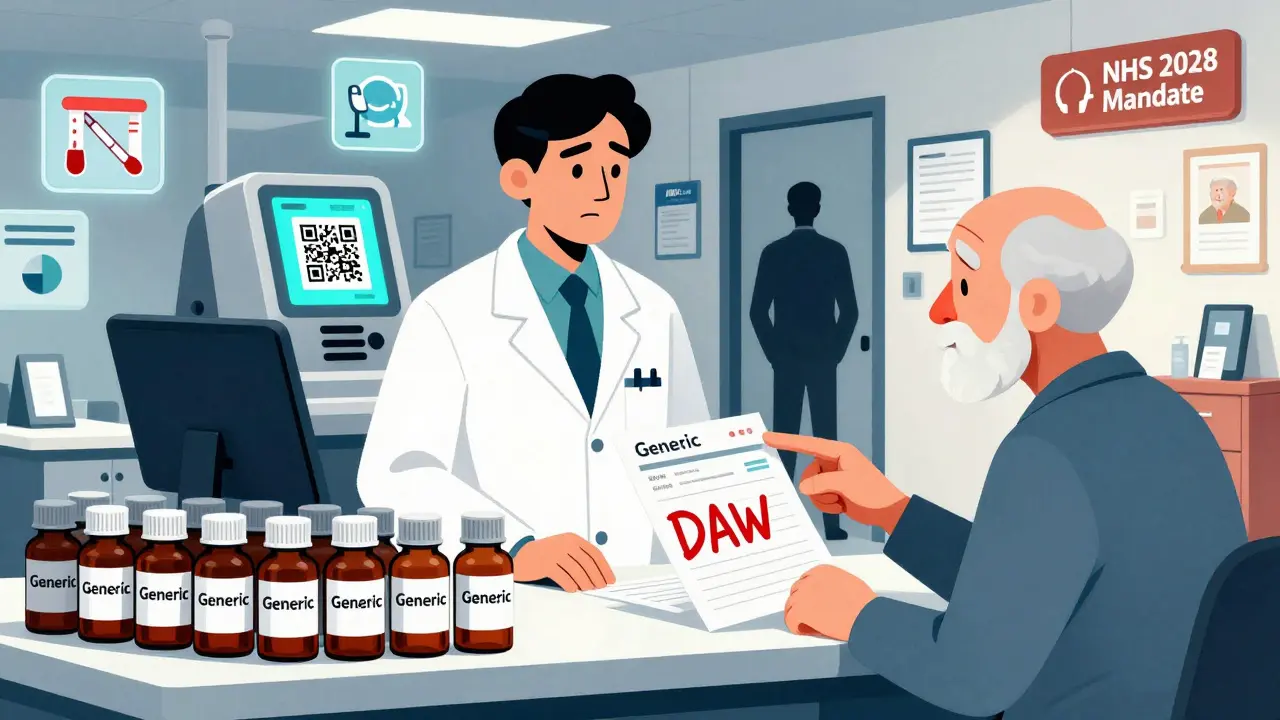
The UK’s healthcare system is changing how medicines are dispensed and where care happens. If you’ve picked up a prescription at your local pharmacy recently, you might not have noticed-but the rules behind what you got, and how you got it, have shifted dramatically since October 2025. These aren’t small tweaks. They’re a full overhaul of how the NHS handles generic medicines and service delivery, driven by new laws, financial pressure, and a push to move care out of hospitals and into homes and communities.
What You Can and Can’t Substitute
For years, pharmacists in the UK have been allowed to swap a branded drug for a cheaper generic version, as long as the doctor didn’t write ‘dispense as written’ (DAW) on the prescription. That rule still stands-but the context around it has changed. Under the Human Medicines (Amendment) Regulations 2025, the focus is no longer just on cost. It’s about control. The NHS now requires that 90% of eligible prescriptions be filled with generics by 2028. That’s up from 83% today. It’s not just about saving money-it’s about standardizing care.
But here’s the catch: not all substitutions are equal. Some medications, like epilepsy drugs or blood thinners, are sensitive to small differences in formulation. Even if two pills have the same active ingredient, the way they’re absorbed can vary slightly. That’s why doctors still have the power to block substitution. If they’re worried, they write DAW. And they’re doing it more often-especially for older patients and those with complex conditions.
The Rise of Digital Pharmacies
One of the biggest changes since June 2025 is the move away from face-to-face pharmacy services. The new rules require all NHS pharmaceutical services to be delivered digitally by licensed Digital Service Providers (DSPs). That means no more walking into your local chemist to pick up your repeat prescription. Instead, you’ll order online, get a text when it’s ready, and either have it delivered or collect it from a kiosk. The pharmacy counter is disappearing.
This isn’t just a tech upgrade. It’s a legal shift. The old model-pharmacists on-site, checking prescriptions, answering questions-is being replaced by a remote system. Pharmacies that were already on the list before June 2025 can keep operating under old rules, but any new pharmacy applying for NHS contracts must meet strict digital-only requirements. That’s forcing many small, independent pharmacies to close or merge. In rural areas, where pharmacies were already scarce, this is causing real access problems.
A survey by the British Pharmaceutical Industry found that 54% of community pharmacies say they need between £75,000 and £120,000 just to upgrade their systems. Many can’t afford it. And while the government says this will cut costs, the reality is that some patients-especially those over 65 or with limited digital skills-are being left behind.
From Hospital to Home
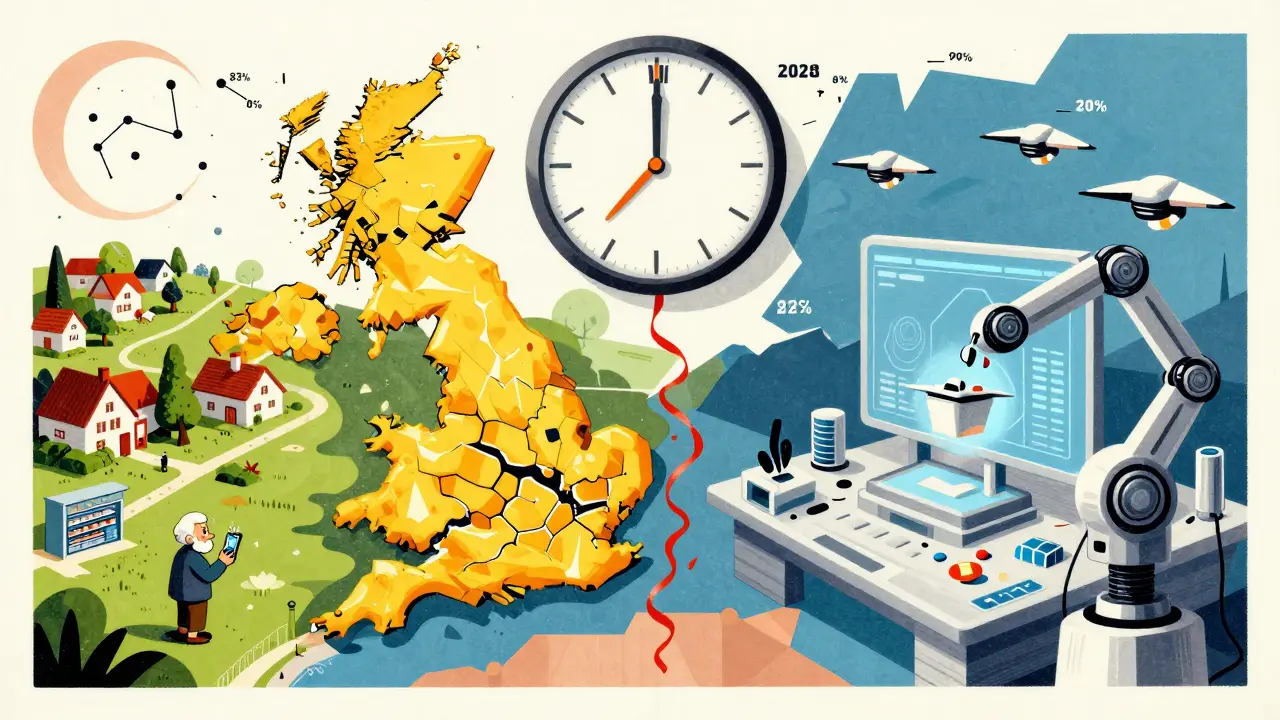
The NHS isn’t just changing how you get your pills-it’s changing where you get your care. The 2025 mandate tells the NHS to move care ‘from hospital to community, sickness to prevention, and analogue to digital.’ That’s not a slogan. It’s a policy. And it’s happening fast.
Instead of waiting months for an outpatient appointment at the hospital, you might now get a virtual consultation. Instead of going in for a blood test, you might get a home kit sent to you. Instead of being admitted for a minor infection, you might be treated by a community nurse who visits your home.
These changes are backed by hard targets. The NHS aims to reduce emergency hospital admissions for people over 65 by 15% by 2027. It’s also planning to shift 30% of outpatient appointments to community settings by 2028. That’s over a million appointments moved off hospital waiting lists. Sounds good, right? But it only works if the community infrastructure is ready.
And it’s not. A report from the NHS Confederation found that 68% of local health boards don’t have enough staff to deliver these new services. In rural areas, 42% of trusts lack the basic facilities-like diagnostic hubs or home visit teams-to make this work. Patients in places like North Wales or rural Cumbria are seeing longer waits, not shorter ones.
Who’s Winning? Who’s Losing?
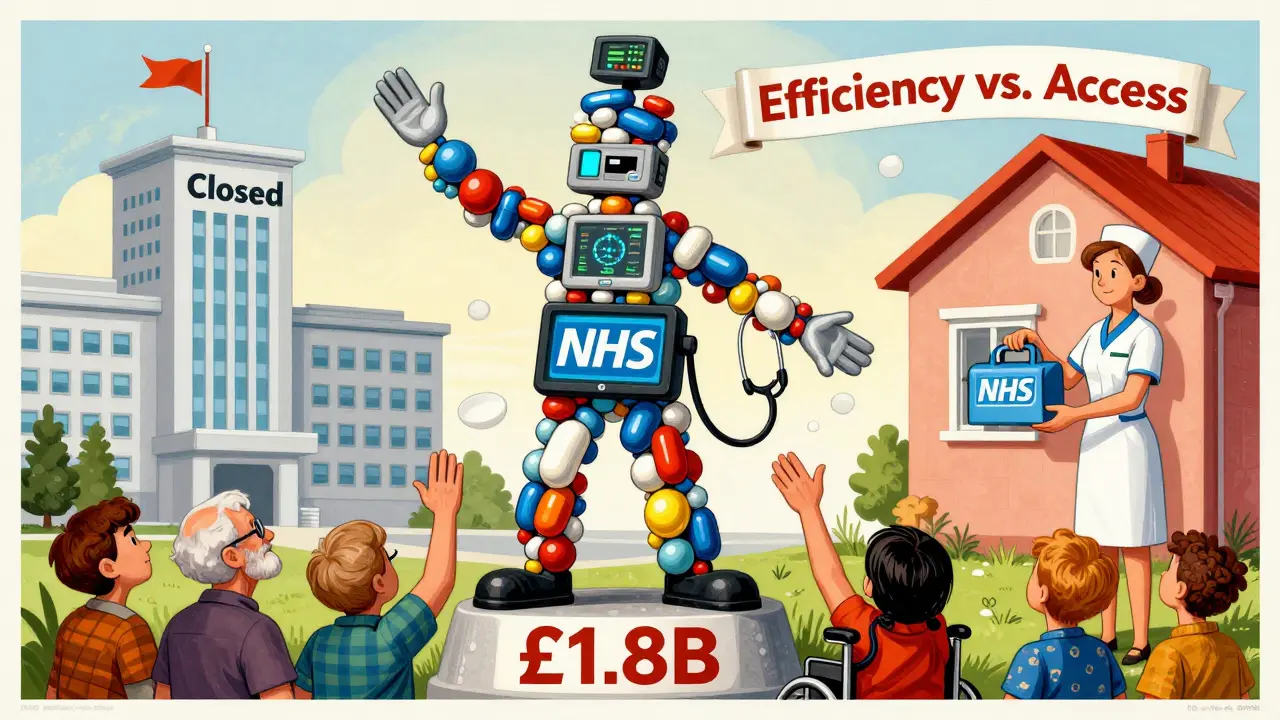
The financial stakes are huge. The government has allocated £1.8 billion for substitution initiatives in 2025-26. That includes £650 million for community diagnostic hubs that will replace 22% of hospital-based testing. The idea is simple: cheaper, faster, less disruptive care.
But the results are mixed. A pilot in North West London found a 12% increase in medication errors after switching to remote dispensing. Patients couldn’t talk to a pharmacist when they had questions. A nurse in Manchester told Reddit users that virtual fracture clinics cut unnecessary follow-ups by 40%-but 15% of elderly patients couldn’t use the app at all.
Meanwhile, the King’s Fund warns that without fixing the 28,000-worker shortfall in community care, these reforms could widen health inequalities by 12-18% in the poorest areas. In Greater Manchester, early substitution efforts actually made gaps worse before targeted support was added. The lesson? You can’t just move care from one place to another-you have to rebuild the system around it.
The Future of Substitution
By 2030, the NHS expects 45% of current outpatient appointments to be handled remotely or in community settings. That’s a massive shift. It could save £4.2 billion a year. But it hinges on three things: more staff, better tech, and real support for vulnerable patients.
The Carr-Hill formula, coming in April 2026, will help by directing more funding to areas with the highest need. That’s a step in the right direction. But it’s not enough. The system still relies on patchy local efforts. Some areas have trained community nurses and invested in digital tools. Others are just trying to keep the lights on.
What’s clear is that substitution isn’t just about drugs anymore. It’s about how care is organized, who delivers it, and whether people can actually access it. The NHS is betting big on efficiency. But efficiency doesn’t mean anything if patients can’t get the care they need.
What This Means for You
If you’re on regular prescriptions, here’s what you need to know:
- Your pharmacist can still swap your branded medicine for a generic-unless your doctor says not to.
- You may no longer be able to walk into your pharmacy to pick up your meds. Look out for text alerts or delivery options.
- If you’re over 65 or have trouble using apps, ask your GP about alternatives. You still have rights.
- Community services are expanding, but not everywhere. If your local clinic has closed, contact your Integrated Care Board-they’re required to provide a solution.
Don’t assume the system is working smoothly. It’s not. But it’s changing. And you need to know how it affects you.
Michaela Jorstad
February 20, 2026 AT 19:31Okay, but let’s be real-this isn’t just about cost-cutting. It’s about dignity. I’ve watched my mom struggle to use the app for her blood pressure meds, and she’s tech-savvy! Now imagine someone who’s 80, lives alone, and can’t read small text. The system’s supposed to help, but it’s making things harder for the people who need it most. We’re automating compassion out of healthcare.
Jeremy Williams
February 21, 2026 AT 10:27As someone who has worked in public health administration for over two decades, I must emphasize that the structural underfunding of community-based services renders these reforms fundamentally unsustainable. The policy architecture is theoretically sound, yet its implementation lacks the necessary ontological grounding in sociological reality. One cannot merely digitize human care without addressing the human element.
Maddi Barnes
February 22, 2026 AT 16:12So let me get this straight… we’re replacing human pharmacists with kiosks and texts… and calling it ‘progress’? 🤦♀️ My grandma’s last prescription was picked up by a volunteer who asked her how her cat was doing. Now? She gets a notification that says ‘Your meds are ready at the red box.’ No smile. No ‘You okay, dear?’ Just… a box. And now they’re shutting down the only pharmacy in her village. 🥲 I’m not mad-I’m just… really sad. This isn’t efficiency. This is abandonment dressed up as innovation.
Jonathan Rutter
February 22, 2026 AT 23:11Look, I get the cost-saving angle, but you can’t just shove elderly people into a digital void and expect them to adapt. I’ve seen it firsthand-my neighbor’s wife had a stroke because she couldn’t figure out how to order her anticoagulants online. The system didn’t fail her. The people designing it did. And now they’re patting themselves on the back for ‘streamlining care.’ Meanwhile, people are dying because they didn’t get their meds on time. This isn’t healthcare reform. It’s a bureaucratic death sentence wrapped in a PowerPoint slide.
Jana Eiffel
February 23, 2026 AT 04:20The philosophical underpinning of this policy reflects a profound epistemological shift in the conception of care: from relational, embodied, and contextual to transactional, algorithmic, and standardized. While efficiency may be mathematically optimal, it is ethically deficient when applied to human vulnerability. The reduction of pharmaceutical care to a logistical operation ignores the ontological weight of trust, presence, and continuity in healing.
aine power
February 24, 2026 AT 03:30Bad policy. Done.
Robin bremer
February 25, 2026 AT 08:49bro like… i just want my pills and now i gotta use an app that crashes every time i open it?? and my pharmacist who knew my dog’s name is gone?? this is wild. 🥲💀
Greg Scott
February 25, 2026 AT 17:20I work in a rural pharmacy in Maine. We’ve been around since 1987. We’re not getting the upgrade money. We’re not getting the support. We’re just being told to vanish. My customers aren’t tech-savvy-they’re just people who need their meds. This isn’t innovation. It’s erasure. And it’s happening in places no one’s watching.
Scott Dunne
February 27, 2026 AT 11:25While I appreciate the ambition of the NHS reforms, I must point out that Ireland has maintained its community pharmacy model for over a century without digital coercion. Our pharmacists are trained clinicians-not logistics operators. The British approach appears to prioritize cost metrics over professional autonomy and patient safety. This is not modernization; it is deregulation masquerading as reform.
Ashley Paashuis
February 28, 2026 AT 22:43It’s important to acknowledge that while systemic change is necessary, the pace and lack of targeted support for vulnerable populations are deeply concerning. The data shows clear disparities in access-particularly among those with low digital literacy, chronic illness, or mobility limitations. A one-size-fits-all digital transition ignores the nuanced reality of care. We need phased implementation, robust outreach, and real-time feedback loops-not top-down mandates.
Davis teo
March 2, 2026 AT 20:12So let me get this straight-you’re telling me my 72-year-old aunt, who still uses a flip phone, has to navigate an app to get her heart meds… and if she fails, she’s just supposed to ‘ask her GP’? Like that’s gonna happen? Meanwhile, the NHS is spending millions on fancy dashboards while nurses are working 80-hour weeks. This isn’t a policy. It’s a performance. And we’re all just extras in the show.
Arshdeep Singh
March 2, 2026 AT 23:13Look, capitalism always wins. They don’t care about you or your grandma. They care about profit margins. Pharma companies are laughing all the way to the bank because now they control the generics. The NHS is just the middleman with a spreadsheet. And you? You’re the sucker who thinks this is ‘healthcare reform.’ Wake up. It’s just another corporate takeover disguised as public service.
Liam Crean
March 3, 2026 AT 03:48I’m not against innovation. I’m against doing it without listening. I’ve talked to nurses in rural Scotland who say they’ve been told to ‘figure it out’ with no training, no backup, and no resources. The people on the ground are screaming for help, but the policy-makers are still in meetings. We need co-design-not top-down mandates. Real people. Real conversations. Real solutions.
Amrit N
March 3, 2026 AT 09:48yo i live in delhi and we got like 3 pharmacies in my whole town and they still use pen and paper lmao. but the uk is trying to go all digital? weird flex but okay. 🤷♂️ maybe just give people the meds and chill??