

Vaccination Risk Calculator for Blood Thinners
Vaccination Safety Calculator
Your Vaccination Risk Assessment
Risk Level:
Personalized Recommendations
Important Note
This tool provides general guidance based on current medical guidelines. Always follow your healthcare provider's specific recommendations.
Getting vaccinated while on blood thinners is safe - if you do it right
You’re on warfarin, Eliquis, or Xarelto. You’ve been told to get your flu shot, your pneumonia vaccine, maybe even your latest COVID booster. But you’re scared. Last time you got a shot, you ended up with a purple bruise the size of a golf ball that lasted for weeks. You’re not alone. Around 68% of people on blood thinners report some bruising after a vaccine. About 12% end up with a hematoma so big they need to see a doctor.
The good news? You don’t have to skip vaccines. The CDC, the American College of Chest Physicians, and the Anticoagulation Forum all agree: the risk of catching the flu or COVID-19 is far greater than the risk of a bad bruise. The problem isn’t the vaccine - it’s how it’s given.
Why do blood thinners make vaccines riskier?
Most vaccines - flu, pneumonia, COVID-19 - are injected into muscle. That’s called an intramuscular, or IM, shot. When you’re on blood thinners, your blood doesn’t clot as quickly. So when the needle goes in, even a tiny bit of bleeding can spread under the skin and turn into a bruise - or worse, a swollen, painful lump called a hematoma.
It’s not about how much blood thinner you take. It’s about technique. A 2023 study in the Journal of Thrombosis and Thrombolysis found that when proper pressure was applied after the shot, complications dropped by 78%. That’s not luck. That’s protocol.
What blood thinners are you on? It matters
Not all blood thinners are the same. And that changes how you prepare.
- Warfarin (Coumadin): You need an INR check before your shot. The goal? Keep your INR below 4.0 - or under your doctor’s personal target range. If your INR is above 4.0, your risk of a big hematoma jumps by 37%. Don’t skip the blood test.
- DOACs (Eliquis, Xarelto, Pradaxa, Savaysa): No INR needed. These drugs don’t require routine blood tests. But timing matters. If you take your dose in the morning, consider scheduling your vaccine for the afternoon - or vice versa - to avoid peak drug levels right at injection time.
- Heparin (Lovenox, Fragmin): Usually safe, but if you’re on high doses for a recent clot, talk to your hematologist. Some providers recommend holding the dose for 12 hours before the shot.
Here’s the catch: if you have severe hemophilia (Factor VIII or IX under 1%), you need factor replacement before any injection. That’s not optional. That’s life-saving.
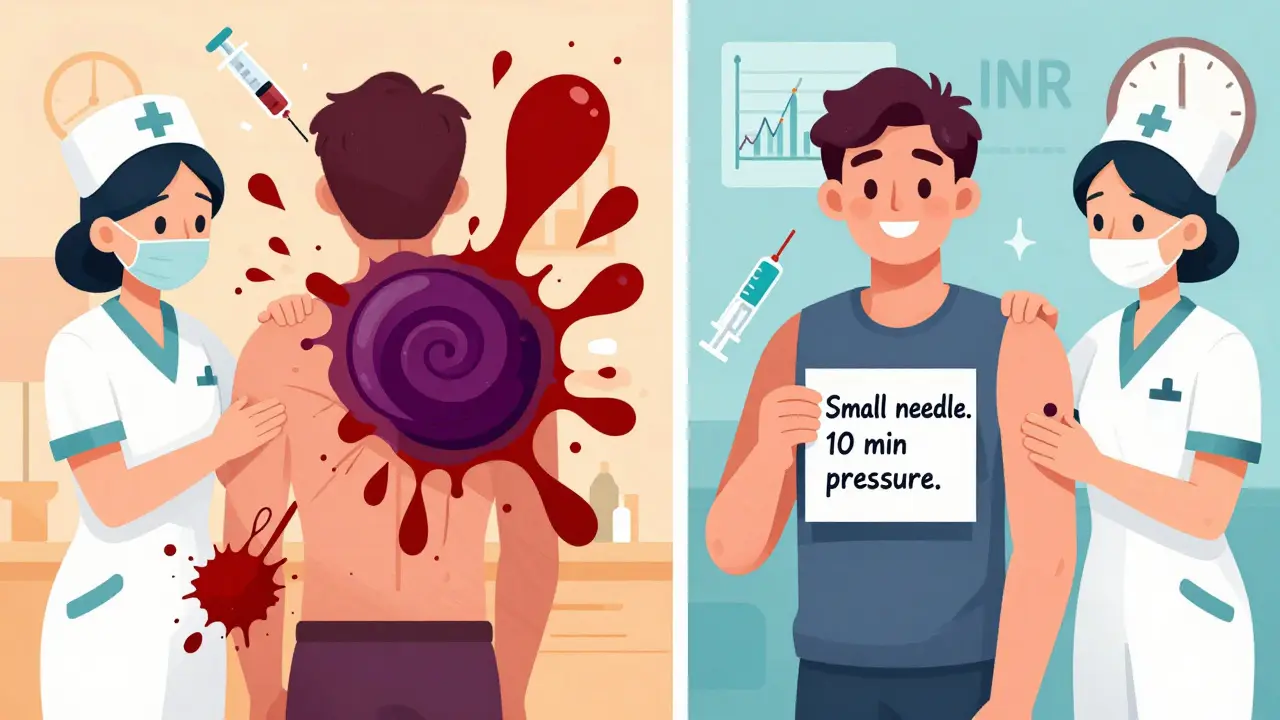
How to get the shot without turning into a walking bruise
There’s a simple 3-step method that cuts complications in half:
- Use a small needle. A 23-gauge or smaller needle is best. Thinner needles mean less tissue damage. Many clinics still use 22-gauge needles - too big. Ask for a 25-gauge if you’re worried.
- Apply firm pressure - no rubbing. Right after the shot, press down hard on the spot with your thumb or a gauze pad. Don’t rub. Don’t massage. Don’t move your arm around. Just hold. For most people, 5 minutes is enough. If you’re on warfarin with an INR near 4, or you’ve had big bruises before, hold for 10 minutes. The Bleeding & Clotting Disorders Institute says this is non-negotiable.
- Don’t leave until it’s done. Many people rush out after the shot. Bad idea. Stay seated. Keep pressure on. Wait. If you’re unsure, ask the nurse to time it for you. Most won’t offer unless you ask.
One patient on HealthUnlocked said: “My nurse used a 25-gauge needle, held pressure for 10 minutes, and I had zero bruising.” That’s not magic. That’s standard care.
What if you already got the shot wrong?
Maybe you didn’t tell your provider you’re on blood thinners. Maybe they didn’t know. Maybe you got a shot and now your arm looks like a bruised banana.
Here’s what to do:
- Apply ice for the first 24 hours - 15 minutes on, 15 minutes off.
- Elevate your arm if it’s swollen.
- Take acetaminophen (Tylenol) for pain. Avoid ibuprofen or aspirin - they make bleeding worse.
- If the bruise keeps growing after 24 hours, or you feel numbness or tingling, get it checked. That could mean pressure on a nerve or a deep hematoma.
And next time? Bring a note. Write down your medication, your INR (if applicable), and your preferred injection technique. Some clinics now give patients “Blood Thinner Alert” wristbands. If your doctor’s office doesn’t have one, ask them to start.
Why so many people get it wrong
A 2023 survey by the National Blood Clot Alliance found that 29% of anticoagulated patients said their vaccinator didn’t adjust technique at all. That’s almost 1 in 3. And those patients had 63% more complications.
Why? Most nurses and pharmacists aren’t trained in anticoagulation. They learn how to give shots in nursing school - not how to adapt for patients on warfarin. The CDC’s guidelines have been clear since 2021. But many clinics still follow the same routine they used in 2019.
Big hospitals like Kaiser Permanente fixed this in 2020 by creating system-wide protocols. Their complication rate dropped 54%. Smaller clinics? They’re still catching up.
What about drug interactions?
There’s a myth that vaccines can interfere with blood thinners. A few old case reports from 2004 suggested flu shots might raise INR levels in warfarin users. But since then, dozens of studies have shown no consistent link. The same goes for DOACs - no evidence they interact with any vaccine.
One exception: if you’re on ibrutinib (a cancer drug) and warfarin together, bleeding risk goes up. That’s not the vaccine’s fault - it’s the combo. If you’re on multiple medications, talk to your pharmacist.
What you should do before your next vaccine
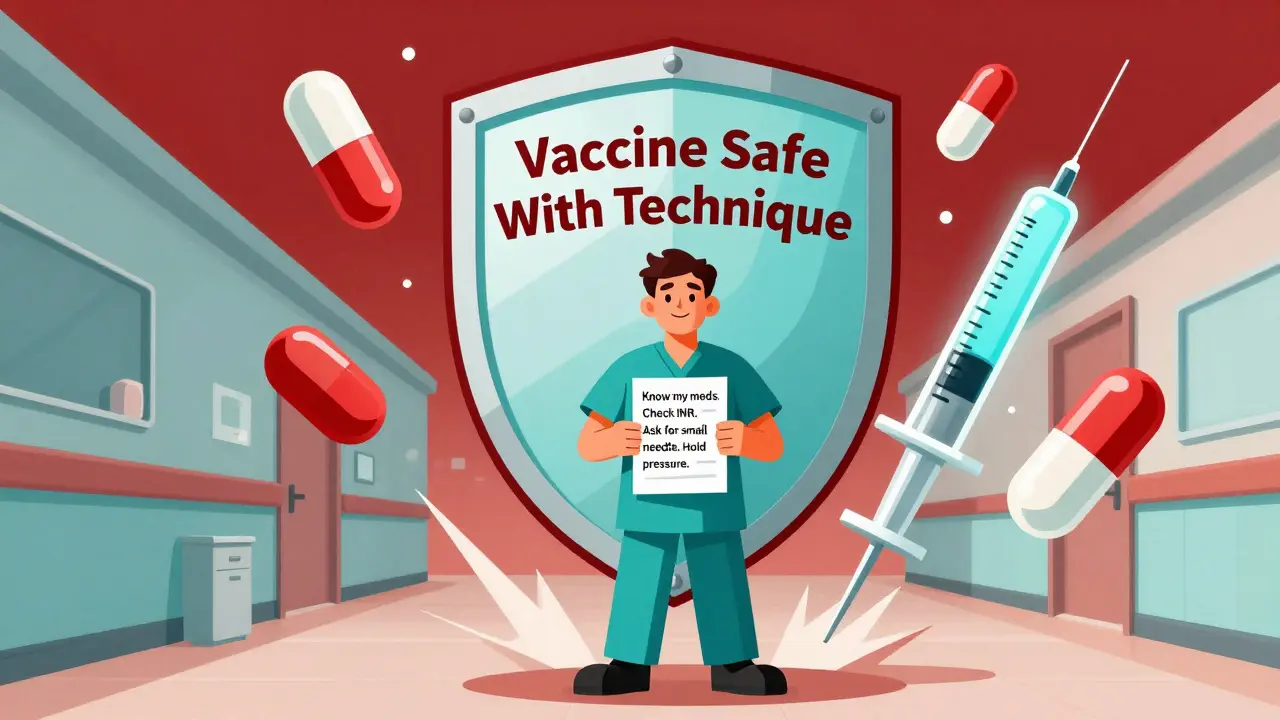
Don’t wait until the day of your appointment to figure this out. Here’s your checklist:
- Know your medication and dose.
- Check your INR if you’re on warfarin - aim for below 4.0.
- Write down your injection technique preferences: small needle, 5-10 minutes of pressure.
- Call ahead. Ask if they have a protocol for anticoagulated patients.
- Bring your medication list. Or better yet - a printed note.
And if they say, “We don’t need to change anything” - politely insist. You’re not being difficult. You’re protecting yourself.
Bottom line: Don’t skip the shot
People on blood thinners are at higher risk for severe illness from flu, pneumonia, and COVID-19. Skipping vaccines doesn’t make you safer - it makes you more vulnerable.
Proper technique isn’t optional. It’s the difference between a small bruise and a hospital visit. It’s the difference between getting your shot and avoiding it for another year.
You’ve done the hard part - staying on your meds, managing your condition. Now make sure the next step - your vaccine - doesn’t undo your work.
Can I get a vaccine if my INR is high?
If your INR is above 4.0, you’re at higher risk for bleeding. Talk to your doctor. They may delay the vaccine until your INR is in range, or suggest a subcutaneous vaccine if available (like some flu shots). Never get an IM shot with an INR over 4.0 without medical clearance.
Should I skip my blood thinner dose before the vaccine?
No. Never skip your dose unless your doctor tells you to. Stopping warfarin or DOACs increases your risk of clots - which can be deadly. Instead, focus on pressure and needle size. Your medication schedule stays the same.
Can I get the shot in my leg instead of my arm?
Yes - if your provider agrees. The deltoid (upper arm) is standard, but the thigh can be used for IM shots in adults. It’s less common, but sometimes preferred for people with easy bruising. Ask if it’s an option.
How long does bruising last after a vaccine on blood thinners?
Minor bruising usually fades in 7-10 days. Larger hematomas can take 2-4 weeks. If the area gets warmer, redder, or more painful after 48 hours, it could be infected. Call your doctor.
Are there vaccines that are safer for people on blood thinners?
Some vaccines are given under the skin (subcutaneous), not into muscle. The flu vaccine comes in both forms - the subcutaneous version is less likely to cause bruising. Ask your provider if a subcutaneous option is available and appropriate for you.
roger dalomba
December 25, 2025 AT 09:58Sophia Daniels
December 27, 2025 AT 04:36Fabio Raphael
December 28, 2025 AT 08:04Amy Lesleighter (Wales)
December 29, 2025 AT 09:58Rajni Jain
December 29, 2025 AT 11:50Natasha Sandra
December 30, 2025 AT 16:58Sumler Luu
December 31, 2025 AT 12:21Steven Destiny
January 1, 2026 AT 08:23Sandeep Jain
January 3, 2026 AT 04:19Brittany Fuhs
January 4, 2026 AT 01:31Becky Baker
January 4, 2026 AT 21:53sakshi nagpal
January 5, 2026 AT 16:28Erwin Asilom
January 7, 2026 AT 00:07