
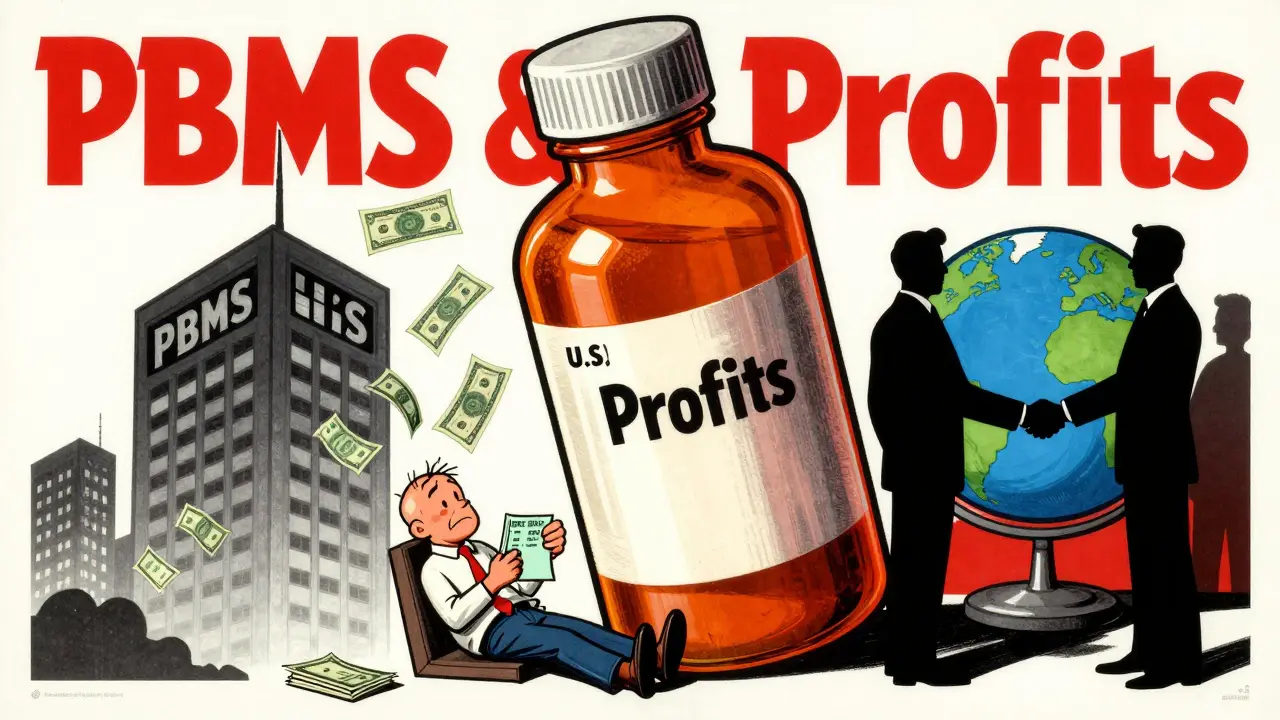
If you’ve ever opened a prescription bottle in the U.S. and stared at the price tag, you’re not alone. A month’s supply of a common diabetes drug can cost $500. A life-saving cancer treatment? $10,000. And yet, the exact same pill, made in the same factory, costs a fraction of that in Canada, Germany, or the UK. Why does this happen? It’s not about quality. It’s not about science. It’s about a system designed to let drug companies charge whatever they want - and no one steps in to stop them.
The System Was Built to Let Prices Soar
In 2003, Congress passed the Medicare Modernization Act. It created Medicare Part D, the prescription drug benefit for seniors. Sounds good, right? But there was a catch: the law banned Medicare from negotiating drug prices with manufacturers. That’s not how it works anywhere else in the developed world. In the UK, Canada, or France, the government sits down with drugmakers and says, ‘This is what we’re willing to pay.’ In the U.S., Medicare has to take whatever price the company sets. That single decision turned the U.S. into the world’s biggest drug market - and the most expensive.
Today, Americans pay more than three times what other OECD countries pay for the same brand-name drugs. The White House confirmed this in late 2025: the U.S. accounts for less than 5% of the global population but generates 75% of the world’s pharmaceutical profits. That’s not a coincidence. It’s a design flaw.
Who’s Really in Charge? The Middlemen
Here’s where it gets even stranger. You don’t pay the drug company directly. You pay a middleman - and there are layers of them. Pharmacy Benefit Managers, or PBMs, are supposed to be the negotiators. They’re hired by insurers to get discounts. But over time, they’ve become powerful corporations that own pharmacies, manage mail-order services, and even have stakes in drug manufacturers. Their profit? It’s tied to the list price of drugs - not what you actually pay.
So here’s the trick: PBMs make more money when the list price goes up. Why? Because their rebate is a percentage of that high price. That means they have a financial incentive to push drugs with higher list prices, even if they’re not the best or cheapest option. The result? A system that rewards inflation, not affordability.
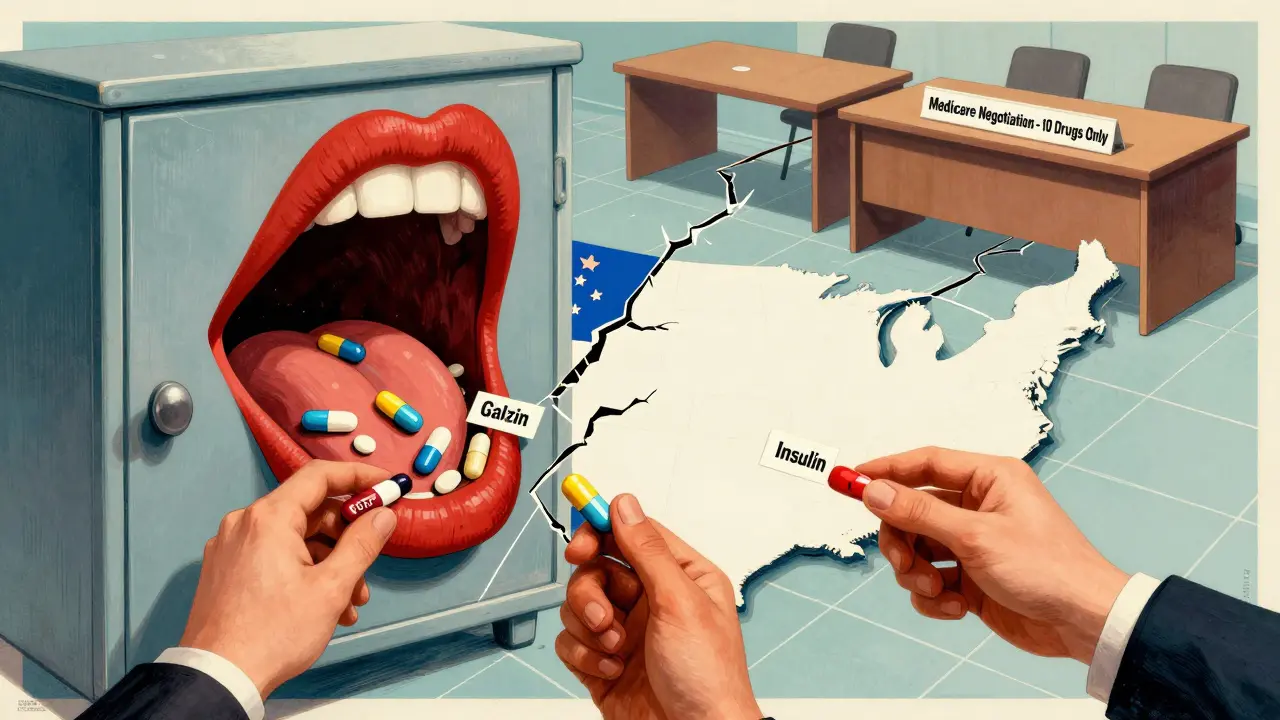
Take Galzin, a drug used to treat Wilson’s disease. In the U.S., it costs $88,800 a year. In the UK? $1,400. In Germany? $2,800. The pill is identical. The factory is the same. But because of how the rebate system works, the U.S. system rewards the highest possible price - not the lowest.
The New ‘Solutions’ That Don’t Fix Much
In 2022, Congress passed the Inflation Reduction Act. It was supposed to change things. And it did - a little. Starting in 2026, Medicare can negotiate prices for 10 drugs a year. That’s it. Ten. Out of thousands. And even then, the 2025 budget bill weakened the program, cutting its potential savings by billions.
There’s also a new rule: if a drug’s price rises faster than inflation, the company has to pay a rebate to Medicare. That helped lower costs for 64 drugs in early 2025. But it doesn’t touch the biggest problem - the list price itself. And it doesn’t help people who don’t have Medicare.
Then there’s the White House’s ‘Most-Favored-Nation’ idea - paying the same price as other countries. Sounds fair. But when President Trump sent letters to drugmakers in July 2025 asking them to lower prices, 87 drugs still went up - by an average of 8%. The system doesn’t respond to pleas. It responds to profit.
Specialty Drugs Are Breaking the Bank
The biggest price spikes aren’t coming from aspirin or antibiotics. They’re coming from specialty drugs - the ones for diabetes, obesity, cancer, and rare diseases. These are complex, high-tech medications. Yes, they cost a lot to develop. But that doesn’t justify what’s happening.
Take Ozempic and Wegovy, drugs for weight loss and diabetes. In 2025, after public pressure, the price dropped from $1,000 and $1,350 a month to $350. That’s a win. But here’s the catch: it only happened because of political pressure, not policy. The same drugs still cost $350 in the U.S. and $70 in Germany. The company didn’t lower the price because it had to. They lowered it because they were being watched.
IQVIA reports that specialty drugs drove an 11.4% increase in U.S. drug spending in 2024 - up from 4.9% the year before. And they’re expected to keep rising. These drugs are designed for small patient groups, so companies charge more to recoup costs. But in the U.S., there’s no cap. No limit. No accountability.
Real People Are Choosing Between Food and Medicine
Behind every number is a person. In 2025, 1.5 million Medicare beneficiaries were spending so much on prescriptions that they had to ration pills - skip doses, cut them in half, or go without. One woman in Ohio told a reporter she was taking half her insulin dose because she couldn’t afford the full amount. She’s not alone.
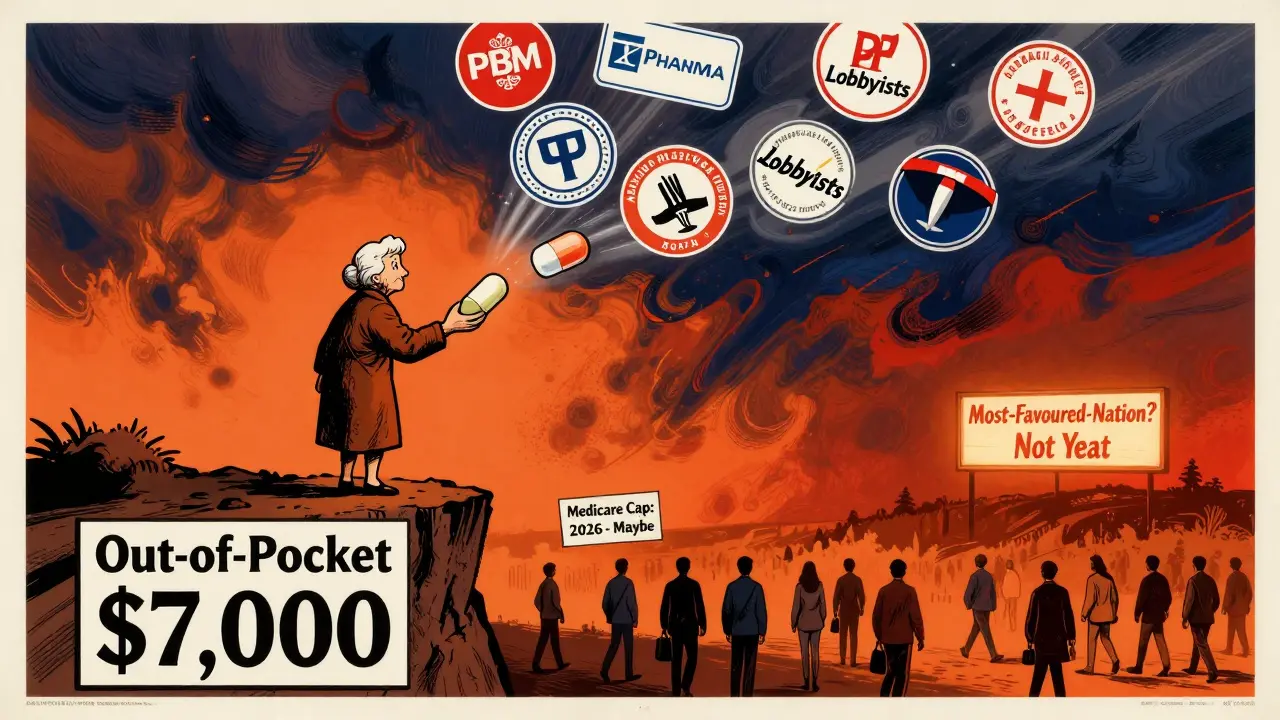
The Inflation Reduction Act’s $2,000 annual out-of-pocket cap for Medicare Part D is a lifeline. For many, it’s the first time in years they won’t have to choose between paying for their medication and buying groceries. But that cap only applies to Medicare. For millions of working-age Americans with private insurance, there’s no such protection. Deductibles can hit $7,000 a year. Coinsurance can be 40% or more.
And if Project 2025’s prescription drug plan becomes law, that cap could disappear. The Center for American Progress warns that up to 18.5 million seniors and disabled people could end up paying more. That’s not reform. That’s a step backward.
Why Can’t We Just Copy Other Countries?
Other countries use simple tools: direct negotiation, price caps, reference pricing. Germany looks at what other nations pay and sets its own price based on that. Canada does the same. Even Japan, a high-tech economy, keeps drug prices low through strict oversight.
In the U.S., the argument against this is always the same: ‘We fund global innovation.’ But the data doesn’t back it up. The U.S. spends more on drugs, yes - but we don’t get more new drugs. We get the same drugs, just priced higher. And the profits? They’re mostly reinvested in marketing, not research. A 2025 study found that pharmaceutical companies spend twice as much on advertising and executive pay as they do on R&D.
Senator Bernie Sanders has pushed the Prescription Drug Price Relief Act since 2025. It would tie U.S. prices to what other wealthy nations pay. It’s not radical. It’s common sense. But the drug lobby spends hundreds of millions a year fighting it. In 2025, they spent more lobbying Congress than any other industry.
What’s Next?
The system isn’t broken - it’s working exactly as designed. The question is: who is it designed for? Not patients. Not taxpayers. Not even doctors. It’s designed for shareholders.
There are small victories. Ten drugs are now being negotiated. Prices for a few have dropped. Transparency rules are coming - eventually. But without a fundamental shift - without letting Medicare negotiate, without breaking the PBM monopoly, without capping prices based on international benchmarks - nothing will change for most people.
The U.S. is the only rich country where you can go bankrupt because you need medicine. That’s not a market failure. It’s a policy failure. And it’s one we’ve chosen - again and again - for over 20 years.
Lethabo Phalafala
January 13, 2026 AT 02:23My cousin in South Africa just got her insulin for $3 a month. Same bottle. Same factory. We pay $400 here. I cried reading this. No one should have to choose between breathing and eating. This isn't capitalism-it's cruelty dressed up as policy.
Avneet Singh
January 15, 2026 AT 00:14It’s a classic case of rent-seeking behavior embedded in neoliberal healthcare architecture-PBMs function as parasitic intermediaries that extract surplus value from the pharmacoeconomic value chain while externalizing cost burdens onto vulnerable patient populations. The structural incentives are perverse, and the regulatory capture is total.
Damario Brown
January 15, 2026 AT 01:56lol drug companies are evil? shocker. also why do u think they make so much? because people are dumb and pay it. also my uncle works at a pbm and he says the rebates are just a scam to make the list price look high so they can 'save' you 20%. the real scam is you believing this narrative.
Clay .Haeber
January 16, 2026 AT 04:59Oh wow, the U.S. is the only country where people pay for medicine? Next you’ll tell me the sky is blue and water is wet. I’m just shocked that anyone still thinks this is a surprise. The real question is why we keep electing people who get paid by these companies to pretend they care.
Priyanka Kumari
January 17, 2026 AT 09:41I’m from India, and we still struggle with access-but at least we don’t have middlemen profiting off list prices. The U.S. system isn’t broken, it’s intentionally engineered. The solution isn’t harder-it’s just politically inconvenient. We need to stop treating medicine like a luxury good.
Angel Tiestos lopez
January 18, 2026 AT 15:40imagine being a person who needs insulin and also being a person who knows the system is rigged. it’s like being stuck in a video game where the boss is a CEO with a yacht. 🫠💔
Trevor Whipple
January 20, 2026 AT 13:36you think this is bad? wait till you see what happens when project 2025 passes. they’re gonna make you pay for your own oxygen next. and don’t even get me started on how the pbums own the pharmacies now. it’s all one big scam. i’ve been saying this for years. nobody listens. i’m just a guy with a reddit account. but i’m right.
Milla Masliy
January 22, 2026 AT 08:28I lived in Germany for two years. My asthma inhaler cost €12. Here? $400. I didn’t realize how much I took for granted until I came back. We’re not just paying more-we’re being exploited. And the worst part? Most Americans think this is normal. We’ve been conditioned to accept it.
Adam Vella
January 22, 2026 AT 13:35Let’s be precise: the problem isn’t pharmaceutical innovation-it’s the monopolistic pricing structures enabled by legislative capture. The 2003 Medicare Part D ban on negotiation was a deliberate act of economic sabotage, designed to enrich shareholders at the expense of fiscal responsibility. The OECD data is unequivocal: per capita spending on pharmaceuticals in the U.S. exceeds the next highest nation by over 200%. This is not market efficiency-it’s institutionalized looting.
Furthermore, the notion that U.S. consumers subsidize global R&D is empirically false. A 2025 analysis by the Journal of Health Economics found that R&D expenditures account for only 14% of pharmaceutical industry revenue, while marketing and administrative costs consume 42%. The myth of innovation subsidy is a rhetorical shield for profit maximization.
Reference pricing, as practiced in Canada and Germany, does not suppress innovation-it aligns pricing with therapeutic value. The U.S. system rewards price inflation, not clinical efficacy. When a drug’s cost increases 300% while its efficacy remains static, that’s not innovation. That’s exploitation.
The Inflation Reduction Act’s ten-drug negotiation cap is a symbolic gesture, not a structural reform. It treats symptoms while ignoring the disease. True reform requires dismantling the PBM oligopoly, enforcing transparency in rebate structures, and adopting international reference pricing as a statutory baseline. Anything less is theater.
And let’s not forget: 1.5 million seniors ration insulin. That’s not a statistic. That’s a moral failure written in blood sugar levels.
sam abas
January 23, 2026 AT 21:57ok but like… if we cap prices then no one will make new drugs right? like what if someone gets cancer next year and the cure doesn’t exist because no one wanted to spend 10 billion to make it? also the pbums are just middlemen they’re not even the bad guys. the real problem is the government not letting insurance companies negotiate. also i heard if you buy from canada you’re breaking the law? so why are we even talking about this. i just want my diabetes pills to be cheaper but also i don’t want to be a bad person for wanting that.
John Pope
January 24, 2026 AT 12:08Let me break this down for the room: The pharmaceutical industry doesn’t sell drugs. They sell hope. And hope? Hope is priceless. Especially when you’re dying. And they know it. That’s why they don’t lower prices. They don’t have to. They’re not selling pills-they’re selling the right to live. And in America, the right to live? Has a monthly payment plan.
And don’t even get me started on how the FDA approves drugs faster than the FDA approves your rent subsidy. That’s not regulation. That’s performance art for Wall Street.
Alan Lin
January 26, 2026 AT 01:13As someone who works in public health policy, I’ve seen the data firsthand. The PBM model is a cancer on the system. Their rebate structure incentivizes higher list prices, which directly harms patients with high-deductible plans. The Inflation Reduction Act’s price caps are a start-but they’re too narrow, too slow, and too weak. We need legislation that mandates transparency, bans gag clauses, and prohibits PBMs from owning pharmacies or having equity stakes in manufacturers. This isn’t activism-it’s basic governance.
And to those who say, ‘But innovation!’-show me the data. Pharma spends more on stock buybacks than R&D. That’s not innovation. That’s financial engineering. We can have innovation and affordability. We just need the political will.
Nelly Oruko
January 26, 2026 AT 14:28It’s not just about money. It’s about dignity. When you have to split a pill because you can’t afford the full dose, you’re not just saving money-you’re surrendering your right to health. And that’s not a market outcome. That’s a moral collapse.
Lance Nickie
January 26, 2026 AT 15:16nah bro the real issue is people taking too many pills anyway. just eat less sugar.
vishnu priyanka
January 27, 2026 AT 02:17Man, I saw this in Mumbai-someone selling fake Ozempic on the street for $2. Meanwhile, in the States, folks are crying over $350. The whole thing’s a circus. But hey, at least the ads on TV are pretty.