

Diphenhydramine Sleep-Aid Risk Estimator
Estimate next-day impairment and long-term risk for your situation.
Educational estimate based on figures cited in the article (half-life by age, 68% next-day impairment, ~0.10% BAC-equivalent at 50 mg, 54% increased dementia risk at 65+, 7-day tolerance). Not a substitute for medical advice.
Grabbing a bottle of Diphenhydramine is the go-to move for millions of Americans struggling to fall asleep. It’s cheap, it’s available at every pharmacy counter, and it works-usually. But behind that quick sedation lies a complex pharmacological profile that many users overlook. While marketed as a simple over-the-counter remedy, this first-generation antihistamine carries significant risks, particularly for older adults and those with specific health conditions. Understanding why your brain gets foggy the next morning isn't just about bad luck; it's about how this drug interacts with your nervous system.
The core issue with diphenhydramine isn't just that it makes you sleepy. It's that it doesn't let go easily. Unlike newer medications designed to target specific sleep pathways, diphenhydramine blocks multiple receptors in the brain, leading to a cascade of side effects that can linger long after the night is over. If you've ever felt like you were driving a car through mud the day after taking a sleep aid, you're experiencing the documented reality of residual sedation. This article breaks down the actual data on these risks and offers evidence-based alternatives that might actually help you sleep without paying the price the next day.
How Diphenhydramine Actually Works in Your Brain
To understand the risks, you have to look at the mechanism. Diphenhydramine is a competitive inverse agonist at the H1 receptor with strong anticholinergic properties. In plain English, it crosses the blood-brain barrier rapidly to sedate you, but it also blocks acetylcholine, a neurotransmitter essential for memory and alertness. This dual action is why it feels so powerful at night but so debilitating during the day.
The speed at which your body processes this drug varies dramatically based on age. For a healthy young adult, the half-life might be around four hours. However, for an elderly patient, that number stretches to nearly 18 hours. This means if a 70-year-old takes a standard 50mg dose at 10 PM, they are still processing more than half of that medication at 4 AM the next morning. By noon, they are still dealing with active levels that impair cognitive function. A 2021 double-blind study involving 127 participants found that 68% of users reported impaired cognitive function the following day compared to only 12% in the placebo group. That isn't just feeling a bit tired; that's measurable brain fog.
The Anticholinergic Burden: Why Age Matters
If you are under 30, diphenhydramine might seem like a harmless hack. But as you age, the risk-benefit ratio shifts sharply. The American Academy of Sleep Medicine (AASM) issued guidelines in 2017 stating that oral diphenhydramine is not recommended for chronic insomnia in adults due to insufficient efficacy evidence and adverse effect concerns. The primary culprit here is the "anticholinergic burden."
High anticholinergic activity is linked to serious long-term health issues. A systematic review published in the Journal of the American Geriatrics Society in 2024 analyzed longitudinal data and found that long-term use of anticholinergic medications was associated with a 54% increased risk of dementia in adults aged 65 and older. Dr. Alon Avidan, director of the UCLA Sleep Disorders Center, has called diphenhydramine "the worst possible choice for sleep in older adults" specifically because of these strong anticholinergic effects. Beyond dementia, common immediate side effects include dry mouth (reported by 76% of users), dizziness (63%), and urinary retention, which affects up to 8.2% of male users over 65 with benign prostatic hyperplasia.

Driving Safety and Cognitive Impairment
You might think you're fine to drive the morning after taking a sleep pill, but the data suggests otherwise. A comparative study in the Journal of Psychopharmacology measured driving performance using simulator tests. The results showed that a single 50mg dose of diphenhydramine produced impairment equivalent to a blood alcohol concentration (BAC) of 0.10%. To put that in perspective, the legal limit in all 50 U.S. states is 0.08%. So, technically, you could be considered legally drunk while driving on the morning after taking one sleep gel.
This level of impairment is why regulatory bodies have tightened their stance. The European Medicines Agency placed diphenhydramine in Category 3, grouping it with benzodiazepines as medicines that may significantly affect the ability to drive. Even the U.S. Federal Aviation Administration prohibits pilots from using it, noting that first-generation antihistamines are unacceptable for flying duty due to central nervous system depressant effects. If your job involves operating machinery or driving long distances, the residual sedation is a genuine safety hazard, not just an inconvenience.
Tolerance and the Trap of Long-Term Use
One of the most frustrating aspects of using diphenhydramine is that it stops working. Tolerance develops rapidly. A University of Michigan study found that 68% of users reported diminished effectiveness after just seven days of regular use. Yet, despite FDA labeling recommending a maximum duration of 14 consecutive days, a 2022 study tracked 450 adults and found that 73% continued use beyond that limit, with 41% using it for more than a month straight.
When the drug stops helping you fall asleep, many people simply take more, unaware that higher doses don't necessarily improve sleep quality but do increase the risk of side effects like hallucinations, confusion, and tachycardia. The FDA updated its labeling requirements in 2023 to include stronger warnings about "serious mental and mood changes," including hallucinations and nervousness, particularly in children. This is a clear signal that the safety margin for this drug is narrower than most consumers realize.
| Feature | Diphenhydramine | Melatonin | CBT-I (Therapy) |
|---|---|---|---|
| Primary Mechanism | H1 antagonist / Anticholinergic | Circadian rhythm regulator | Behavioral/Cognitive restructuring |
| Next-Day Grogginess | High (68% report impairment) | Low (22% report moderate drowsiness) | None |
| Risk of Dementia (Age 65+) | 54% increased risk | No significant link | Protective effect observed |
| Efficacy Duration | Diminishes after ~7 days | Consistent for circadian issues | Lasts 12-24 months post-treatment |
| Best For | Very occasional, short-term use | Jet lag, shift work, mild onset issues | Chronic insomnia |
Safer Options: What Actually Works?
If diphenhydramine feels risky or ineffective, what are the alternatives? The answer depends on the root cause of your insomnia, but there are three main paths to consider.
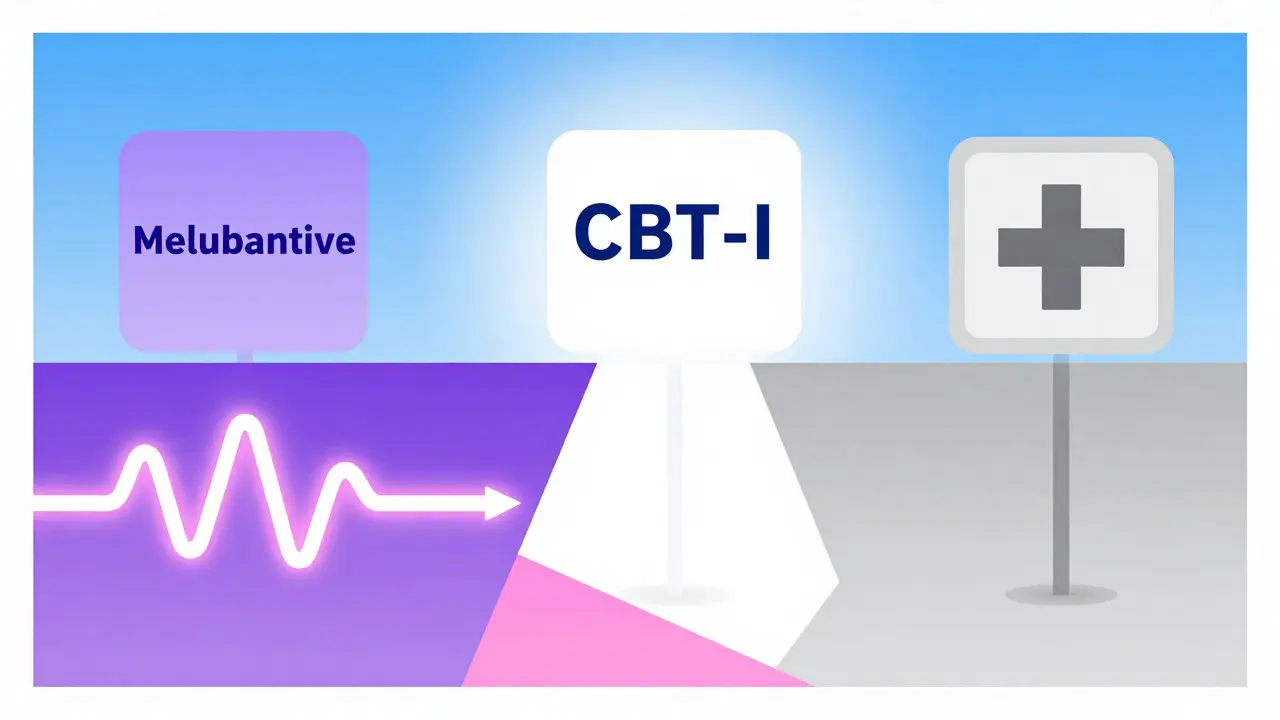
Melatonin: This hormone helps regulate your circadian rhythm rather than forcing sedation. In a 2023 meta-analysis, doses between 2-5 mg showed a 62% efficacy rate for improving sleep onset. User surveys indicate that only 22% of melatonin users experience moderate to severe next-day drowsiness, compared to 58% for diphenhydramine users. It is generally safer for long-term use and does not carry the same anticholinergic burden, making it a better fit for older adults who need help resetting their sleep clock.
Cognitive Behavioral Therapy for Insomnia (CBT-I): This is the gold standard for chronic insomnia. Instead of masking the problem with chemicals, CBT-I addresses the behaviors and thoughts that keep you awake. Data from the AASM shows efficacy rates of 70-80%, with benefits lasting 12 to 24 months after treatment ends. It requires effort and time, but it fixes the underlying issue rather than suppressing symptoms.
Prescription Options: For severe cases, doctors may prescribe non-benzodiazepine hypnotics like zolpidem (Ambien). These should only be used under strict medical supervision for short periods. They carry their own risks, including complex sleep behaviors (like sleepwalking), but they are targeted therapies rather than broad-spectrum sedatives.
When to See a Doctor
Don't self-medicate indefinitely. If you find yourself relying on sleep aids for more than two weeks, it’s time to consult a healthcare provider. Specific red flags include:
- Difficulty urinating or feeling of incomplete bladder emptying (common in men with prostate issues).
- Increased confusion or memory lapses, especially if you are over 60.
- Need to increase the dose to get the same effect.
- Daytime accidents or near-misses while driving or working.