
Imagine taking a medication that works perfectly when you wake up, but fails to absorb properly after your morning coffee and toast. Or picture an athlete who trains hard on an empty stomach, only to find their high-intensity performance tanking because they lacked fuel. This isn't just hypothetical; it is the core reality of fasted vs fed state testing, a critical scientific methodology used across pharmaceuticals and exercise physiology. Whether you are developing a new drug or optimizing a training regimen, understanding how the body behaves in these two distinct states is non-negotiable. The difference between eating nothing for eight hours and consuming a high-fat meal changes everything-from how fast your stomach empties to how your muscles burn energy.
The Physiology Behind the States
To understand why dual-condition testing matters, we first need to look at what happens inside the body. The terms "fasted" and "fed" are not vague concepts; they are strictly defined physiological states with measurable differences in gastrointestinal function and metabolism.
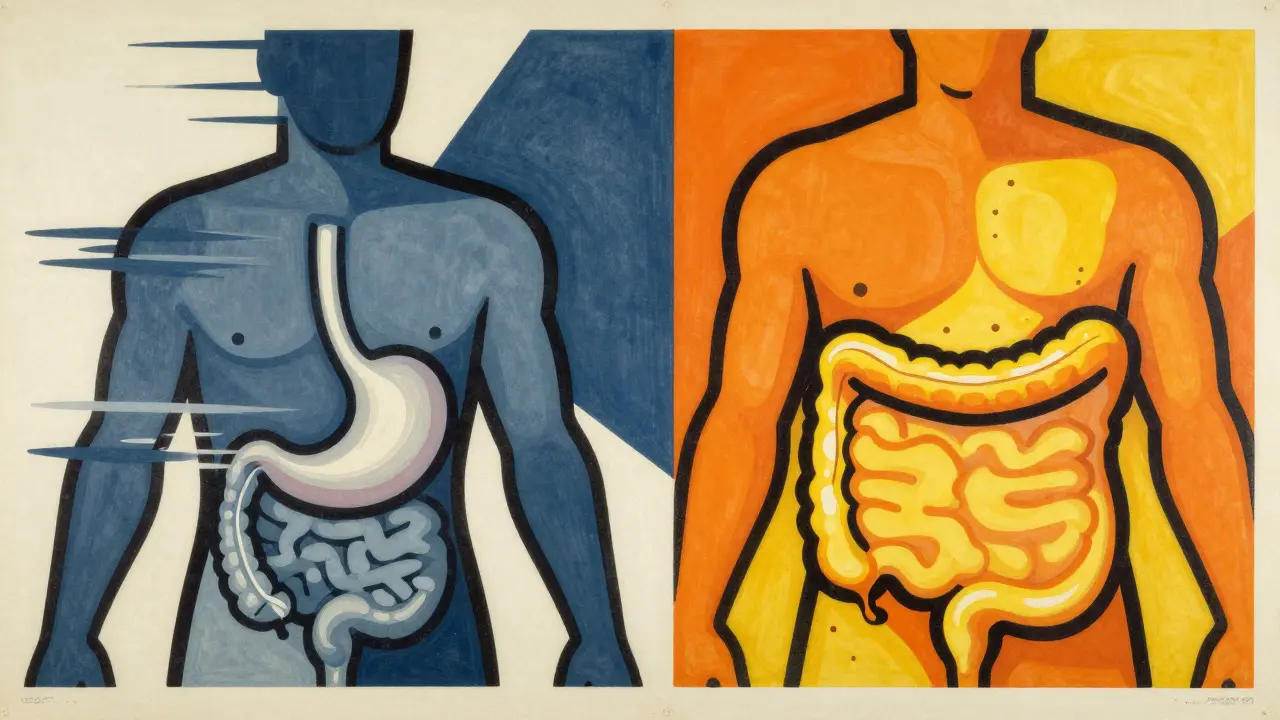
In the pharmaceutical world, regulatory bodies like the FDA and EMA have standardized these definitions to ensure consistency. A fasted state is typically defined as having no caloric intake for at least 8 to 12 hours prior to testing. During this time, the stomach is mostly empty, gastric acid levels are lower (median pH around 2.5), and the gut moves content through quickly. Studies using SmartPill capsules show that gastric residence time-the time food or drugs stay in the stomach-averages just 13.7 minutes in a fasted state.
Conversely, the fed state involves consuming a standardized meal before testing. For bioequivalence studies, this isn't just any meal. It is a "high-fat, high-calorie" meal designed to stress-test the drug's absorption. According to FDA guidelines, this meal contains approximately 800-1,000 calories, with about 50% of those calories coming from fat. In this state, the stomach slows down significantly. Gastric residence time jumps to an average of 78.3 minutes, and the environment becomes more acidic, with pH dropping to a median of 1.5. These physical changes drastically alter how substances interact with the digestive system.
| Parameter | Fasted State | Fed State (High-Fat Meal) |
|---|---|---|
| Fasting Duration | 8-12 hours without calories | Within 30 mins of standardized meal |
| Gastric Residence Time | ~13.7 minutes | ~78.3 minutes |
| Intragastic pH (Median Min) | 2.5 | 1.5 |
| Pressure Variations | 30-304 mbar | Consistently >240 mbar |
| Meal Composition (Fed Only) | N/A | 800-1000 kcal, ~50% fat |
Why Pharma Requires Dual-State Bioequivalence
In the pharmaceutical industry, bioequivalence standards mandate that most oral drugs be tested in both conditions. This requirement emerged in the 1990s after regulators realized that food could dramatically change a drug's efficacy. Without testing both states, a medication might appear safe and effective in trials but fail-or worse, cause toxicity-in real-world use where patients eat regularly.
Food can act as a catalyst or a blocker for drug absorption. For lipophilic (fat-loving) compounds like fenofibrate, a fatty meal can increase bioavailability by 200-300%. The bile released during digestion helps dissolve these drugs, allowing them to enter the bloodstream more efficiently. On the flip side, drugs like griseofulvin see their absorption drop by 50-70% when taken with food, likely due to delayed gastric emptying keeping the drug trapped in the stomach longer than intended.
This variability is why the European Medicines Agency (EMA) now requires fed-state testing for all oral drugs where the food effect is unknown. An analysis of 1,200 New Drug Applications found that 35% showed clinically significant food interactions. If manufacturers skipped fed-state testing, millions of patients might receive incorrect dosing instructions. For drugs with narrow therapeutic indices-where the difference between a helpful dose and a harmful one is small-Dr. Lawrence Lesko, a prominent FDA pharmacologist, has stated that fed-state testing is "non-negotiable" if food effects exceed 20% in bioavailability.

Exercise Physiology: Fueling Performance vs. Adaptation
While pharma uses these states to ensure safety, exercise physiologists use them to optimize human performance. The debate here is less about regulation and more about adaptation. Should you train on an empty stomach to burn fat, or eat beforehand to perform better?
A comprehensive meta-analysis by Lundsgaard et al. (2018) reviewed 46 peer-reviewed studies to settle this question. The findings were nuanced. For prolonged aerobic exercise lasting more than 60 minutes, fed-state exercise enhanced performance by 8.3%. When glycogen stores are full, muscles can sustain higher intensities for longer periods. However, for shorter bouts under 60 minutes, feeding provided no significant performance benefit.
So why do athletes still train fasted? The answer lies in metabolic adaptation. Training in a fasted state increases post-exercise circulating free fatty acids (FFAs) by 27.6%. More importantly, it upregulates PGC-1α expression by 40-50%. PGC-1α is a master regulator of mitochondrial biogenesis, meaning fasted training signals your body to build more mitochondria-the powerhouses of your cells. This leads to better long-term metabolic health and improved fat oxidation efficiency.
However, there is a trade-off. Fasted training reduces high-intensity work capacity by 12-15%. If your goal is to sprint faster or lift heavier weights, the lack of immediate glucose availability holds you back. Dr. John Hawley, a professor of exercise and nutrition, notes that while fasted training potentiates fat oxidation adaptations, it should be periodized carefully to avoid compromising high-intensity performance.

Real-World Implications and Individual Variability
The science is clear, but individual responses vary. In the fitness community, surveys reveal split preferences. A 2022 Reddit survey of over 1,200 users found that 68% reported better endurance performance when fed. Meanwhile, in keto-focused communities, 42% preferred fasted training for fat loss goals, though nearly a third reported side effects like dizziness or reduced workout intensity.
In pharma, individual variability is also emerging as a key factor. Recent research indicates that genetic factors play a role. A 2022 study found that variants in the PPARGC1A gene explain 33% of the variability in how individuals respond to fasted versus fed training. Similarly, ethnic differences affect gastric emptying rates. Asian subjects, for instance, exhibit 18-22% slower gastric emptying times in fed conditions compared to Caucasian subjects, which can impact drug absorption profiles. This is why the FDA's 2023 draft guidance emphasizes including diverse populations in fed-state testing.
Practical Guidelines for Implementation
If you are designing a study or structuring a training plan, standardization is key. Here are the practical steps to ensure valid results:
- For Fasted Protocols: Ensure participants abstain from calories for 8-12 hours. Water is permitted. Control for sleep duration (minimum 7 hours) and hydration status (urine specific gravity <1.020). Maintain a 24-hour sedentary period before testing to normalize glycogen stores.
- For Fed Protocols (Pharma): Use the standardized high-fat meal (800-1000 kcal, 50% fat). Administer the drug within 30 minutes of completing the meal. Adhere to ±10% tolerance for calorie and macronutrient values.
- For Fed Protocols (Exercise): Consume 1-4 g/kg of carbohydrate 1-4 hours pre-exercise. This ensures glycogen replenishment without causing gastrointestinal distress during activity.
Understanding these distinctions allows researchers and practitioners to make informed decisions. Whether ensuring a life-saving drug reaches the bloodstream effectively or helping an athlete peak for competition, ignoring the state of the body is a mistake that data simply does not support.
What defines a fasted state in clinical trials?
A fasted state is defined as having no caloric intake for at least 8 to 12 hours prior to the administration of a drug or start of exercise. Participants may consume water, but no food or caloric beverages are allowed. This state ensures minimal interference from digestion on absorption or metabolic measurements.
Why is a high-fat meal used in fed-state bioequivalence studies?
A high-fat meal (typically 800-1000 calories with 50% fat) is used because it maximally delays gastric emptying and stimulates bile secretion. This creates the most challenging condition for drug dissolution and absorption, ensuring that if a drug works well in this state, it will likely work in all other dietary scenarios.
Does fasted exercise really help with fat loss?
Fasted exercise increases acute fat oxidation during the workout and boosts markers like PGC-1α, which supports mitochondrial health. However, long-term body composition changes may not differ significantly from fed training if total daily calorie expenditure is equal. The primary benefit is metabolic adaptation rather than immediate fat loss.
How does food affect drug absorption?
Food can increase or decrease drug absorption. For lipophilic drugs, fat in the meal enhances solubility via bile, potentially increasing bioavailability by up to 300%. For other drugs, delayed gastric emptying can keep the drug in the stomach too long, reducing absorption by 50-70%. This is why dual-state testing is mandatory for most oral medications.
When should an athlete choose fed-state training?
Athletes should choose fed-state training when the goal is high-intensity performance, sprinting, or heavy lifting, especially for sessions lasting over 60 minutes. Fed training preserves muscle glycogen, allowing for greater power output and reduced risk of catabolic stress compared to fasted training.