

Your vision is blurry. You’ve tried new glasses, but the world still looks distorted. Maybe your optometrist mentioned a condition called keratoconus, which is a progressive eye disease where the clear dome at the front of the eye thins and bulges into a cone shape. It’s not just bad eyesight; it’s a structural change in your cornea that standard soft contact lenses or glasses can’t fully fix. But there is a solution that works for most people: rigid lenses.
Keratoconus affects about 1 in 2,000 people worldwide. It usually starts in your teens or early twenties and progresses until your forties. The good news? You don’t have to accept blurry vision as your new normal. Rigid lenses-specifically rigid gas permeable (RGP) and scleral lenses-are the gold standard for restoring clear sight in moderate to advanced cases. They work by creating a smooth optical surface over your irregular cornea, essentially replacing the bumpy landscape with a perfectly flat window.
Why Soft Lenses Fail in Keratoconus
If you wear soft contacts, you know they mold to the shape of your eye. In a healthy eye, this is great for comfort. In keratoconus, it’s a problem. Because your cornea has thinned and bulged into a cone, a soft lens simply drapes over that irregular shape. It doesn’t correct the distortion; it just sits on top of it. This leads to persistent blurriness, ghosting, and light sensitivity.
Rigid lenses behave differently. They are stiff enough to maintain their own shape. When placed on the eye, the tear film fills the gap between the back of the rigid lens and the front of the cornea. This fluid layer creates a new, smooth refractive surface. Light enters the eye through this uniform surface rather than the irregular cornea, resulting in significantly sharper vision. Studies show that patients often improve from an average visual acuity of 20/80 before fitting to 20/25 after adapting to rigid lenses.
Types of Rigid Lenses for Keratoconus
Not all rigid lenses are created equal. Depending on the severity of your keratoconus, your eye doctor will recommend one of three main types:
- Rigid Gas Permeable (RGP) Lenses: These are small, hard lenses typically 9-10mm in diameter. They sit directly on the cornea. RGPs are highly breathable, with oxygen permeability ratings (Dk values) ranging from 50 to 150, ensuring your cornea gets enough air during wear. They are usually the first line of defense for mild to moderate keratoconus.
- Hybrid Lenses: As the name suggests, these combine a rigid center for clear vision with a soft outer skirt for comfort. They are ideal if you struggle with the initial sensation of a traditional RGP but need better optics than soft lenses provide.
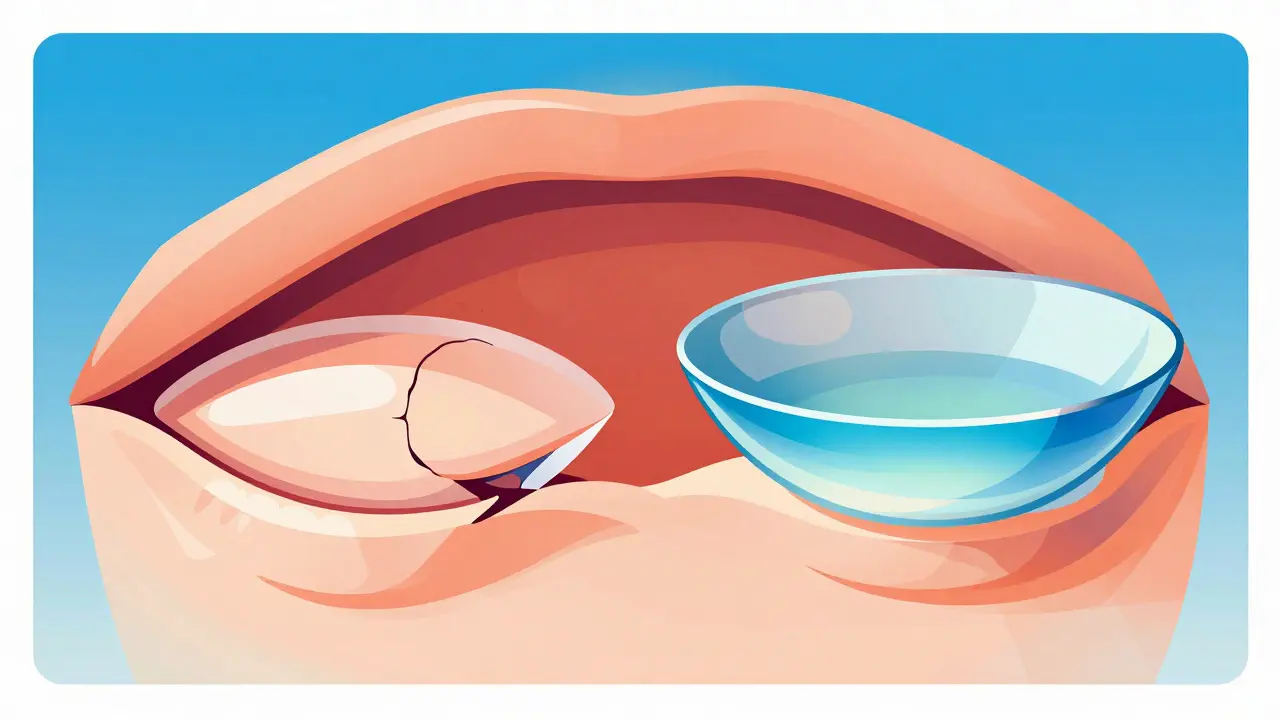
- Scleral Lenses: For advanced keratoconus, scleral lenses are often the best option. These are large-diameter lenses (15-22mm) that vault completely over the cornea and rest on the white part of the eye (the sclera). They create a reservoir of fluid between the lens and the cornea. This design provides exceptional stability and comfort, even for eyes with severe scarring or extreme irregularity. Systems like PROSE (Prosthetic Replacement of the Ocular Surface Ecosystem) are widely used in clinical settings.
| Lens Type | Diameter | Best For | Comfort Level |
|---|---|---|---|
| RGP | 9-10mm | Mild to Moderate Keratoconus | Low initially, improves with adaptation |
| Hybrid | Variable | Patient sensitive to RGP feel | Medium to High |
| Scleral | 15-22mm | Advanced Keratoconus, Dry Eye | High (does not touch cornea) |
The Adaptation Process: What to Expect
Let’s be honest: putting on rigid lenses feels strange at first. About 30% of patients report initial discomfort, describing a "foreign body sensation" or feeling like something is stuck in their eye. This is normal. Your brain needs time to ignore the presence of the lens.
Successful adaptation isn’t overnight. Most eye doctors recommend a gradual approach:
- Week 1: Wear the lenses for 2-4 hours daily. Take them out, clean them, and let your eyes rest.
- Week 2: Increase wear time by 1-2 hours each day.
- Weeks 3-4: Aim for full-time wear during waking hours.
By the end of four weeks, 85% of patients achieve comfortable, full-time wear. During this period, you might experience lens awareness (feeling the lens move when you blink) or difficulty inserting/removing the lens. Practice makes perfect here. Use plenty of preservative-free rewetting drops to keep the lens lubricated. If you experience pain-not just discomfort-but actual sharp pain, remove the lens immediately and contact your doctor.
Combining Rigid Lenses with Corneal Cross-Linking
Rigid lenses fix your vision, but they don’t stop keratoconus from getting worse. To halt the progression of the disease, many patients undergo corneal cross-linking (CXL), which is a procedure that uses ultraviolet light and riboflavin drops to strengthen collagen bonds in the cornea. FDA-approved in 2016, CXL has a 90-95% success rate in stopping progression over five years.
Here’s the key connection: CXL stabilizes the cornea, while rigid lenses correct the vision. They are complementary treatments. In fact, 78% of cornea specialists now recommend combining CXL with rigid lens therapy. After CXL, your cornea may still be irregular, so you’ll likely still need rigid lenses for clear vision. However, because the cornea is no longer changing shape rapidly, your lens fit becomes more stable over time, making long-term management easier.

When Rigid Lenses Aren’t Enough
While rigid lenses work for 60-70% of diagnosed keratoconus cases, they aren’t a cure-all. In approximately 15-25% of advanced cases, the cornea becomes too scarred or irregular for any lens to fit properly. Other reasons for failure include chronic dry eye (affecting 8-10% of patients) or extreme decentration issues.
In these scenarios, surgical options become necessary:
- INTACS: Implantable ring segments that reshape the cornea. However, 35-40% of patients still need rigid lenses after INTACS implantation.
- Corneal Transplantation: Required for 10-20% of patients. This involves replacing the entire cornea (penetrating keratoplasty) or just the front layers (deep anterior lamellar keratoplasty). Recovery is slow, often taking over 12 months for vision to stabilize, and carries risks like graft rejection (5-10% incidence).
Because of these risks and recovery times, preserving your natural cornea with rigid lenses and CXL is always the preferred first path.
Troubleshooting Common Issues
Even successful wearers face hiccups. Here’s how to handle the most common problems:
- Lens Fogging: Reported by 25% of users. This happens when proteins build up on the lens. Use specialized cleaning solutions recommended by your manufacturer, such as those designed for BostonSight or Contex lenses.
- Decentration: If the lens slides off-center, your vision will blur. This affects 15% of users. It usually means the lens parameters need adjustment. Return to your fitter for a tweak.
- Solution Sensitivity: Some eyes react to preservatives in multipurpose solutions. Switch to preservative-free rewetting drops and hydrogen peroxide-based disinfection systems if irritation persists.
Remember, rigid lens fitting is an art. It typically requires 3-5 follow-up visits over 4-6 weeks to optimize parameters. Don’t settle for a "good enough" fit. A precise fit ensures comfort, safety, and the best possible vision.
Do rigid lenses cure keratoconus?
No, rigid lenses do not cure keratoconus. They correct the vision impairment caused by the irregular corneal shape by creating a smooth optical surface. To stop the disease from progressing, you need corneal cross-linking (CXL). Rigid lenses manage the symptoms; CXL manages the disease.
How long does it take to get used to rigid lenses?
Most patients adapt within 2 to 4 weeks. The process involves gradually increasing wear time from a few hours a day to full-time wear. Initial discomfort is common, but 85% of patients achieve comfortable, full-time wear within this timeframe.
Are scleral lenses better than RGP lenses?
It depends on the severity of your keratoconus. Scleral lenses are generally more comfortable because they don't touch the cornea, making them ideal for advanced cases or those with dry eye. However, they are larger, more expensive, and require more complex fitting. RGPs are often sufficient for mild to moderate cases and are less costly.
Can I drive with rigid lenses?
Yes, once you have adapted to them. Many patients find their vision is clearer and more stable with rigid lenses than with glasses or soft contacts, making driving safer. Ensure you carry spare lenses and solution in case a lens dislodges while on the road.
What if my rigid lenses fall out?
If a lens falls out, locate it immediately. Rinse it with sterile saline solution, inspect it for cracks, and reinsert it. If you cannot find it or it is damaged, use your backup glasses. Do not rub your eye. If the lens is lost, contact your eye care provider for a replacement.