
Imagine you are at the counter. A patient hands over a prescription for levothyroxine, a medication with a notoriously narrow margin for error. You check your inventory, see the brand name is out of stock, and reach for the generic equivalent from a different manufacturer. It’s a routine move, one that saves the patient money and keeps the shelf stocked. But what happens if that switch causes their thyroid levels to plummet? Who pays the price? The answer isn’t just medical; it’s legal, complex, and varies wildly depending on which state line you cross.
For pharmacists, generic drug substitution is the backbone of modern practice, accounting for roughly 90% of all prescriptions filled in the United States. Yet, this efficiency comes with a hidden trapdoor: professional liability. Since the Supreme Court’s 2011 ruling in PLIVA v. Mensing, the legal landscape has shifted dramatically. Generic manufacturers can no longer be sued under state laws for failing to update warning labels because federal regulations force them to keep their labels identical to the brand-name original. This creates a "liability gap" where injured patients often have nowhere to turn, leaving the pharmacist as the primary target for malpractice claims.
The Legal Landscape: Why Pharmacists Bear the Brunt
To understand the risk, you need to look at the hierarchy of responsibility. In the current system, the buck stops at the pharmacy counter. The 2011 Mensing decision and the subsequent 2013 Mutual Pharmaceutical Co. v. Bartlett ruling established that federal law preempts state failure-to-warn claims against generic makers. Essentially, generic companies argue they couldn't change the label even if they wanted to, so they shouldn't be liable. Brand-name companies argue they didn't make the pill the patient took, so they aren't liable either.
This leaves you, the pharmacist, holding the bag. When a patient suffers an adverse event due to a subtle difference in bioavailability or excipients (inactive ingredients) between a brand and its generic counterpart, the lawsuit often targets the dispenser. A 2019 study by the National Community Pharmacists Association highlighted that states with robust liability protections for pharmacists saw 32% fewer substitution-related malpractice claims. Conversely, in states like Connecticut and Massachusetts, where explicit protections are lacking, claim rates are significantly higher. The core issue is that while you are legally permitted-or sometimes mandated-to substitute, you are not always legally shielded from the consequences if that substitution goes wrong.
State Laws Are Not Created Equal
If you think pharmacy law is uniform across the country, think again. The rules governing generic substitution vary across 50 states and Washington, D.C., creating a patchwork of obligations that can trip up even experienced practitioners. Understanding these variations is the first step in risk reduction.
| Legal Dimension | Current Status (Approximate) | Risk Implication for Pharmacist |
|---|---|---|
| Duty to Substitute | 27 states mandate it; 23 permit but don't require it. | In mandatory states, refusing to substitute without cause may violate board rules. In permissive states, you have more discretion to refuse high-risk switches. |
| Notification Requirements | 18 states require independent patient notification beyond package labeling. | Failing to notify in these states is a clear breach of duty. In other states, silence might be legally acceptable but professionally risky. |
| Consent Protocols | 32 states allow patients to refuse substitution. | If a patient requests "Dispense as Written" (DAW), ignoring this request exposes you to immediate negligence claims. |
| Liability Protections | 27 states explicitly protect pharmacists from greater liability than if the brand were dispensed. | In unprotected states, you face full tort liability for any adverse outcome linked to the generic product. |
You cannot rely on memory here. A pharmacist moving from Texas to California faces a completely different regulatory environment. In Texas, comprehensive protections shield you from greater liability provided you follow protocol. In other jurisdictions, you might be operating with minimal safeguards. The solution? Annual verification via the National Association of Boards of Pharmacy's Compendium of State Pharmacy Laws. Make this a non-negotiable part of your continuing education.
The Narrow Therapeutic Index (NTI) Danger Zone
Not all generics are created equal, and not all substitutions carry the same weight. The concept of bioequivalence requires generic drugs to demonstrate 80-125% equivalence to the brand-name drug in pharmacokinetic parameters. For most medications, like statins or antihypertensives, this range is safe. Patients rarely notice a difference, and clinical outcomes remain stable.
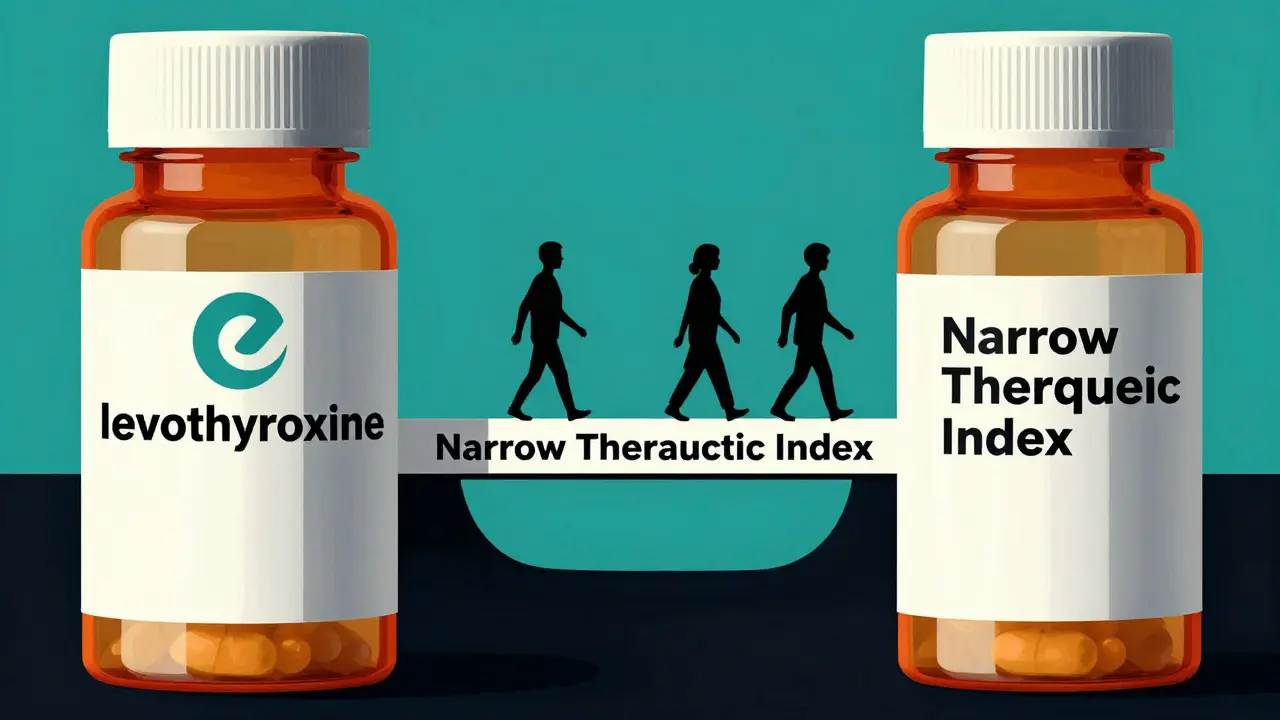
But then there are the Narrow Therapeutic Index (NTI) drugs. These are medications where a small change in blood concentration can lead to therapeutic failure or severe toxicity. Think warfarin, carbamazepine, lithium, and levothyroxine. For these drugs, the 80-125% rule is a gamble.
A 2017 study published in Epilepsy & Behavior documented that 18.3% of patients experienced therapeutic failure after generic substitution of antiepileptic drugs. Another study showed a 7.9% increased seizure risk with generic antiepileptic substitution. When a patient on warfarin switches manufacturers, their INR levels can swing wildly, increasing the risk of stroke or bleeding. The American Epilepsy Society guidelines from 2018 specifically flagged these risks, yet many state laws treat NTI drugs the same as penicillin.
This discrepancy is where liability spikes. If you substitute an NTI drug without specific physician approval or explicit patient consent, you are walking into a minefield. Even if the generic is technically "approved," the clinical reality is that switching manufacturers mid-treatment can destabilize a fragile condition. Documenting why you chose to stick with a specific manufacturer, or why you switched, becomes your best defense.
Practical Strategies to Reduce Professional Risk
Knowing the risks is half the battle. Implementing a structured defense mechanism is the other half. Based on guidelines from the American Society of Health-System Pharmacists (ASHP) and real-world data, here is a practical framework to minimize your exposure.
- Implement EHR Alerts for NTI Drugs: Configure your dispensing software to flag every prescription containing an NTI drug. The alert should prompt you to verify if the patient has been stable on a specific manufacturer. If they have, consider keeping them on that source unless medically necessary to change.
- Standardize Consent Forms: Don't rely on verbal nods. Use a standardized form for patients who wish to refuse substitution (DAW). Have them sign off acknowledging that they understand the potential cost implications and that they are accepting responsibility for maintaining their current therapy. For NTI drugs, consider a separate acknowledgment form detailing the risks of switching manufacturers.
- Document Everything: Your dispensing log is your legal shield. Record the National Drug Code (NDC) number, the lot number, and the manufacturer for every dispensed item. If a patient calls six months later complaining of side effects, you need to prove exactly which version of the drug they received. Maintain substitution logs that trace back to the specific batch.
- Establish Physician Communication Protocols: Before substituting an NTI drug, call the prescriber. Ask: "Is this patient sensitive to manufacturer changes?" Document the conversation. If the doctor says "yes," honor it. If they say "no," you have shared liability. This simple step shifts some of the burden away from your shoulders.
- Annual Liability Risk Assessment: Use the 27-point framework suggested by the Journal of the American Pharmacists Association to audit your practice annually. Check for gaps in training, outdated software alerts, or missing consent forms. Fix them before a lawsuit does.
The Human Element: Patient Expectations vs. Reality
Risk isn't just about laws and labels; it's about people. A 2021 survey by the Patient Advocacy Foundation found that 41% of patients were unaware their prescription had been substituted until they experienced side effects. Another 28% reported that pharmacists didn't provide the required notification under state laws. This lack of transparency breeds distrust and fuels litigation.
When a patient feels unheard, they are more likely to sue. Simple communication strategies can defuse tension. Instead of saying, "We don't have the brand, here's the generic," try this: "The brand you take is currently out of stock. We have a bioequivalent generic from [Manufacturer]. For most patients, this works perfectly. However, since you're on [NTI Drug], would you like me to check with your doctor to ensure this switch is safe for you?"
This approach does three things: it informs the patient, it shows due diligence, and it invites collaboration. It transforms a transactional exchange into a clinical consultation. Pharmacists who adopt this proactive style report lower anxiety levels and better patient relationships. Remember, 82% of patients are satisfied with generic substitutions for common meds like lisinopril. The problem arises when expectations aren't managed for the high-stakes drugs.

Future Trends: Biosimilars and Evolving Liability
The world of substitution is expanding beyond small-molecule generics. Biosimilars-biologic medicines highly similar to an already approved biologic-are entering the market rapidly. As of 2026, 45 states have enacted biologic substitution laws, but the liability frameworks are still maturing. Biosimilars are more complex than generics, with larger molecular structures that can elicit immune responses. Switching manufacturers here carries even higher uncertainty.
Legislators are beginning to address the "liability gap." Several states have introduced versions of the "Generic Drug Safety Act," proposing shared liability systems where brand-name manufacturers must update labels within 30 days of new safety info, forcing generics to follow suit. While this won't happen overnight, staying informed on these legislative changes is crucial. Join professional organizations like the National Community Pharmacists Association (NCPA) to track these developments. They often provide early warnings about shifting legal tides.
Additionally, insurance markets are reacting. Malpractice premiums for pharmacists have risen 18% since the Mensing decision. Some insurers now offer supplemental coverage specifically addressing substitution risks. Review your policy. Does it cover claims arising from generic substitution? If not, you might be paying for protection that doesn't exist.
Conclusion: Vigilance Is Your Best Defense
Reducing professional liability in generic substitution isn't about avoiding generics altogether-it's about practicing with precision. By understanding the legal nuances of your state, respecting the unique risks of NTI drugs, documenting every decision, and communicating openly with patients, you build a fortress around your practice. The goal isn't just to avoid lawsuits; it's to ensure that every patient gets the safest, most effective therapy possible, regardless of the logo on the bottle.
What is the PLIVA v. Mensing decision and how does it affect pharmacists?
The 2011 Supreme Court decision in PLIVA v. Mensing ruled that federal law preempts state failure-to-warn claims against generic drug manufacturers. Because generic makers must use the exact same label as the brand-name drug, they cannot be sued for inadequate warnings under state law. This shifts much of the liability burden onto pharmacists and physicians, who become the primary defendants in cases where patients suffer harm due to unknown risks associated with generic substitutions.
Which drugs are considered Narrow Therapeutic Index (NTI) drugs?
NTI drugs include medications like warfarin, levothyroxine, carbamazepine, lithium, phenytoin, and cyclosporine. These drugs have a small window between effective dosage and toxic dosage. Small variations in absorption between different generic manufacturers can lead to significant clinical differences, making substitution riskier than with standard medications like antibiotics or pain relievers.
Do I need patient consent to substitute a generic drug?
It depends on your state's laws. In 32 states, patients have the right to refuse substitution, often indicated by a "Dispense as Written" (DAW) code on the prescription. In 18 states, pharmacists are required to independently notify patients of the substitution. Always check your state's specific regulations via the NABP Compendium. When in doubt, especially for NTI drugs, obtaining explicit verbal or written consent is a best practice for risk mitigation.
How can pharmacists protect themselves from malpractice suits related to generic substitution?
Key protective measures include: 1) Verifying state-specific substitution laws annually. 2) Using EHR alerts to flag NTI drugs. 3) Documenting the manufacturer, lot number, and NDC for every dispensed item. 4) Communicating with prescribers before switching NTI drugs. 5) Obtaining explicit patient consent for substitutions, particularly for high-risk medications. 6) Ensuring your malpractice insurance covers substitution-related claims.
Are biosimilars subject to the same substitution laws as generic drugs?
Biosimilars are regulated differently than traditional generics due to their complex biological nature. While 45 states have enacted biologic substitution laws, the liability frameworks are less settled. Biosimilar substitution often requires stricter adherence to interchangeability standards set by the FDA. Pharmacists should exercise extra caution and stay updated on evolving state regulations regarding biosimilar interchangeability and liability protections.