

Imagine receiving a diagnosis or a new prescription, but the instructions are written in dense medical jargon, printed in tiny text, and assume you know what terms like "hypertension" or "contraindication" mean. For many older adults, this isn't just an inconvenience-it's a barrier to survival. Senior patient education is the specialized practice of creating health communication resources designed specifically for adults aged 65 and older to address age-related challenges in health literacy, sensory limitations, and cognitive processing. It is not simply about dumbing down information; it is about respecting the intelligence of the patient while accommodating the physical and cognitive changes that come with aging.
The stakes are incredibly high. According to data from the Centers for Disease Control and Prevention (CDC), 71% of adults older than age 60 had difficulty using standard print materials in the 2003 National Assessment of Adult Literacy. Even more strikingly, 80% struggled with documents like forms or charts. When patients don't understand their care plans, errors happen. Misunderstood medication schedules lead to hospital readmissions, which cost the U.S. healthcare system billions annually. Effective senior patient education reduces these errors, improves treatment adherence, and ultimately saves lives by ensuring that the care plan prescribed in the doctor's office is actually followed at home.
The Science Behind Accessible Health Information
Why do standard medical brochures fail so many seniors? The answer lies in the intersection of declining sensory acuity and complex language. As we age, our eyesight often deteriorates, making small fonts difficult to read. Our hearing may decline, affecting how we process verbal instructions. Cognitive processing speed can also slow down, meaning that dense paragraphs of text become overwhelming rather than informative.
To combat this, experts recommend writing content at a 3rd to 5th grade reading level. This might sound counterintuitive for educated seniors, but remember that stress and illness impair comprehension. A study published in the Journal of General Internal Medicine in 2021 demonstrated that materials written at this lower reading level improved comprehension by 42% compared to standard medical materials among adults over 65. The goal is clarity, not condescension. Using plain language means avoiding Latin-derived medical terms. Instead of saying "administer orally," say "take by mouth." Instead of "adverse effects," say "side effects."
Visual design is equally critical. The National Institute on Aging (NIA) guidelines specify a minimum 14-point font size with easy-to-read typefaces like Arial or Verdana. High contrast between text and background-black text on white paper-is essential. Avoid light gray text on white backgrounds, which becomes invisible to those with macular degeneration. Additionally, providing context for similar-sounding letters and numbers helps prevent confusion. For example, when discussing phone numbers or codes, clarify "m as in Mary" or "zero as in Ohio." These small details bridge the gap between professional intent and patient understanding.
Key Characteristics of Effective Senior Materials
Creating materials that work requires a multimodal approach. Relying solely on text is insufficient. The CDC’s 'Developing Materials for Older Adults' resource specifies that information should be offered through multiple channels, including fact sheets, drawings, models, or videos. Here is what effective materials look like in practice:
- Large, Clear Fonts: Use at least 14-point font. Avoid italicized or underlined text, which can reduce readability for those with visual impairments.
- Simple Layouts: Use ample white space. Break up long paragraphs into short sentences. Use bullet points to list key actions.
- Visual Aids: Include illustrations that depict real people of similar age. Photos of pill bottles with clear labels help patients identify their medications visually.
- Plain Language: Write at a 3rd to 5th grade level. Define any necessary technical terms immediately after using them.
- Step-by-Step Instructions: Number steps clearly. A 2023 systematic review found that illustrated step-by-step instructions improved medication adherence by 37% among older adults with low health literacy.
Resources like HealthinAging.org, run by the American Geriatrics Society, exemplify this approach. Since 2020, their materials have been accessed 2.3 million times annually. They distill complex scientific information into formats that are easier to comprehend, covering topics from chronic disease management to healthy aging. Similarly, MedlinePlus uses the Health Education Materials Assessment Tool (HEMAT) to identify easy-to-read materials, organizing them alphabetically by health topic for quick access.
The Power of the Teach-Back Method
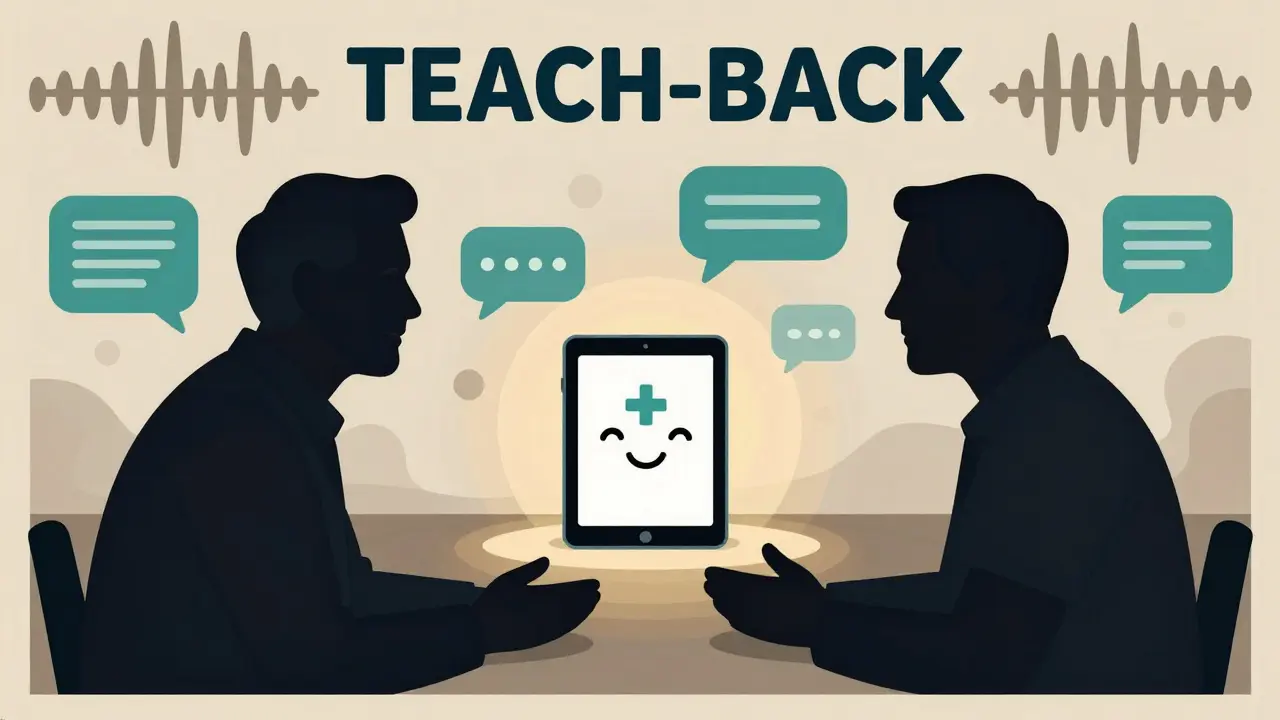
Even the best-printed materials fall short if there is no dialogue. The Teach-Back Method is a cornerstone of effective senior patient education. This technique involves asking patients to repeat information in their own words to confirm understanding. It is not a test of the patient’s memory; it is a check on the provider’s communication.
For example, instead of asking, "Do you understand how to take this medicine?" which often elicits a polite "yes" even when confused, ask, "Just to make sure I explained this clearly, can you tell me how you will take this pill when you get home?" If the patient misses a key detail, the provider re-explains it differently and asks again until the concept is clear.
Research supports this approach. The American Geriatrics Society recommends including a teach-back component in all educational interactions. A study in Patient Education and Counseling found that providers who used health literacy techniques like teach-back spent only 2.7 additional minutes per patient visit but achieved 31% better comprehension outcomes. This small investment of time yields significant returns in patient safety and satisfaction.
| Feature | Standard Medical Material | Senior-Friendly Material |
|---|---|---|
| Reading Level | 8th-12th Grade | 3rd-5th Grade |
| Font Size | 10-12 Point | Minimum 14 Point |
| Language Style | Technical Jargon (e.g., "Hypertension") | Plain Language (e.g., "High Blood Pressure") |
| Visual Support | Minimal or Complex Charts | Illustrations, Large Icons, White Space |
| Verification | Assumed Understanding | Teach-Back Confirmation |
Digital Literacy and Modern Challenges
The landscape of patient education is shifting rapidly with technology. Telehealth utilization among older adults increased from 17% in 2019 to 68% in 2023, according to Commonwealth Fund data. This surge means that digital literacy is now part of health literacy. Seniors need materials that explain not just *what* to do for their health, but *how* to use the technology required to manage it.
However, a digital divide persists. Many older adults face barriers such as lack of internet access, fear of scams, or difficulty navigating small screens. The NIA addressed this by launching an updated version of their Go4Life exercise program in January 2024, incorporating voice-activated technology and simplified video demonstrations. These tools acknowledge that some users may struggle with touchscreens but can interact easily via voice commands.
Providers must also consider that not all seniors are comfortable with digital tools. A hybrid approach is often best: provide a simple, large-print handout alongside a link to a video tutorial. Ensure that websites used for patient education are compatible with screen readers and allow for text resizing. The Plain Language Act of 2010 established federal guidelines requiring government agencies to use clear communication, and these principles apply equally to digital platforms.
Implementation Strategies for Healthcare Providers
Creating effective materials is resource-intensive. The HealthPartners Institute reports that developing a single patient education resource takes approximately 8-12 weeks, involving 5-7 rounds of patient testing with target demographic representatives. Despite this effort, implementation remains a challenge. Only 28% of U.S. healthcare systems have fully integrated health literacy universal precautions into their standard operating procedures, according to Dr. Jane Johnson of the University of Michigan.
To overcome this, organizations can adopt the following strategies:
- Universal Precautions: Assume every patient may have difficulty understanding health information. Apply plain language and clear formatting to all materials, not just those labeled "for low literacy." This avoids stigmatizing patients.
- Staff Training: Invest in training for healthcare providers. The American Medical Association’s 2024 policy update recommends specific health literacy training in medical education. Simple role-playing exercises can help staff master the teach-back method.
- Patient Testing: Before finalizing any material, test it with at least 15 older adult representatives from the target demographic. Ask them to complete tasks based on the material (e.g., "Find out when to take your next dose"). Observe where they stumble.
- Leverage Existing Resources: Don’t reinvent the wheel. Use vetted resources from the NIA, CDC, or HealthinAging.org as a base, then customize them for your specific clinic or hospital needs.
The financial incentive is strong. Medicare’s 2023 Annual Report highlighted that hospitals implementing comprehensive senior patient education programs saw 14.3% fewer readmissions among Medicare beneficiaries. This translates to approximately $1,842 in savings per patient. In a system where limited health literacy costs between $106 billion and $238 billion annually, investing in clear communication is not just ethical-it is economically vital.
Future Trends: Personalization and AI
Looking ahead, the future of senior patient education lies in personalization. One-size-fits-all materials are giving way to adaptive tools. The National Institutes of Health is funding a $4.2 million study through 2026 to develop AI-driven patient education tools that adapt content based on individual cognitive and sensory capabilities. Imagine a tablet app that detects if a user is squinting at the screen and automatically increases the font size, or simplifies sentences if it detects hesitation during interaction.
Furthermore, as the U.S. population ages-with adults aged 65 and older projected to reach 22% of the population by 2040-the demand for these tailored solutions will grow. The Congressional Budget Office projects that Medicare spending on health literacy initiatives will increase significantly by 2027. This reflects a broader recognition that effective communication is a determinant of health.
For caregivers and family members, the message is clear: advocate for clear information. If a loved one receives confusing instructions, ask for clarification. Use the teach-back method yourself. Encourage doctors to provide written summaries in large print. By bridging the communication gap, we empower older adults to take control of their health with confidence and dignity.
What is the ideal reading level for senior patient education materials?
The ideal reading level is 3rd to 5th grade. Research shows this level improves comprehension by 42% among adults over 65 compared to standard medical materials, which are often written at an 8th to 12th-grade level.
How does the teach-back method improve patient outcomes?
The teach-back method involves asking patients to repeat instructions in their own words. Studies show it leads to 31% better comprehension outcomes and reduces medical errors by confirming understanding before the patient leaves the clinic.
What font size is recommended for older adults?
A minimum of 14-point font is recommended. This accommodates common age-related vision declines. High-contrast colors, such as black text on a white background, further enhance readability.
Why is digital literacy important in senior patient education?
With telehealth usage rising to 68% among older adults, digital literacy is crucial. Patients need to navigate apps, portals, and virtual visits. Materials must explain both health concepts and the technology used to deliver care.
What are Universal Precautions for Health Literacy?
Universal Precautions mean assuming every patient may have difficulty understanding health info. Providers should use plain language, clear visuals, and teach-back for all patients, regardless of their apparent education level, to avoid stigma and ensure clarity.